艺廊
作品介绍
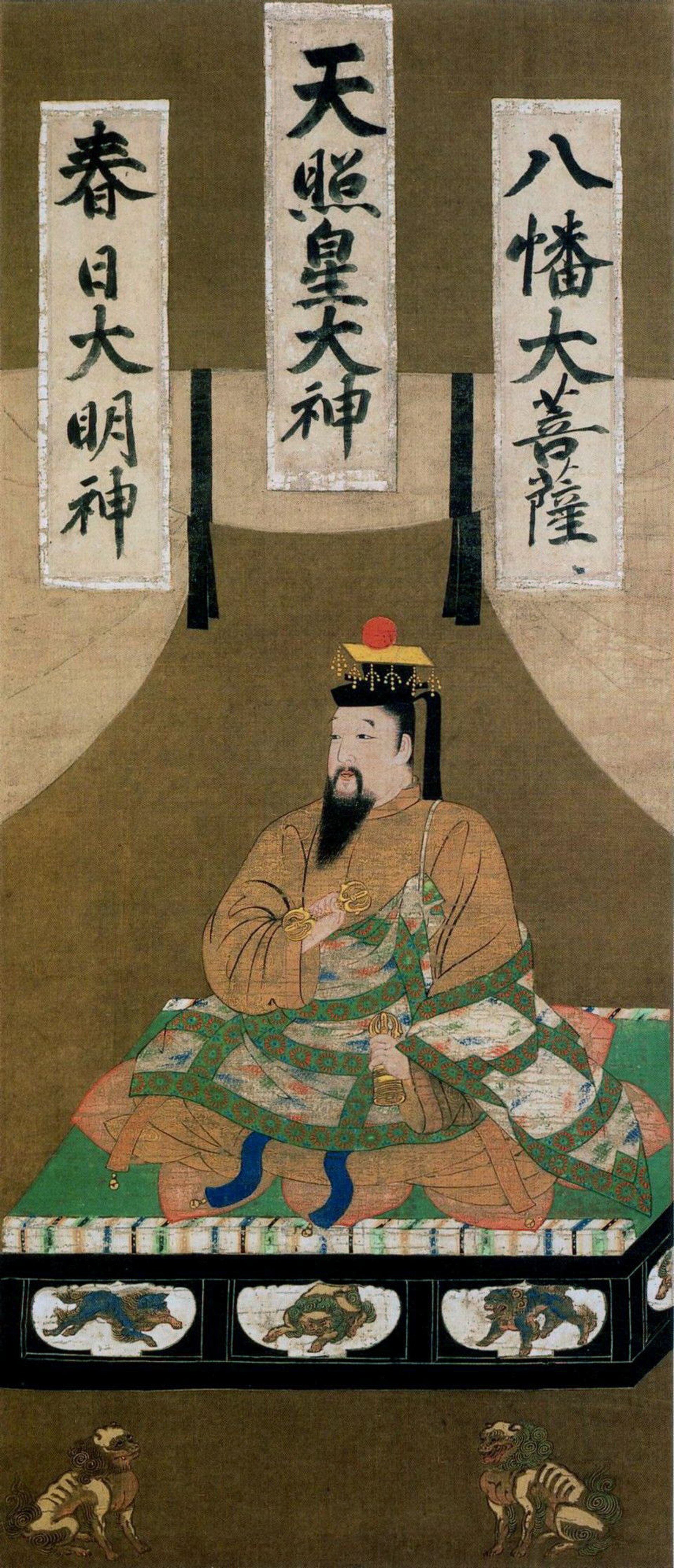
Silken Painting of Emperor Go-Daigo is a portrait and Buddhist painting of Emperor Go-Daigo from the Nanboku-chō period. The painting was supervised by the Buddhist priest and protector of Emperor Go-Daigo, Bunkanbo Koshin. After his death, Buddhābhiṣeka opened his eyes on September 20, October 23, 1339, the fourth year of Enen4/Ryakuō, during the 57th day Buddhist memorial service.Meiji 33rd year (1900), April 7, designated as Important Cultural Property. As Emperor of Japan rather than Cloistered Emperor, he was granted the highest Abhisheka (coronation ceremony) of Shingon Buddhism He was united with Vajrasattva, a Bodhisattva, as a secular emperor, and became a symbol of the unification of the royal law, Buddhism, and Shintoism under the Sanja-takusen, in which the three divine symbols were written. After the end of the Civil War of the Northern and Southern Dynasties, it was transferred to the head temple of the Tokishu sect, Shōjōkō-ji (Kanagawa Prefecture Fujisawa, Kanagawa), by the 12th Yūkyō Shōnin, a cousin of Go-Daigo and the founder of the Tokishu sect. During the Sengoku period, it became an object of worship for the Tokimune sect of the time, and copies were made. Because it is directly related to the theory of kingship in the Kenmu Restoration, it is important in Art history, History of religion, and Political history. It is said to show the legitimate kingship as the protector of Vajrayana succeeding his father, Emperor Go-Uda, as well as the harmonious political and religious kingship as in the reign of Prince Shōtoku.
Overview
On October 26, 1330, the year before the Genkō War against the Kamakura shogunate, Emperor Go-Daigo was given a ritual called the Yu-Gi-Kanjo at Jounei-Den in the palace by his Buddhist confidant and renowned painter, Bunkanbo Koshin. This was the most sacred ritual of the Shingon Buddhism of the time, as it was said to be the "ultimate perfumation" and "the highest attainment of esoteric Buddhism. The only thing higher than this is the attainment of Buddhahood. Although it is exceptional for a secular emperor to receive the Yu Gion Puja, it is believed that he followed in the footsteps of his father, Emperor Go-Uda, who was also a prominent practitioner of esoteric Buddhism, and that he had practiced enough to qualify for the Yu Gion Puja. This is not unusual. Godaigo, who was a loving wife, asked Bunkan to have the middle palace, Saionji Kishi, undergo the same ceremony on November 23 of the same year. This work was painted under the supervision (or actual production) of Fumikan Shonin himself, who led the perfuming ceremony, as a representation of the Yu-Gi perfuming scene. On September 20, Engen4/Ryakuō2 (October 23, 1339), thirty-five days after the fall of Go-Daigo, the Buddhist priest instructed Bunkan in the Buddhābhiṣeka and completed it.
The setting depicts a scene in which he was 43 years old, but since his portrait shows features of old age, it is thought that he actually modeled his face at the time of his death, when he was about 52 years old. The composition in the painting shows him uniting with Vajrasattva, the second founder of Shingon Buddhism, a Bodhisattva who acts as an intermediary between man and Buddha (Vairocana). Vajrasattva, a bodhisattva. It is also said to be related to Go-Daigo's belief in Rāgarāja, one of the incarnations of Vajrasattva. He is said to be wearing a Emperor Jimmu Benkan, Emperor Chūai Mianfu, National Treasure, and Buddhism, the Kūkai kesa of Kōbō Daishi, from the collection of Tō-ji. However, it seems that these treasures were not available for reference at the time of painting, and the kesa in particular is clearly different from the real thing. In addition, the crown (Emperor Jinmu's crown) and the ordinary crown are worn twice, which is thought to be an imitation of the Śrīmālādevī Siṃhanāda Sūtra of Prince Shotoku, who was regarded as a supreme being in both the sacred and secular realms. It is thought to be a copy of the Śrīmālādevī Siṃhanāda Sūtra The upper three oracles, Amaterasu, Kasuga Gongen, and Hachiman, respectively, preside over honesty, compassion, and purity, and are associated with the Imperial House of Japan, Kuge (Fujiwara clan), Buke (Seiwa Genji). This image shows that Emperor Go-Daigo, as Vajrasattva, identified with these three Shinto deities and became the center of royal law, Buddhism, and Shintoism.
However, it is unclear whether this work was created under the direction of Go-Daigo himself or his dying wish. However, it is not clear whether the deification of this work was directed by Go-Daigo himself or his dying wish. It is thought that the deification of this work was done hastily as a memorial to the emperor before the 57th day memorial service after his death, and the deification was done by projecting the impressions that Bunkan and other senior retainers of the Southern Court had of Go-Daigo.
On August 1, 1396, four years after the unification of the Northern and Southern dynasties, the temple passed from the hands of a former vassal of the Southern dynasty to the hands of the 12th head of the Toki sect, Youko Shonin, who was the founder of the Toki sect. He was the son of Prince Tsuneaki, the prince of Emperor Kameyama (the grandfather of Emperor Go-Daigo), and was also a cousin of Emperor Go-Daigo. Afterwards, it was kept in Shōjōkō-ji (Kanagawa Prefecture, Fujisawa City), the head temple of the Ji-shu sect. On March 21, Eishō (Muromachi period)14 (1517), a copy of the statue was made by a priest of the Ji-shu, Yaamida Buddha, and worship was conducted through the copy. In this case, according to the Honji suijaku theory, it is thought that the goddess Amaterasu was worshipped as Vairocana, the bodhisattva Hachiman as Amitābha, the main deity of the Tokishu, and Kasuga Daimyojin as Amida's assistant, the snare Kannon. It is also believed that Amitābha was worshipped as Amitābha.
On April 7, 1900, the statue was designated as a National Treasure at the time and later as an Important Cultural Property as a "silken copy of the statue of Emperor Godaigo.
原文较长,这里只摘了前面一部分,摘自英文维基百科「Silken Painting of Emperor Go-Daigo」(暂时没有中文条目,下面是英文原文),按 CC BY-SA 4.0 使用,去掉了参考文献、外部链接等尾部小节和表格,其余文字未作改动。