艺廊
资料卡
- 类型
- 佛寺
- 创立
- 1325 年
- 国家
- 日本
- 所在地
- 藤泽市
- 地址
- 神奈川県藤沢市西富一丁目8番1号
- 创办人
- Donkai
- 文化遗产级别
- 登录有形文化财、日本国家级古迹
- 坐标
- 北纬 35.3485°,东经 139.4886°
资料来自 Wikidata Q11561284(CC0)。
博物馆介绍
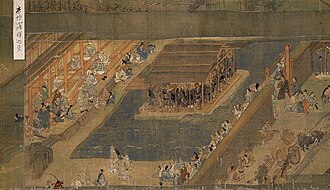
清净光寺(しょうじょうこうじ)是位在日本神奈川县藤泽市的寺院,时宗总本山。山号“藤泽山”(とうたくさん)。本尊阿弥陀如来、开基(创立者)为俣野五郎景平、开山(初代住持)为呑海。时宗的法主被称作游行上人,所以通称游行寺(ゆぎょうじ)。藤泽作为游行寺的门前町而诞生,发展成东海道的宿场町,最后成为今日的藤泽市。
关连项目
一遍
摘自维基百科「清净光寺」,按 CC BY-SA 4.0 使用,繁体已转简体,去掉了参考文献、外部链接等尾部小节和表格,其余文字未作改动。
中文条目比较短,展开看英文维基百科的条目(英文原文)
Shōjōkō-ji (清浄光寺) is a Buddhist temple located in the city of Fujisawa, Kanagawa Prefecture, Japan. It is the headquarters of the Ji-shu branch of Pure Land Buddhism, founded in the Kamakura period by Ippen. The formal name of the temple is Tōtaku-san Muryōkō-in Shōjōkō-ji (藤沢山 無量光院 清浄光寺), and its honzon is a statue of Amida Nyorai. As the head priest of the temple, Tōtaku Shōnin, also bears the inherited title Yugyō Shōnin (遊行上人), the temple has become familiarly known as Yugyō-ji (遊行寺) since the Edo period. The temple is also sometimes referred to as Fujisawa-dōjō.
History
The temple was founded in 1325 by the local Matano clan, whose estates extended from present-day Nishimatano, Fujisawa to Matano-chō and Higashimatano-chō in Totsuka-ku, Yokohama and the 4th head of the sect, Dōnkai. However, it was located on the site of a much older temple called Gokuraku-ji, were Ippen had stayed while preaching in Kamakura and making a pilgrimage to Enoshima. The temple was supported by the kanrei Ashikaga Mochiuji in 1435. The temple was destroyed in 1513 in a battle between Hōjō Soun, Miura Dosun, and Ōta Sukeyasu. Shōjōkō-ji had bad relations especially with the Later Hōjō clan after the castellan of Tamanawa Castle had seized temple properties. In 1591, the 32nd Yugyō Shōnin was invited by Satake Yoshinobu of Hitachi Province to build the Mito Fujisawa Dōjō (later known as Jinnō-ji) in Mito, making it the headquarters of the Ji-shu sect. Shōjōkō-ji was finally rebuilt in 1607, almost after a century.
In 1631, the temple received official recognition from the Tokugawa shogunate as the head temple of the 274 Ji-shu temples in the country. It burned down in 1661, but the new Main Hall was completed in 1664. In 1694, in accordance with Shōgun Tokugawa Tsunayoshi's Edicts on Compassion for Living Things (生類憐みの令, Shōruiawareminorei) Shōjōkō-ji became a sanctuary for goldfish in the city of Edo. On October 15, 1737, the current principal image of the temple, a seated Amida Nyōrai, was moved from Hōjū-in, a sub-temple of Nirin-ji Temple in Asakusa. Following the Meiji restoration, the temple lost the estates that had been granted it by the shogunate for its upkeep, as well as its official red seal which had permitted its priests to travel freely anywhere in the country. However, the temple gained prestige when Emperor Meiji made it his lodging on October 10, 1868 en route to Tokyo. Most of the temple was destroyed by a fire in 1880, leaving only the Chujakumon Gate. Although quickly rebuilt, the temple again burned down on July 6, 1911, which also destroyed its National Treasure "Ippen Shōnin Ekotōba-den" (Illustrated Tales of Yugyō Shōnin) scrolls. The temple suffered further damage in the 1923 Great Kanto earthquake, which collapsed its Main Hall. The current Main Hall was rebuilt in 1937.
In 1977, the Yugyōji Treasure Museum was established, displaying picture scrolls related to Ippen that had previously been scattered throughout the country.
Fujisawa Memorial Tower to Friends and Foe
The Fujisawa Memorial Tower to Friends and Foe (藤沢敵御方供養塔, Fujisawa tekimikata kuyōtō) is a kuyōtō, or a form of stupa built for the purpose of memorial service so that the deceased can rest in peace, and is thus slightly different from the more secular cenotaph. It was built by the 14th head of the sect, Taikū, to commemorate the people and animals who died in the Uesugi Zenshu Rebellion of 1416. This was a civil war between the Kantō Kubō Ashikaga Mochiuji and the kanrei Uesugi Zenshū. The disturbance cumulated in the Eikyō Rebellion in 1438. Also called the "Enshin Byōdō Monument" is 130-cm high and 28-cm wide. It was designated a National Historic Site in 1926.
摘自英文维基百科「Shōjōkō-ji」,按 CC BY-SA 4.0 使用。