艺廊

作品介绍
The Venus of Laussel is an 18.11-inch-high (46.0-centimetre) limestone bas-relief of a nude woman. It is painted with red ochre and was carved into the limestone of a rock shelter (Abri de Laussel) in Marquay, Dordogne, southwestern France. Approximately 25,000 years old, the carving is associated with the Gravettian culture of the Upper Paleolithic. It is currently displayed in the Musée d'Aquitaine in Bordeaux, France.
Description
The figure holds a bison horn, or possibly a cornucopia, in one hand, which has thirteen notches. She has large breasts, a great stomach, and wide hips. There is a "Y" on her thigh and her faceless head is turned toward the horn. The lower relief was covered in red ochre.
Discovery and display
The relief was discovered in 1911 by Jean-Gaston Lalanne, doctor of sciences and neuropsychiatrist in Bordeaux. It was carved into large block of limestone in a rock shelter (Abri de Laussel) at the commune of Marquay in the Dordogne department of south-western France. The limestone block fell off the wall of the shelter. It was brought to the Musée d'Aquitaine in Bordeaux.
Meaning
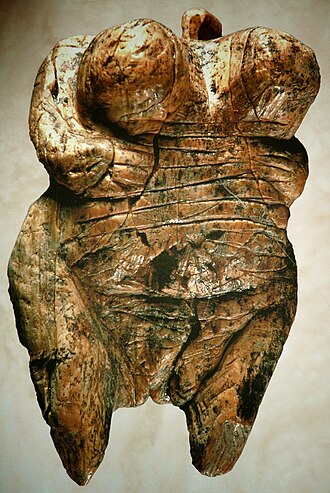
The figure and the horn are considered significant in figurative studies of Paleolithic art. There are many similarly formed Venus figurines, such as the Venus of Willendorf, and other representations of female figures, said to be of potential significance in Eurasian prehistoric religion. Some suggest the color and the number of notches on the horn may symbolize the number of lunar months or menstrual cycles in one year, or the number of days from menstruation to ovulation.
摘自英文维基百科「Venus of Laussel」(暂时没有中文条目,下面是英文原文),按 CC BY-SA 4.0 使用,去掉了参考文献、外部链接等尾部小节和表格,其余文字未作改动。