艺廊

作品介绍
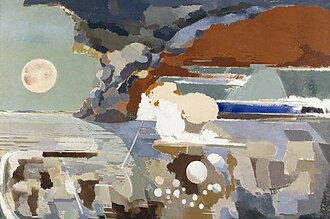
死海(德语:Totes Meer)是保罗·纳许1941年创作的一幅油画。它描绘了月光下的风景,周围是纳粹德国空军失事飞机的墓地。机翼和机身上破碎的金属碎片类似于锯齿状冰的海景,可能受到卡斯帕·大卫·弗里德里希的《冰海》的启发。它的尺寸为40.0×60.0英寸(102×152厘米),自1946年起一直被泰特美术馆收藏。
纳许是第一次和第二次世界大战中的官方战争艺术家。1940年,纳许受邀到空军部工作,同年开始《死海》的创作。空军部的一些代表不喜欢他的艺术风格,年底前终止了他的全职职位。《死海》于1941年完成,并于1941年提供给战争艺术家咨询委员会。纳许为这幅画支付了150英镑。
摘自维基百科「死海 (画作)」,按 CC BY-SA 4.0 使用,繁体已转简体,去掉了参考文献、外部链接等尾部小节和表格,其余文字未作改动。
中文条目比较短,展开看英文维基百科的条目(英文原文)
Totes Meer (German: Dead Sea) is a 1941 painting by Paul Nash. It depicts a moonlit landscape populated by a graveyard of crashed aircraft of the German Luftwaffe. The broken shards of metal from the wings and fuselages resemble a seascape of jagged ice, possibly inspired by Caspar David Friedrich's The Sea of Ice. It measures 40.0 × 60.0 inches (102 × 152 cm) and has been in the collection of the Tate Gallery, since 1946.
Background
Paul Nash was an official war artist in the First and Second World Wars. In 1940, he was asked to work for the Air Ministry, and Nash started work on Totes Meer that year. Some representatives of the Air Ministry disliked his style of art, and his full-time position was terminated before the end of the year. Totes Meer was completed in 1941, and offered to the War Artists' Advisory Committee in 1941. Nash was paid £150 for the painting.
Description
The work was based on sketches and photographs made at the Metal and Produce Recovery Unit at Cowley near Oxford in August 1940, where the remains of both German and British crashed aircraft were brought to be recycled at the Morris Motors car factory nearby, which was being used to construct and repair aircraft. Nash wrote that, under moonlight, the sea of wreckage could be perceived to move and twist, but in reality it was of course dead, and the only movement was the flight of a white owl, depicted near the horizon at the right.
The desolate landscape harkens back to the paintings that Nash made as a war artist in the First World War, such as We are Making a New World or The Menin Road. The mournful tone may also have been influenced by his personal circumstances: an affair with painter Eileen Agar was coming to an end, and Nash was suffering from a respiratory illness which ultimately caused his death.
Nash initially called the work Iron Sea, but he hoped that the work could be reproduced on postcards to be sent to Germany as propaganda and decided on a German title instead. Nash described his painting:
The thing (the salvage dump) looked to me, suddenly, like a great inundating sea. You might feel – under certain circumstances – a moonlight night, for instance, this is a vast tide moving across the fields, the breakers rearing up and crashing on the plain. And then, no, nothing moves, it is not water or even ice, it is something static and dead. It is metal piled up, wreckage. It is hundreds and hundreds of flying creatures which invaded these shores (how many Nazi planes have been shot down or otherwise wrecked in this country since they first invaded?). Well, here they are, or some of them. By moonlight, the waning moon, one could swear they began to move and twist and turn as they did in the air. A sort of rigor mortis? No, they are quite dead and still. The only moving creature is the white owl flying low over the bodies of the other predatory creatures, raking the shadows for rats and voles. She isn’t there, of course, as a symbol quite so much as the form and colour essential just there to link up with the cloud fringe overhead.
Reception
Kenneth Clark, chairman of the War Artists' Advisory Committee, described Totes Meer as "the best war picture so far" and the painting was an immediate success when it was displayed in an exhibition of National War Pictures at the National Gallery in May 1941. It was presented to the Tate Gallery in 1946 and is considered to be one of the most important British paintings of the Second World War.
摘自英文维基百科「Totes Meer」,按 CC BY-SA 4.0 使用。
相关词条
相关作品