艺廊
作品介绍
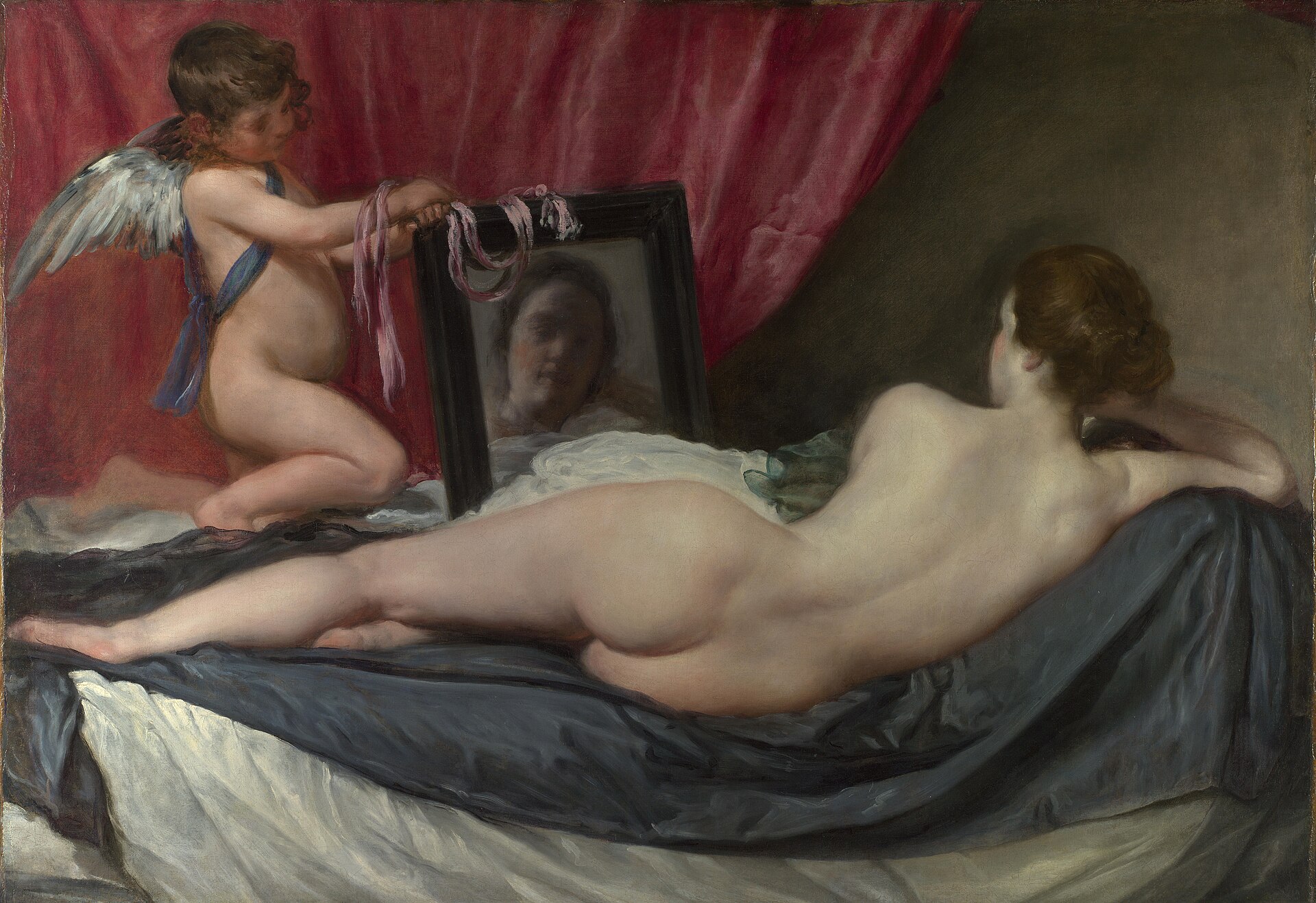
《镜前的维纳斯》(西班牙文:La Venus del espejo;英文:The Toilet of Venus、The Rokeby Venus、Venus at her Mirror或Venus and Cupid,又常译为《维纳斯对镜梳妆》)是西班牙画家迪亚哥·委拉斯盖兹大约在1647年与1651年间访问意大利时创作的。画作显示了裸体的希腊神话爱神维纳斯和小爱神邱比特。
这是宗教严厉的17世纪西班牙少有的几幅裸体画像之一。现藏于英国伦敦国家美术馆。
后世
流行文化
在BBC电视节目《名作背后》(The Private Life of a Masterpiece)中,其中一集介绍了此画的来龙去脉。
摘自维基百科「镜前的维纳斯」,按 CC BY-SA 4.0 使用,繁体已转简体,去掉了参考文献、外部链接等尾部小节和表格,其余文字未作改动。
中文条目比较短,展开看英文维基百科的条目(英文原文)
The Rokeby Venus ( ROHK-bee; also known as The Toilet of Venus, Venus at her Mirror, Venus and Cupid and, in Spanish, La Venus del espejo) is a painting by Diego Velázquez, the leading artist of the Spanish Golden Age. Completed between 1647 and 1651, and probably painted during the artist's visit to Italy, the work depicts the goddess Venus in a sensual pose, lying on a bed with her back facing the viewer, and looking into a mirror held by the Roman god of physical love, her son Cupid. The painting is in the National Gallery, London.
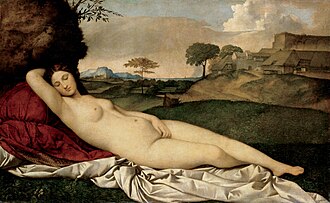
Numerous works, from the ancient to the baroque, have been cited as inspiring Velázquez. The nude Venuses of the Italian painters, such as Giorgione's Sleeping Venus (c. 1510) and Titian's Venus of Urbino (1538), were the main precedents. In this work, Velázquez combined two established poses for Venus: recumbent on a couch or a bed, and gazing at a mirror. She is often described as looking at herself in the mirror, although this is physically impossible since viewers can see her face reflected in their direction. This phenomenon is known as the Venus effect. In some ways the painting represents a pictorial departure, through its central use of a mirror, and because it shows the body of Venus turned away from the observer of the painting.
The Rokeby Venus is the only surviving female nude by Velázquez. Nudes were extremely rare in seventeenth-century Spanish art, which was policed actively by members of the Spanish Inquisition. Despite this, nudes by foreign artists were keenly collected by the court circle, and this painting was hung in the houses of Spanish courtiers until 1813, when it was brought to England to hang in Rokeby Park, Yorkshire. In 1906, National Art Collections Fund purchased the painting for the National Gallery, London. Although it was attacked and badly damaged in 1914 by Canadian suffragette Mary Richardson, it was soon fully restored and returned to display. Just Stop Oil attacked it again and smashed its protective glass in 2023.
Painting
Description
The Rokeby Venus depicts the Roman goddess of love, beauty and fertility reclining languidly on her bed, her back to the viewer—in Antiquity, portrayal of Venus from a back view was a common visual and literary erotic motif—and her knees tucked. She is shown without the mythological paraphernalia normally included in depictions of the scene; jewellery, roses, and myrtle are all absent. Unlike most earlier portrayals of the goddess, which show her with blonde hair, Velázquez's Venus is a brunette.
Venus gazes into a mirror held by Cupid, who is without his usual bow and arrows. When the work was first inventoried, it was described as "a nude woman", probably owing to its controversial nature.
Venus looks outward at the viewer of the painting through her reflected image in the mirror. However, the image is blurred and reveals only a vague reflection of her facial features; the reflected head is much larger than it would be in reality. The critic Natasha Wallace has suggested that Venus's indistinct face may be the key to the underlying meaning of the painting, in that "it is not intended as a specific female nude, nor even as a portrayal of Venus, but as an image of self-absorbed beauty." According to Wallace, "There is nothing spiritual about face or picture. The classical setting is an excuse for a very material aesthetic sexuality—not sex, as such, but an appreciation of the beauty that accompanies attraction".
Intertwined pink silk ribbons drape over the mirror and curl over its frame. Art historians have debated the ribbon's function; suggestions include an allusion to the fetters Cupid used to bind lovers, that it was used to hang the mirror, and that it was used to blindfold Venus moments before. The critic Julián Gallego found Cupid's facial expression to be so melancholy that he interprets the ribbons as fetters binding the god to the image of Beauty, and gave the painting the title "Amor conquered by Beauty".
The folds of the bed sheets echo the goddess's physical form, and are rendered to emphasise the sweeping curves of her body. The composition mainly uses shades of red, white, and grey, which are used even in Venus's skin; although the effect of this simple colour scheme has been much praised, recent technical analysis has shown that the grey sheet was originally a "deep mauve", which has now faded.……
节选,摘自英文维基百科「Rokeby Venus」,按 CC BY-SA 4.0 使用。
相关词条
相关作品