艺廊
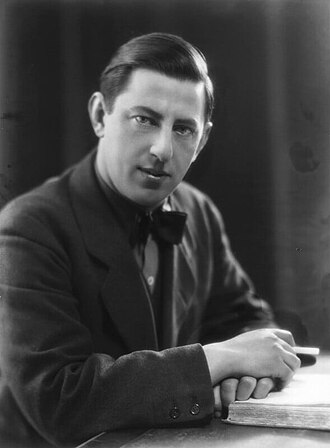
资料卡
- 出生
- 1889 年
- 出生地
- 肯辛顿特
- 去世
- 1946 年
- 逝世地
- 博斯科姆
- 国籍
- 英国、大不列颠及爱尔兰联合王国
- 职业
- 摄影师、诗人、雕刻师、艺术家、战争艺术家、插画家 等 18 项
- 领域
- 绘画
- 流派
- 超现实主义
- 就读
- 切尔西艺术与设计学院、斯莱德艺术学院
- 配偶
- Margaret Nash
资料来自 Wikidata Q727643(CC0)。
生平与创作
Paul Nash (11 May 1889 – 11 July 1946) was a British surrealist painter and war artist, as well as a photographer, writer and designer of applied art. Nash was among the most important landscape artists of the first half of the twentieth century. He played a key role in the development of modernism in English art.
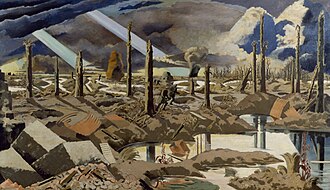
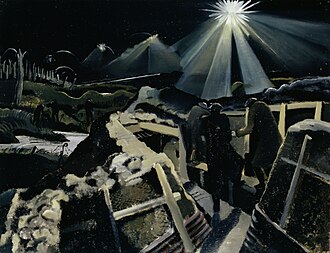
Born in London, Nash grew up in Buckinghamshire where he developed a love of the landscape. He entered the Slade School of Art but was poor at figure drawing and concentrated on landscape painting. Nash found much inspiration in landscapes with elements of ancient history, such as burial mounds, Iron Age hill forts such as Wittenham Clumps and the standing stones at Avebury in Wiltshire. The artworks he produced during World War I are among the most iconic images of the conflict. After the war Nash continued to focus on landscape painting, originally in a formalized, decorative style but, throughout the 1930s, in an increasingly abstract and surreal manner. In his paintings he often placed everyday objects into a landscape to give them a new identity and symbolism.
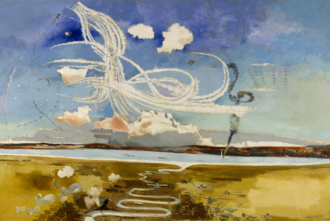
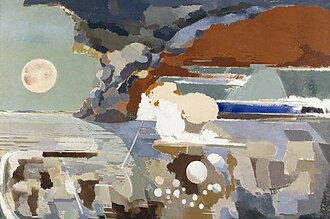
During World War II, although sick with the asthmatic condition that would kill him, he produced two series of anthropomorphic depictions of aircraft, before producing a number of landscapes rich in symbolism with an intense mystical quality. These have perhaps become among the best known works from the period. Nash was also a fine book illustrator, and designed stage scenery, fabrics and posters.
He was the elder brother of the artist John Nash.
Early life
Nash was the son of a successful barrister, William Harry Nash, and his wife Caroline Maude, the daughter of a captain in the Royal Navy. He was born in Kensington and grew up in Earl's Court in West London, but in 1902 the family moved to Iver Heath in Buckinghamshire. It was hoped the move to the countryside would help Caroline Nash, who was increasingly showing symptoms of mental illness. The growing cost of Caroline Nash's treatment led to the house at Iver Heath being rented out while Paul and his father lived together in lodgings and his younger sister and brother went to boarding schools. On Valentine's Day 1910, aged forty-nine, Caroline Nash died in a mental institution.
Paul Nash was originally intended for a career in the Navy, following the path of his maternal grandfather, but despite additional training at a specialist school in Greenwich, he failed the Naval Entrance Examination and returned to finish his schooling at St Paul's School. Encouraged by a fellow student at St Paul's, Eric Kennington, Nash considered the possibility of a career as an artist. After studying for a year at the South-Western Polytechnic in Chelsea, he then enrolled at the London County Council School of Photo-engraving and Lithography, in Bolt Court off Fleet Street, in the autumn of 1908. Nash spent two years studying at Bolt Court, where he began to write poetry and plays and where his work was spotted and praised by Selwyn Image. He was advised by his friend, the poet Gordon Bottomley, and by the artist William Rothenstein, that he should attend the Slade School of Art at University College, London. He enrolled in October 1910, though he later recorded that on his first meeting with the Professor of Drawing, Henry Tonks, 'It was evident he considered that neither the Slade, nor I, were likely to derive much benefit'.
The Slade was then opening its doors to a remarkable crop of young talents – what Tonks later described as the school's second and last 'Crisis of Brilliance'. Nash's fellow students included Ben Nicholson, Stanley Spencer, Mark Gertler, William Roberts, Dora Carrington, C. R. W. Nevinson, David Bomberg and Edward Wadsworth. Nash struggled with figure drawing, and spent only a year at the school. Nash had shows in 1912 and 1913, sometimes with his brother John, largely devoted to drawings and watercolours of brooding landscapes, influenced by the poetry of William Blake and the paintings of Samuel Palmer and Dante Gabriel Rossetti.
Two locations in particular featured in his landscape work at this time, the view from his father's house in Iver Heath and a pair of tree-topped hills in the Thames Valley known as the Wittenham Clumps. These were the first in a series of locations, which would eventually include Ypres, Dymchurch, the Romney Marshes, Avebury and Swanage, that would inspire Nash in his landscape paintings throughout his life. By the summer of 1914 Nash was enjoying some success and during that year he worked briefly at the Omega Workshops under Roger Fry and also worked with him on restoring the Mantegna cartoons at Hampton Court Palace.
He was elected to The London Group in 1914.
World War I
Army officer
On 10 September 1914, shortly after the start of World War I, Nash reluctantly enlisted in the Territorial Force as a private for home service. Initially he served with the Artists' Rifles, formally the 28th (County of London) Battalion of the London Regiment. Nash's duties, which included guard duty at the Tower of London, allowed him time to continue drawing and painting.
In December 1914 Nash married Jerusalem-born Margaret Theodosia Odeh, an Oxford-educated campaigner for Women's Suffrage, at St Martin-in-the-Fields, Trafalgar Square. Her father, Revd Naser Odeh, who was born in Palestine and educated at Monkton Combe School, had been the founding priest in charge of St Mary's Mission and the pro-cathedral, Cairo. Margaret was naturalised British in 1912. The couple had no children.
Nash began officer training in August 1916 and was sent to the Western Front in February 1917 as a second lieutenant in the Hampshire Regiment. He was based at Saint-Eloi on the Ypres Salient at a relatively quiet time and although the area did come under shelling, no major engagements took place while he was there. Whilst clearly aware of the destruction that had taken place there, he was delighted to see that, with spring arriving, the landscape was recovering from the damage inflicted on it. However, on the night of 25 May 1917, Nash fell into a trench, broke a rib and, by 1 June, had been invalided back to London.……
原文较长,这里只摘了前面一部分,摘自英文维基百科「Paul Nash (artist)」(暂时没有中文条目,下面是英文原文),按 CC BY-SA 4.0 使用,去掉了参考文献、外部链接等尾部小节和表格,其余文字未作改动。