艺廊
资料卡
- 出生
- 1860 年
- 出生地
- 伦敦
- 去世
- 1928 年
- 逝世地
- 伦敦
- 安葬地
- 戈德斯格林火葬场
- 国籍
- 英国
- 职业
- 画家、雕塑家、大学教师、币章雕刻家、珠宝设计师、素描家
- 流派
- 新雕塑
- 代表作
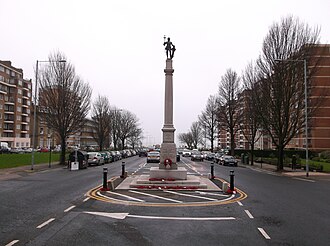
- Edith Cavell Memorial、昆汀与爱丽丝·霍格纪念碑
- 就读
- 皇家艺术学院、伦敦市艺术学院、Lambeth School of Art
- 所属团体
- 皇家艺术学院、艺术工作者协会、Royal Society of Sculptors
- 获奖
- 利奥波德二世大军官勋章、下级勋位爵士
- 配偶
- Christabel Cockerell
资料来自 Wikidata Q2265709(CC0)。
生平与创作
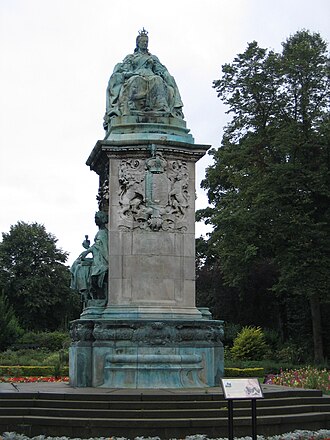
Sir George James Frampton, (18 June 1860 – 21 May 1928) was a British sculptor. He was a leading member of the New Sculpture movement in his early career when he created sculptures with elements of Art Nouveau and Symbolism, often combining various materials such as marble and bronze in a single piece. While his later works were more traditional in style, Frampton had a prolific career in which he created many notable public monuments, including several statues of Queen Victoria and later, after World War I, a number of war memorials. These included the Edith Cavell Memorial in London, which, along with the Peter Pan statue in Kensington Gardens are possibly Frampton's best known works.
Biography
Early life
Frampton was born on 18 June 1860 in London, where his father was a woodcarver and stonemason. George Frampton began his own working life as a stone carver in 1878, working on the Hôtel de Ville in Paris. Frampton returned to London to study under William Silver Frith at the South London Technical School of Art during 1880 and 1881. He went on to the Royal Academy Schools where, between 1881 and 1887, he won a gold medal and travelling scholarship. While still studying at the Royal Academy, Frampton undertook a number of sculpture commissions including, in 1885, pieces for the facade of both the Constitutional Club in Northumberland Avenue and for the Chelsea Conservative Club. He also created an altarpiece for Manchester Cathedral, some decorative pieces for the Henry Fawcett Memorial in London and a pair of terracotta figures representing Concord and Industry which were exhibited in Paris and purchased for the Municipal Building in Christchurch, New Zealand. From 1887 to 1890, he studied and worked at the studio of Antonin Mercie in Paris, where he also studied painting under Pascal Dagnan-Bouveret and Gustave Courtois.
Early works
Frampton returned to England and, briefly, worked in the studio of Sir Joseph Edgar Boehm. He then took up a teaching post at the Slade School of Art in 1893 and was also, for a year, the joint head of the Central School of Arts and Crafts.
In 1893, Frampton married the artist Christabel Cockerell and the couple set up home together at St John's Wood in London. Together they designed a decorative frieze for the interior of the house and Frampton began to design household fittings, jewellery in enamel and precious metals and also medals, most notably for Glasgow University and Winchester College. By this time, Frampton was, according to the critic M.H. Spielmann "in open rebellion against white sculpture". In 1893, he showed Mysteriarch, a polychromatic plaster bust with Symbolism motifs at the Royal Academy and, two years later he showed another polychromatic work, Mother and Child at the same venue. Mother and Child has bronze figures, of Frampton's wife and son, set against a copper plaque, and a white enamel disc behind the mother's head.
In his statue of Dame Alice Owen (1897) Frampton combined bronze, alabaster, gilding and marble, and, later, with the bust Lamia (1899-1900) he contrasted an ivory head and neck with bronze clothing inlaid with opals. The statue of Dame Alice Owen was originally shown at the Royal Academy as a free-standing statue but when it was installed in the entry hall of Owen's School Frampton made it the centre of a larger installation that he designed. In panels and niches around the statue, which he placed on a pink marble pedestal, Frampton included 16th-century carvings of Owen's ancestors and fragments of her 17th-century tomb.
In 1896, Frampton exhibited, with the architect Charles Harrison Townsend, a large fireplace in American walnut at the Arts and Crafts Exhibition Society. The fireplace was decorated with an innovative tree and foliage design by Frampton that was subsequently much imitated by Art Nouveau and Arts and Crafts designers and became known as the "Frampton tree". Frampton used a similar design in his 1897 memorial to Charles Mitchell for St George's Church in Jesmond in Newcastle upon Tyne.
Recognition
Frampton's body of work in the 1880s brought him considerable recognition. The University of St Andrews awarded him an honorary doctorate in 1894. In 1897, examples of Frampton's work featured at the Venice Biennale and at the Vienna Secession the following year. He regularly exhibited at the La Libre Esthétique in Brussels, a city he considered an important market for his work. For the four pieces he showed at the Paris International Exhibition in 1900, Frampton was awarded the Grand Prix. Those works included My Thoughts Are My Children, 1894, a large polychromic relief in bronze in a wooden frame depicting a woman holding a lily surrounded by drapery under a second female figure holding an infant and two children in front of a symbol of a rising sun. The work appears to have had a special significance to Frampton as he frequently chose it to represent his work at other major international exhibitions and kept the piece in his possession throughout his life. The work passed to his son, Meredith Frampton, who eventually donated it to the Walker Art Gallery in Liverpool.
Recognition also brought Frampton two significant public commissions at this time. The architect John William Simpson appointed Frampton as master sculptor for the decoration of the facade of the Kelvingrove Art Gallery and Museum in Glasgow. As well as overseeing the work of several other sculptors, Frampton created a bronze sculpture group and three sets of stone spandrels for the north porch of the new building. The sculpture group, of St Mungo attended by the muses of Art and Music, in the central arch of the porch contains Symbolism style motifs featuring trees, bells and fishes similar to those Frampron had used in some of his earlier smaller pieces. Frampton's other commission was for a frieze on the facade of the Lloyd's Register building in Fenchurch Street in London. There, Frampton created, at first floor level, a frieze in Portland stone of female figures representing Trade, Commerce and Shipping with four bronze statuettes at key points. Both commissions, but especially the Fenchurch Street frieze, were widely praised at the time.
原文较长,这里只摘了前面一部分,摘自英文维基百科「George Frampton」(暂时没有中文条目,下面是英文原文),按 CC BY-SA 4.0 使用,去掉了参考文献、外部链接等尾部小节和表格,其余文字未作改动。