艺廊
资料卡
资料来自 Wikidata Q5393700(CC0)。
生平与创作
Ernest Procter (22 March 1885–21 October 1935) was an English designer, illustrator and painter, and husband of British artist Dod Procter. He was actively involved with the Newlyn School, partner of the Harvey-Procter School and an instructor at the Glasgow School of Art.
Personal life and education
Ernest Procter was born into a Quaker family in Tynemouth, Northumberland. His father Henry Richardson Procter was an eminent scientist and a Leeds University professor who specialised in leather chemistry. He was also a Fellow of the Royal Society. Edward painted his father's portrait.[1]
Procter, like his father, attended school first in York at the Quaker Bootham School. From 1907 to 1910 he was a student of Stanhope Forbes at the Forbes' School of Painting in Newlyn, Cornwall. He contributed to the school's publication, The Paper Chase in 1908 and 1909, was an assistant to Stanhope and Elizabeth Forbes, and was a successful, well-respected student. At Forbes' Procter met his future wife Doris "Dod" Shaw; They were "amongst the Forbes' star pupils."
In 1910 and 1911 Procter studied in Paris at Atelier Colarossi. Dod Shaw was also a student at Atelier Colarossi. Ernest and Dod were both influenced by Impressionism and Post-Impressionism and the artists that they met in France, such as Pierre-Auguste Renoir and Paul Cézanne. In 1912 Procter married Dod at the church of Saint-Vincent-de-Paul, Paris. They had a son together named Bill and stayed in Paris until 1918.
In 1918 Procter and his wife returned to Newlyn, where they primarily lived from that point onward. On 21 October 1935, after years of high blood pressure, Procter died of a cerebral haemorrhage in North Shields, County Durham, while travelling.
First World War
During the First World War Procter was a conscientious objector, serving with the Friends' Ambulance Unit in Dunkirk from April 1916 until February 1919.
Career
After the war Dod and Ernest Procter returned to Newlyn, where Ernest was a member of the Newlyn Society of Artists. In 1920 Ernest and Harold Harvey established the Harvey-Procter School. They taught painting of still life, figures and landscapes in watercolour and oil. He and his wife, accepted a commission to decorate the Kokine Palace, Rangoon, in 1919 and 1920.
Procter created in 1931 what he called Diaphenicons, which were "painted and glazed decorations that provided their own light source." Leicester Galleries exhibited these works.
The Glasgow School of Art appointed him Director of Studies in Design and Craft in 1934.
Works
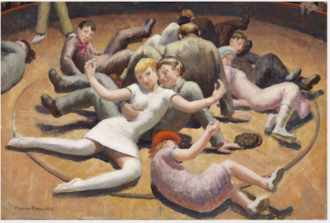
Procter's works included portraits and landscapes.
Museums and galleries
His works are part of collections at the Imperial War Museum, Tate, Leeds, Newcastle, Penlee House Gallery and Museum, and Worthing / Adelaide.
Memberships
He was a member or affiliated to the following organisations:
摘自英文维基百科「Ernest Procter」(暂时没有中文条目,下面是英文原文),按 CC BY-SA 4.0 使用,去掉了参考文献、外部链接等尾部小节和表格,其余文字未作改动。