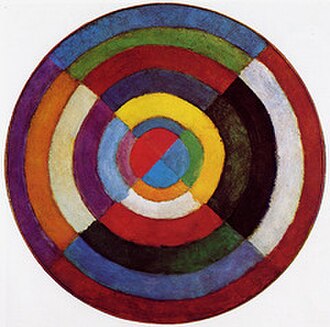
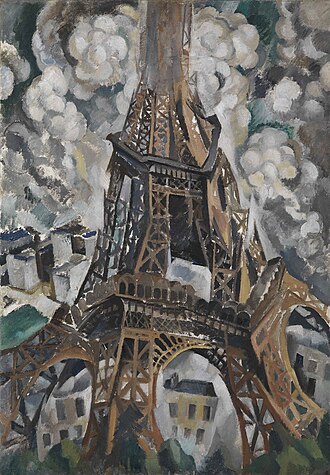
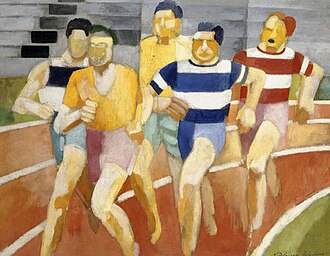
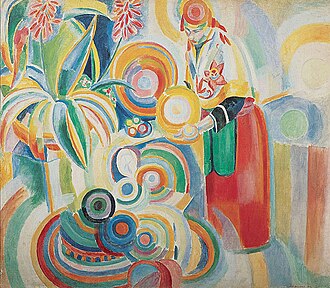
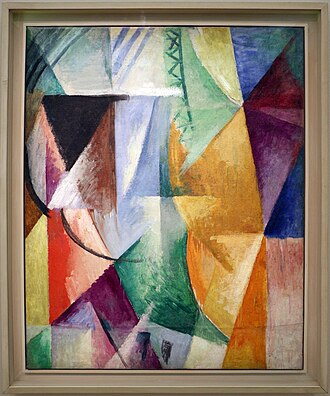
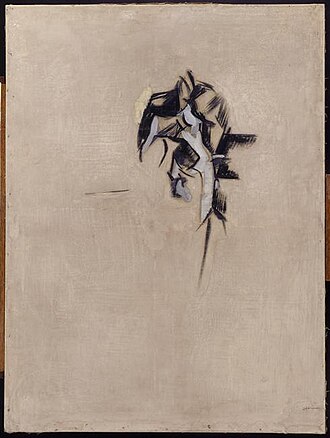
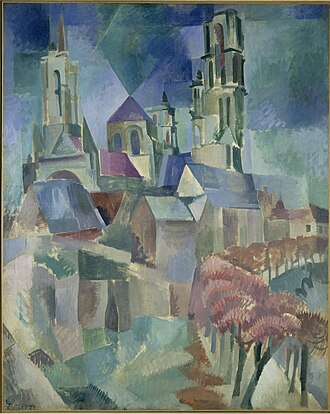
艺廊
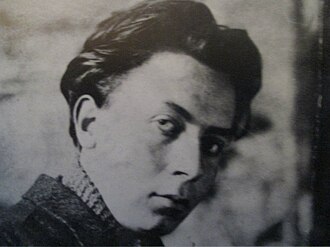
资料卡
- 出生
- 1885 年
- 出生地
- 巴黎
- 去世
- 1941 年
- 逝世地
- 蒙彼利埃
- 安葬地
- 冈拜
- 国籍
- 法国
- 职业
- 画家、视觉艺术家、设计师、剧场设计师
- 领域
- 绘画、视觉艺术
- 学生
- 莱昂内尔·费宁格、Léon-Laurent Galand
- 代表作
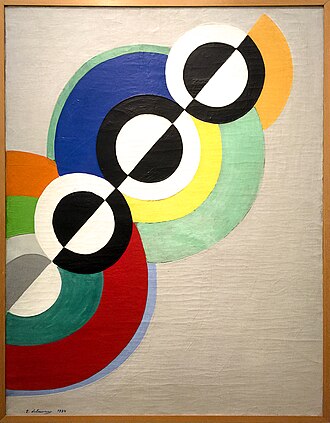
- Simultaneous Disc、Eiffel Tower with Trees、Hommage to Blériot
- 就读
- 魁北克小修院
- 配偶
- 索尼亚·德劳内
资料来自 Wikidata Q33978(CC0)。
生平与创作
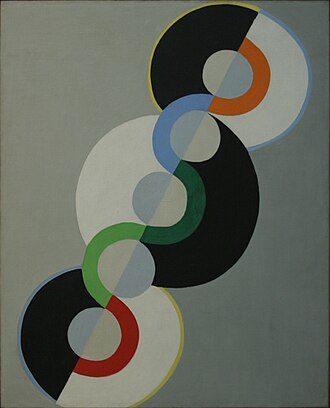
罗贝尔·德劳内(法语:Robert Delaunay,法语发音:[ʁɔbɛʁ dəlonɛ];1885年4月12日—1941年10月25日)是一位法国艺术家,1904年19岁时作品已在独立者沙龙参展,早年旅居英国,受阿凡桥派的后印象派画风影响较大,1910年代早期与他的妻子索尼娅·德劳内一起开启了奥费主义运动。他生平大部分时间待在巴黎,一战期间则前往西班牙和葡萄牙。晚年则走抽象主义路线,风格近似保罗·克利。
生平
罗贝尔·德劳内出生于法国巴黎,父亲是乔治·德劳内(George Delaunay),母亲是女伯爵贝尔特·费利西·德·罗斯(Berthe Félicie de Rose)。幼年时父母离异,由姨玛丽(Marie)和姨父夏尔·达穆尔(Charles Damour)在布尔日附近的拉龙谢尔(La Ronchère)抚养长大。他学业上没什么成就,因而前往巴黎美丽城学习装饰艺术,在一家画室中打工。19岁时离开画室独立,参加了1904年的独立者沙龙,沙龙上共展出了他的六幅作品。
之后他前往布列塔尼旅行,受到了阿凡桥派的影响。1906年在独立者沙龙上展出了数幅描绘布列塔尼的作品,并在会上结识了亨利·卢梭和让·梅金杰。路易·沃克塞尔在1907年将他与梅金杰列为当代分割派画家。
摘自维基百科「罗伯特·德劳内」,按 CC BY-SA 4.0 使用,繁体已转简体,去掉了参考文献、外部链接等尾部小节和表格,其余文字未作改动。
中文条目比较短,展开看英文维基百科的条目(英文原文)
Robert Delaunay (French: [ʁɔbɛʁ dəlonɛ]; 12 April 1885 – 25 October 1941) was a French artist of the School of Paris movement who, with his wife Sonia Delaunay and others, co-founded the Orphism art movement, noted for its use of strong colours and geometric shapes. His later works were more abstract. His work includes the bold use of color, and shows his clear love of experimentation with both depth and tone.
Overview
From 1912 to 1914, Delaunay's nonfigurative paintings focused on color. His early paintings were deeply rooted in Neo-Impressionism, which he abandoned later. His writings on color, which were influenced by scientists and theoreticians, were largely intuitive and could sometimes be random statements based on the belief that color was a thing in itself, with its own powers of expression and form. He believed that painting was a purely visual art that depended on intellectual elements, and perception was in the impact of colored light on the eye.
His theories about color and light influenced many artists such as Stanton Macdonald-Wright, Morgan Russell, Patrick Henry Bruce, Der Blaue Reiter, August Macke, Franz Marc, Paul Klee, Thomas Hart Benton, Lyonel Feininger and dozens more. The poet and art critic Guillaume Apollinaire was also influenced by Delaunay's theories of color and quoted from them to explain Orphism, which he had named.
Biography
Early life
Robert Delaunay was born in Paris, the son of George Delaunay and Countess Berthe Félicie de Rose. While he was a child, Delaunay's parents divorced, and he was raised by his mother's sister Marie and her husband Charles Damour, in La Ronchère near Bourges. When he failed his final exam and said he wanted to become a painter, his uncle in 1902 sent him to Ronsin's atelier to study Decorative Arts in the Belleville district of Paris.
Career beginnings
At age 19, Delaunay left Ronsin to focus entirely on painting and contributed six works to the Salon des Indépendants in 1904. He traveled to Brittany, where he was influenced by the group of Pont-Aven; and, in 1906, he contributed works he painted in Brittany to the 22nd Salon des Indépendants, where he met "Le Douanier" Henri Rousseau.
Delaunay formed a close friendship at this time with Jean Metzinger, with whom he shared an exhibition at a gallery run by Berthe Weill early in 1907. The two of them were singled out by the art critic Louis Vauxcelles in 1907 as Divisionists who used large, mosaic-like 'cubes' to construct small but highly symbolic compositions.
Robert Herbert writes: "Metzinger's Neo-Impressionist period was somewhat longer than that of his close friend Delaunay... The height of his Neo-Impressionist work was in 1906 and 1907, when he and Delaunay did portraits of each other (Art market, London, and Museum of Fine Arts, Houston) in prominent rectangles of pigment. (In the sky of Coucher de soleil no. 1, 1906–07, Collection Rijksmuseum Kröller-Müller, is the solar disk which Delaunay was later to make into a personal emblem)." Herbert describes the vibrating image of the sun in Metzinger's painting, and so too of Delaunay's Paysage au disque (1906–07), as "an homage to the decomposition of spectral light that lay at the heart of Neo-Impressionist color theory..."
Metzinger, followed closely by Delaunay—the two often painting together in 1906 and 1907—would develop a new sub-style of Neo-Impressionism that had great significance shortly thereafter within the context of their Cubist works. Piet Mondrian developed a similar mosaic-like Divisionist technique circa 1909. The Futurists later (1909–1916) would incorporate the style, under the influence of Gino Severini's Parisian works (from 1907 onward), into their dynamic paintings and sculpture.
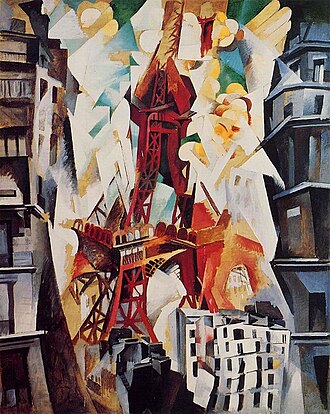
In 1908, after a term in the military working as a regimental librarian, he met fellow artist Sonia Terk; at the time she was married to a German art dealer whom she would soon divorce. In 1909, Delaunay began to paint a series of studies of the city of Paris and the Eiffel Tower, the Eiffel Tower series.
The following year, he married Terk, and, together with a few others, they founded the Orphism art movement. The couple settled in a studio apartment in Paris, where their son Charles was born in January 1911.……
节选,摘自英文维基百科「Robert Delaunay」,按 CC BY-SA 4.0 使用。
师承与影响
同属「奥费主义」的画家
流派页 ›同时代的法国画家
流派与收藏
作品(28)