艺廊
资料卡
- 本名
- August Robert Ludwig Macke
- 出生
- 1887 年
- 出生地
- 梅舍德
- 去世
- 1914 年
- 逝世地
- 苏安-佩尔特莱叙尔吕
- 安葬地
- 苏安-佩尔特莱叙尔吕
- 国籍
- 普鲁士王国
- 职业
- 画家、雕塑家、平面设计师、建筑绘图员、舞台美学师、素描家
- 领域
- 绘画
- 流派
- 表现主义
- 配偶
- Elisabeth Erdmann-Macke
资料来自 Wikidata Q33981(CC0)。
生平与创作
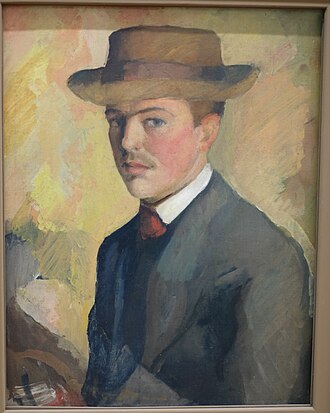
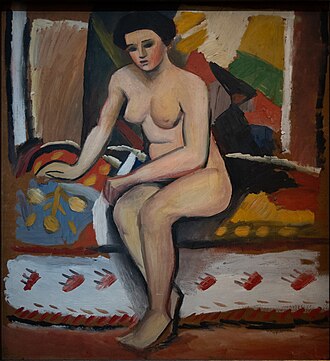
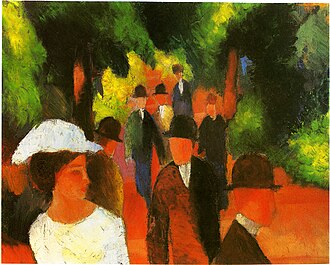
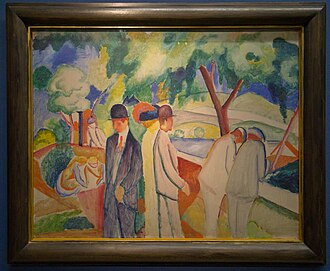
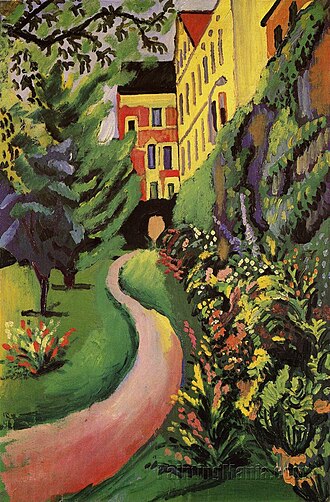
奥古斯特·马克(August Macke,1887年1月3日—1914年9月26日)是一位德国表现主义画家,蓝骑士的领袖人物之一。他是德国最早的表现主义画家之一,推动了其在德国的发展。
他出生于德国梅舍德,但一生中大多数时间都在波恩创作,亦曾短暂地前往图恩湖和欧洲其他地区寻求灵感。第一次世界大战爆发后参军,两个月后死于法国香槟前线。
1997年及2000年他的两幅画售出超过200万美元的高价, 而《Im Bazar》(1914)则在2011年拍出396万英镑的价格。
摘自维基百科「奥古斯特·马克」,按 CC BY-SA 4.0 使用,繁体已转简体,去掉了参考文献、外部链接等尾部小节和表格,其余文字未作改动。
中文条目比较短,展开看英文维基百科的条目(英文原文)
August Robert Ludwig Macke (3 January 1887 – 26 September 1914) was a German Expressionist painter. He was one of the leading members of the German Expressionist group Der Blaue Reiter (The Blue Rider). He lived during a particularly active time for German art: he saw the development of the main German Expressionist movements as well as the arrival of the successive avant-garde movements which were forming in the rest of Europe. As an artist of his time, Macke knew how to integrate into his painting the elements of the avant-garde which most interested him. Like his friend Franz Marc and Otto Soltau, he was one of the young German artists who died in the First World War.
Early life
August Robert Ludwig Macke was born in Germany on 3 January 1887, in Meschede, Westphalia. He was the only son of August Friedrich Hermann Macke (1845–1904), a building contractor and amateur artist, and his wife, Maria Florentine, née Adolph, (1848–1922), who came from a farming family in Westphalia's Sauerland region. Shortly after August's birth the family settled at Cologne, where Macke was educated at the Kreuzgymnasium (1897–1900) and became a friend of Hans Thuar, who also became an artist. In 1900, when he was thirteen, the family moved to Bonn, where Macke studied at the Realgymnasium and became a friend of Walter Gerhardt and Gerhardt's sister, Elisabeth, whom he married a few years later.
The first artistic works to make an impression on the boy were his father's drawings, the Japanese prints collected by his friend Thuar's father and the works of Arnold Böcklin which he saw on a visit to Basel in 1900. In 1904 Macke's father died, and in that year Macke enrolled at the Kunstakademie Düsseldorf, under Adolf Maennchen (1904–1906). During this period he also took evening classes under Fritz Helmut Ehmke (1905), did some work as a stage and costume designer at the Schauspielhaus Düsseldorf, and visited northern Italy (1905) and Netherlands, Belgium and Britain (1906).
Artistic career 1907–1914
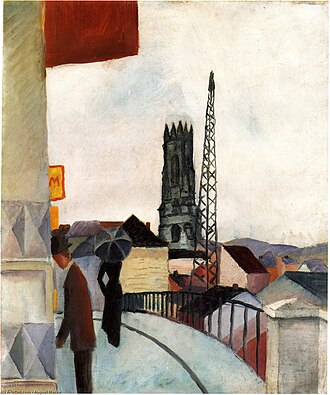
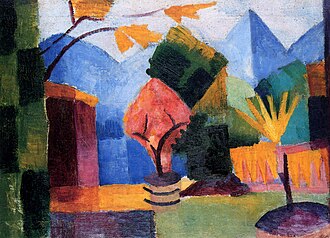
Thereafter Macke lived most of his creative life in Bonn, with the exception of a few periods spent at Lake Thun in Switzerland and various trips to Paris, Italy, the Netherlands and Tunisia. In Paris, where he traveled for the first time in 1907, Macke saw the work of the Impressionists, and shortly after he went to Berlin and spent a few months in Lovis Corinth's studio. His style was formed within the mode of French Impressionism and Post-Impressionism and later went through a Fauve period. In 1909 he married Elisabeth Gerhardt. In 1910, through his friendship with Franz Marc, Macke met Kandinsky and for a while shared the non-objective aesthetic and the mystical and symbolic interests of Der Blaue Reiter.
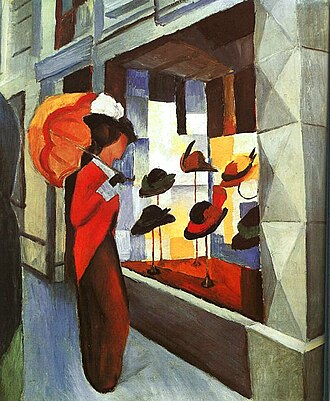
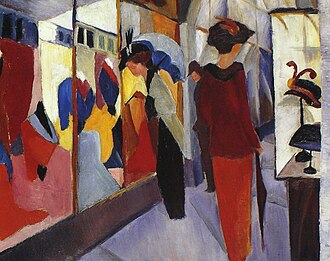
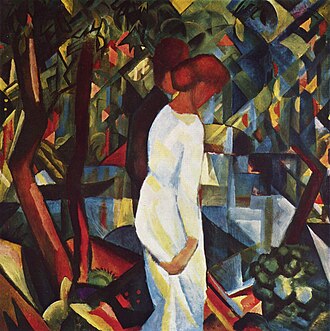
Macke's meeting with Robert Delaunay in Paris in 1912 was to be a sort of revelation for him. Delaunay's chromatic Cubism, which Apollinaire had called Orphism, influenced Macke's art from that point onwards. His Shops Windows can be considered a personal interpretation of Delaunay's Windows, combined with the simultaneity of images found in Italian Futurism.
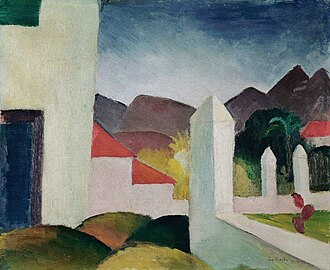
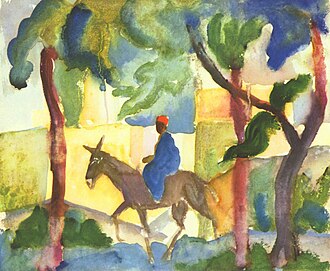
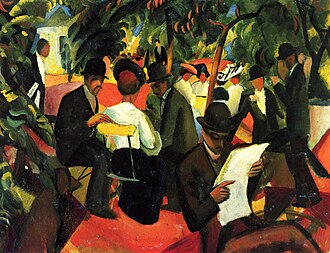
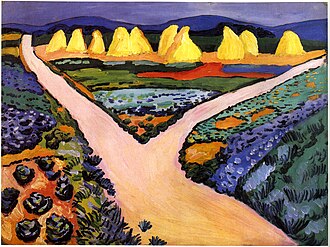
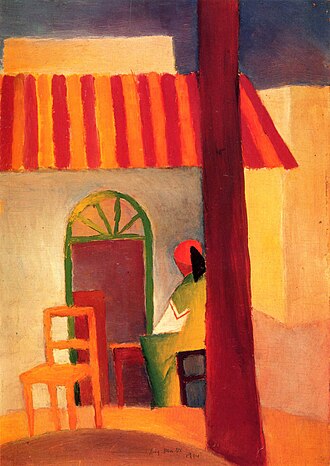
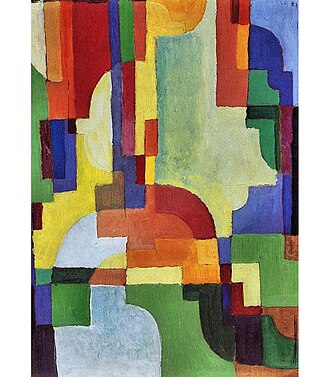
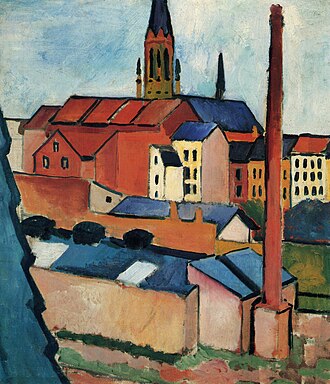
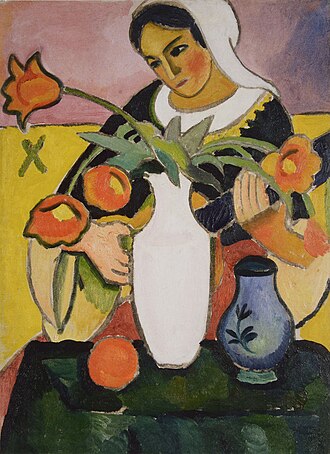
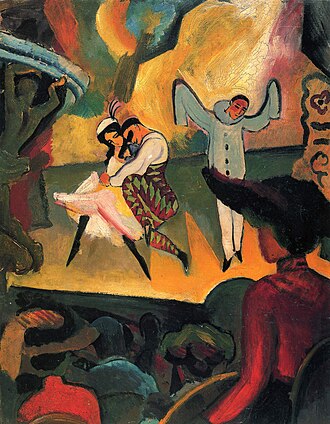
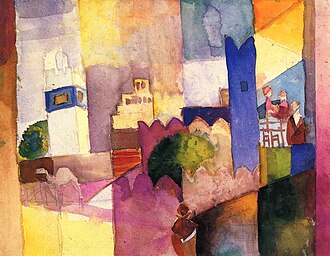
The exotic atmosphere of Tunisia, where Macke traveled in April 1914 with Paul Klee and Louis Moilliet was fundamental for the creation of the luminist approach of his final period, during which he produced a series of works now considered masterpieces, like his famous painting Türkisches Café. August Macke's oeuvre can be considered as Expressionism (in its original German flourishing between 1905 and 1925), and also as part of Fauvism. The paintings concentrate primarily on expressing feelings and moods rather than reproducing objective reality, usually distorting colour and form.
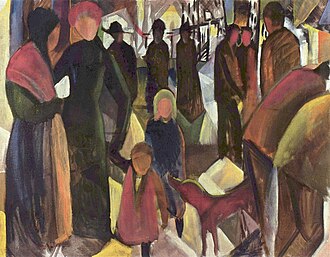
Macke's career was cut short by his early death in the second month of the First World War at the front in Champagne, France, on 26 September 1914. He was buried in the German Military Cemetery in Souain-Perthes-lès-Hurlus. His final painting, Farewell, depicts the mood of gloom that settled after the outbreak of war.
August Macke Prize
The August Macke Prize, was given the first time in 1959 by the districts Arnsberg, Brilon, Olpe and Meschede, town of birth of August Macke in Germany.
节选,摘自英文维基百科「August Macke」,按 CC BY-SA 4.0 使用。
同属「表现主义」的画家
流派页 ›同时代的普鲁士王国画家
流派与收藏
作品(62)