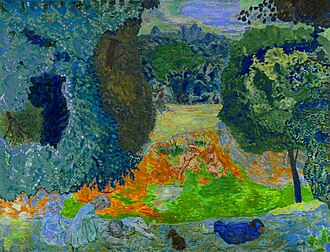
艺廊
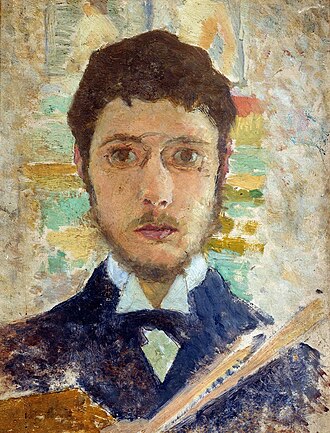
资料卡
- 出生
- 1867 年
- 出生地
- 丰特奈欧罗斯
- 去世
- 1947 年
- 逝世地
- 勒卡内
- 安葬地
- Notre Dame des Anges Cemetery
- 国籍
- 法国
- 职业
- 印刷者、艺术家、插画家、画家、雕塑家、视觉艺术家 等 8 项
- 领域
- 绘画
- 流派
- 纳比派
- 学生
- Baladine Klossowska、Teofil Fraerman
- 就读
- 朱利安艺术学校、孔多塞高级中学、路易大帝中学、Lycée Michelet, Vanves
- 所属团体
- 皇家艺术学院、Comité national de l'estampe
- 配偶
- 玛尔特·博纳尔
资料来自 Wikidata Q26408(CC0)。
生平与创作
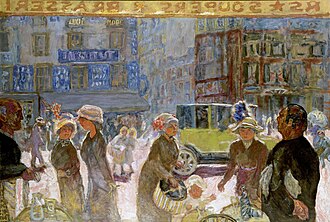
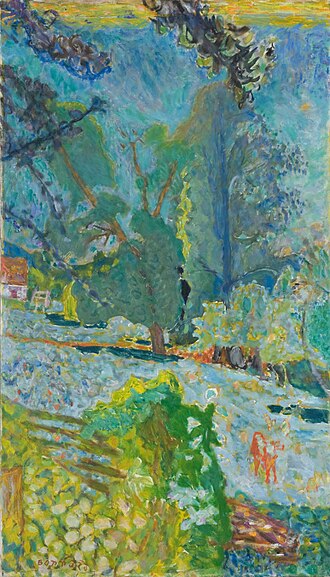
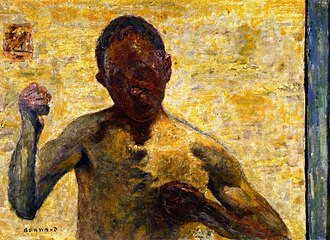
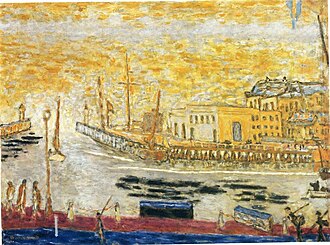
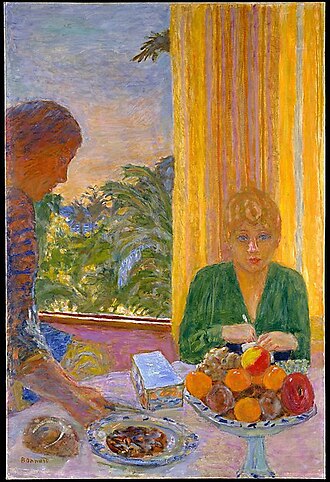
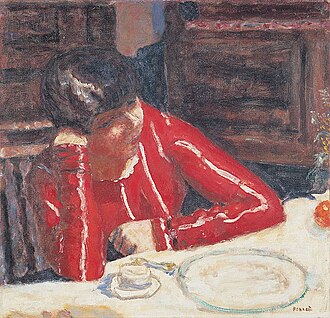
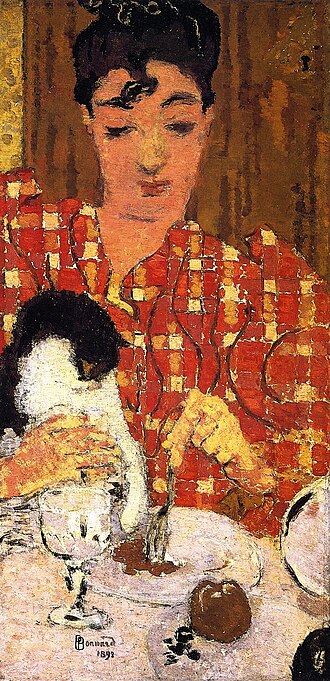
皮耶·波纳尔(法语:Pierre Bonnard, 法语:[bɔnaʁ]、1867年10月3日—1947年1月23日)是一位法国画家和版画家,也是后印象派与那比派创始成员之一。皮耶·波纳尔使用素描当作参考,特点是梦境。温馨的家庭场景也许是皮耶·波纳尔最有名的作品,通常包括妻子玛尔特德。
皮耶·波纳尔被形容为“二十世纪最伟大的异质画家”,而他的作品具有较少传统图案结构模式,充满妖娆的色彩、诗意的典故、视觉。
生平
1867年出生于法国丰特奈-欧罗斯,父亲是法国战争部官员。他的童年快乐而无拘无束,长大后应父亲的要求学习了法律,1888年开始当出庭律师。但他又跑去法国美术学院和朱利安学院上课,立志成为艺术家。
1891年他结识罗特列克,开始在独立者沙龙上参展。同年和爱德华·维亚尔一起为《白色杂志》绘制卷头。
摘自维基百科「皮尔·波纳尔」,按 CC BY-SA 4.0 使用,繁体已转简体,去掉了参考文献、外部链接等尾部小节和表格,其余文字未作改动。
中文条目比较短,展开看英文维基百科的条目(英文原文)
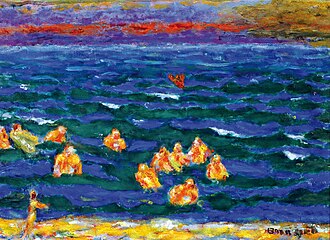
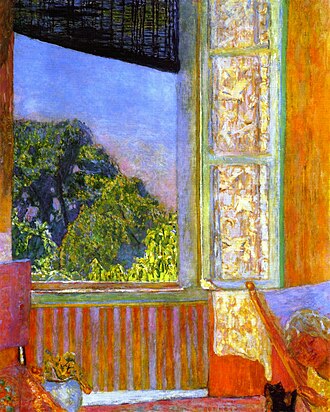
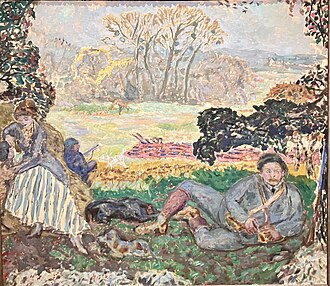
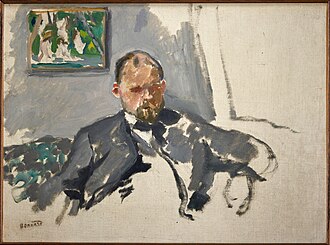
Pierre Bonnard (French: [pjɛʁ bɔnaʁ]; 3 October 1867 – 23 January 1947) was a French painter, illustrator and printmaker, known especially for the stylized decorative qualities of his paintings and his bold use of color. A founding member of the Post-Impressionist group of avant-garde painters Les Nabis, his early work was strongly influenced by the work of Paul Gauguin, as well as the prints of Hokusai and other Japanese artists. Bonnard was a leading figure in the transition from Impressionism to Modernism. He painted landscapes, urban scenes, portraits and intimate domestic scenes, where the backgrounds, colors and painting style usually took precedence over the subject.
Early life and education
Pierre Bonnard was born in Fontenay-aux-Roses, Hauts-de-Seine on 3 October 1867. His mother, Élisabeth Mertzdorff, was from Alsace. His father, Eugène Bonnard, was from the Dauphiné, and was a senior official in the French Ministry of War. He had a brother, Charles, and a sister, Andrée, who in 1890 married the composer Claude Terrasse.
He received his education at the Lycée Louis-le-Grand and Lycée Charlemagne in Vanves. He showed a talent for drawing and watercolors, as well as caricatures. He painted frequently in the gardens of his parents' country home at Le Grand-Lemps near La Côte-Saint-André in the Dauphiné. He also showed a strong interest in literature. He received his baccalaureate in the classics, and, to satisfy his father, between 1886 and 1887 earned his license in law, and began practicing as a lawyer in 1888.
While he was studying law, he attended art classes at the Académie Julian in Paris. At the Académie Julian he met his future friends and fellow artists, Paul Sérusier, Maurice Denis, Gabriel Ibels and Paul Ranson.
In 1888, Bonnard was accepted by the École des Beaux-Arts, where he met Édouard Vuillard and Ker Xavier Roussel. He also sold his first commercial work of art, a design for a poster for France-Champagne, which helped him convince his family that he could make a living as an artist. His first studio was on the rue Lechapelais.
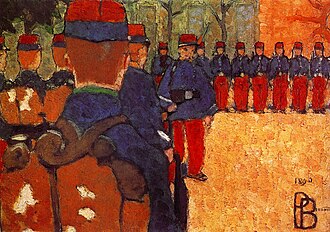
In 1889–1890, Bonnard performed military service as a soldat de deuxième classe in the 52nd Infantry Regiment.
Personal life
From 1893 until her death, Bonnard lived with Marthe de Méligny (1869–1942), and she was the model for many of his paintings, including many nudes. Her birth name was Maria Boursin, but she had changed it before she met Bonnard. They married in 1925. In the years before their marriage, Bonnard had love affairs with two other women, who also served as models for some of his paintings: Renée Monchaty (the partner of the American painter Harry Lachmann) and Lucienne Dupuy de Frenelle, the wife of a doctor. It has been suggested that Bonnard may have been the father of Lucienne's second son. Renée Monchaty committed suicide shortly after Bonnard and de Méligny married.
Early career (1888-1899)
The Nabis
Although Bonnard had received his license to practice law in 1888, he failed in the examination for entering the official registry of lawyers. After the summer holidays, he joined with his friends from the Academy Julian to form Les Nabis, an informal group of artists with different styles and philosophies but common artistic ambitions. Bonnard was then entirely unaware of the Impressionist painters, or of Gauguin and other new painters. His friend Paul Sérusier showed him a painting on a wooden cigar box he made after visiting Paul Gauguin at Pont-Aven, using patches of pure color in the style of Gauguin. In 1890, Maurice Denis, at age twenty, formalized the doctrine in which a painting was considered "a surface plane covered with colors assembled in a certain order".
Some of the Nabis had highly religious, philosophical or mystical approaches to their paintings, but Bonnard remained more cheerful and unaffiliated. The painter-writer Aurelien Lugné-Poe, who shared a studio at 28 rue Pigalle with Bonnard and Vuillard, later wrote: "Pierre Bonnard was the humorist among us; his nonchalant gaiety, and humor expressed in his productions, of which the decorative spirit always preserved a sort of satire, from which he later departed."
节选,摘自英文维基百科「Pierre Bonnard」,按 CC BY-SA 4.0 使用。
师承与影响
同属「纳比派」的画家
流派页 ›同时代的法国画家
流派与收藏
作品(65)