艺廊
作品介绍
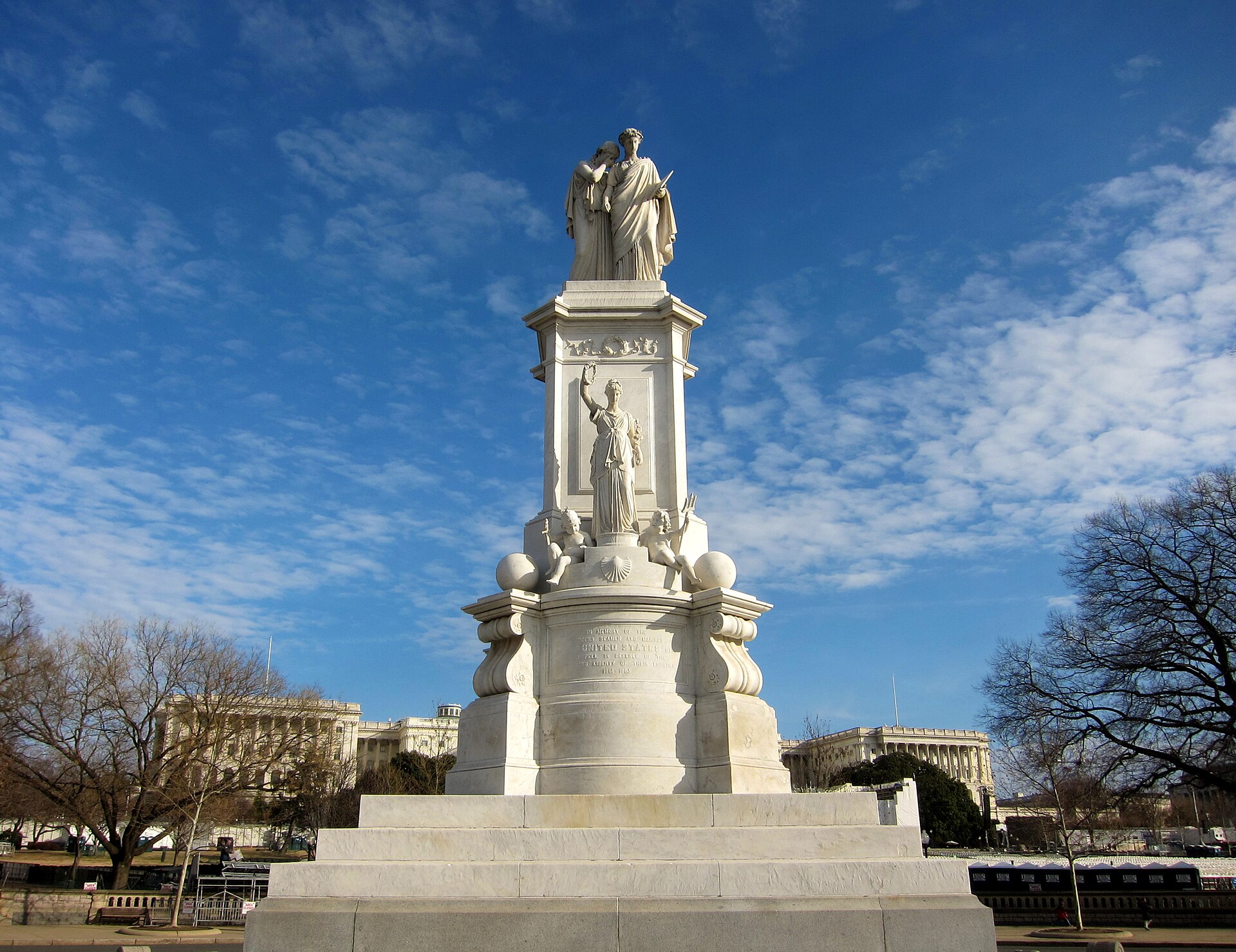
The Peace Monument, also known as the Navy Monument, Naval Monument or Navy-Peace Monument, stands on the western edge of the United States Capitol Complex in Washington, D.C. It is in the middle of Peace Circle, where First Street and Pennsylvania Avenue NW intersect. The surrounding area is Union Square, which the monument shares with the Ulysses S. Grant Memorial, James A. Garfield Monument, and the Capitol Reflecting Pool. The front of the monument faces west towards the National Mall while the east side faces the United States Capitol.
The idea of a monument honoring men who fought in the Union Navy during the Civil War was spearheaded by Admiral David Dixon Porter, who wanted the monument to stand in Annapolis, Maryland, where his father, Commodore David Porter, had assisted in the installation of the Tripoli Monument. Due to an uneasy relationship between the younger Porter and Secretary of the Navy Gideon Welles, the monument was not installed in Annapolis. Porter lobbied Congress and an additional $20,000 was allocated to build the base. This was in addition to the $9,000 Porter raised amongst naval personnel and private citizens. Porter chose Franklin Simmons to sculpt the monument's statues, one of many works in Washington, D.C., by Simmons. Architect of the Capitol Edward Clark designed the base. Pieces of the monument began to arrive in 1876, and the final piece arrived in January 1878. Unlike most of the city's war monuments, there was no formal dedication ceremony.
The monument is made of Carrara marble, which has led to numerous restorations, since that type of marble is not meant to be outside in the elements. The monument is 44 feet (13 m) high and is 10 feet (3.0 m) long on each side. There were additional pieces that were to be installed, including decorative lampposts and water features, but either due to funding or Welles' intervention, the monument remained unfinished. The monument has become a gathering place during protests and rallies, leading to further deterioration of the marble. People protesting against the Vietnam War, the Three Mile Island accident, and the murder of George Floyd, have gathered at the monument. It was also a site where rioters gathered before the January 6 United States Capitol attack.
The Peace Monument is a contributing property to four listings on the National Register of Historic Places and the District of Columbia Inventory of Historic Sites: the National Mall Historic District, the Pennsylvania Avenue National Historic Site, the collective listing of Civil War Monuments in Washington, D.C., and the L'Enfant Plan. Ownership of the monument was transferred in 1973 to the Architect of the Capitol, which has performed several cleaning and restoration projects since that time.
Memorial plans and installation
After the Civil War, there were plans to erect a significant number of memorials in Washington, D.C., honoring men who served in the Union Army. Admiral David Dixon Porter wanted to also honor Union Navy sailors amongst the memorials. Porter had started planning for a memorial in 1864 after Union forces captured Fort Fisher. His father, Commodore David Porter, had also led a movement to honor United States Navy sailors who fought in the Barbary Wars. His father's memorial, the Tripoli Monument, was originally placed in the Washington Navy Yard, but it was moved to Annapolis, Maryland, in 1860. Porter Jr. was selected to lead the United States Naval Academy after the war. It was there, in 1865, that he began making serious plans for the Civil War monument.
Porter raised money for his project via naval personnel and private citizens. By 1871, he had raised $9,000, and sketched what the monument should look like. No competition to design the monument was held, as Porter directly selected Franklin Simmons to sculpt the work. Simmons was known for making portrait sculptures and by 1868 had moved to Rome to work on a statue of Roger Williams for the United States Capitol, which would be the first of several he produced for the National Statuary Hall Collection. Porter had probably seen Simmons' works since the latter had moved to Washington, D.C., in the 1860s, producing a series of 24 medallions depicting figures from the executive branch and military of the Union starting in 1864. Simmons had also already designed a Civil War monument located in Lewiston, Maine. Porter gave Simmons his sketch for the monument, and insisted it be made of Carrara marble. After fundraising was complete, Simmons began carving the commission at his art studio in Rome. Gideon Welles, Secretary of the Navy, was angry that he was not consulted on the matter. The two men had a tumultuous relationship; Porter knew Welles would have rejected the idea.
After Porter lobbied members of Congress in 1872, the federal government approved the monument and allocated $20,000 for the base. Porter wanted the monument to be placed in Annapolis, where his father's monument was located, but Welles said no. The Congress found a better location for the monument, near the U.S. Capitol complex. An Act of Congress passed on July 31, 1876, allowing for the monument to be erected on the proposed site. The following year, Simmons began shipping pieces of the monument to Washington, D.C., on a boat named Supply. Architect of the Capitol Edward Clark designed the granite base and most pieces of the monument were installed in 1877. The statue of Peace was added to the monument in January 1878.
Unlike many other Civil War memorials erected at the time, the Naval Monument (later renamed the Peace Monument by the press), did not receive an elaborate dedication with a parade and speeches from prominent individuals. This may be in part to the bad blood between Porter and Welles, or the fact the monument was not actually finished. Decorative lampposts and elaborate water features were never completed, possibly due to lack of funding. One writer mentioned the parts that were never installed: "Cascades flow from the mouths of bronze dolphins in the sub-base, and four artistic lamp posts stand at the rim of the basin."
原文较长,这里只摘了前面一部分,摘自英文维基百科「Peace Monument」(暂时没有中文条目,下面是英文原文),按 CC BY-SA 4.0 使用,去掉了参考文献、外部链接等尾部小节和表格,其余文字未作改动。