艺廊

作品介绍
Jupiter and Antiope (French: Jupiter et Antiope) is an oil painting by the French artist Antoine Watteau. It is also known as the Satyr and the Sleeping Nymph and was probably painted between 1714 and 1719. Intended to be placed over a doorway, today it hangs in the Musée du Louvre in Paris.
Description
The painting is oval shaped, with a width of 107.5 cm and a height of 73 cm. In the foreground it depicts the naked, sleeping Antiope. She lies with her head on the left edge of the painting, twisted so that her front side faces the viewer. Her right arm is bent under her head while her left arm hangs down into the abyss in front of her. This arm covers the right breast, while the left remains free. Her legs are bent up towards the viewer, with the right continuing the line of her body at the knee while her left leg is only slightly bent to point back to the lower right of the painting. The whole body is painted in pale, warm colours and lights up the otherwise dark and earthy image. Under the sleeping woman there is a cloth, which hangs over the abyss near her breast, disappears under her arm near her head and is lifted by the satyr behind her.
The satyr, whose head is crowned with grape vines symbolising the presence of the god Bacchus, lies in the opposite direction behind the woman, with the front of his body also facing the viewer. With his left arm he lifts the cloth to the height of Antiope's shoulder and it is obvious that he has just uncovered the sleeping maiden. His left arm is bent on a tree root at the right edge of the image and props up his upper body. With his head and upper body, the satyr looms over the hips of the sleeper in order to gaze upon her – he licks his lips lustfully. His body is shadowy and cannot be made out below his hips. The satyr is depicted in brown tones. His suntanned skin and muscular body forms a clear contrast with the softly worked, shapely Antiope.
The lower edge of the image is taken up by an abyss, which is depicted in dark brown tones and is edged with bare soil. On either side, gnarled roots grow in the soil, which rise into indistinct trees. The ground continues above the trees into the background, where there is a hill with lone houses. Above that is the cloudy sky, discreetly lit by the glow of twilight.
The composition fits the oval shape of the image. The sleeping Antiope forms the central horizontal, with her hips and bent legs creating the central vertical. The arms of the satyr and the legs of the woman curve in parallel with the upper edge of the painting – in this way the two central characters repeat the oval within the image, which is broken only by dangling left arm of the woman. Spatial depth is created by the stooped posture of Jupiter and by the bent knees of Antiope.
Mythological background and reception in art
The painting comes out of the story of the seduction of Antiope by the god Zeus in Greek mythology, later imported into Roman mythology and told of the god Jupiter. According to this myth, Antiope, the beautiful daughter of King Nycteus of Thebes, was surprised and seduced by Zeus in the form of a satyr. She became pregnant and bore the twins Amphion and Zethus, who later killed Nycteus' brother Lycus in revenge for his treatment of Antiope and took over the city of Thebes.
Satyr and Nymph
Satyrs and nymphs form two extremes in Greek mythology, which are united only by their instinctive natures. While the nymph was the source of the psychological term nymphomania (now hypersexuality), the satyr was the source of the once common but now outdated term satyriasis and can be understood as the nymph's male equivalent.
Accordingly, both nymphs and satyrs are very regularly depicted in mythology – and thence also in their subsequent artistic reception – in erotic contexts and are accordingly favoured topics of art. In addition there is a clear aesthetic contrast between the two stereotypes. The nymph is in general very beautiful and physically perfect. They were mostly depicted with ivory, light and very delicate colours and an idealised female form, having close similarities with depictions of Venus. On the other hand, the satyrs, who are the followers of Bacchus, are very ugly, with the horns, legs and sometimes the tail of a goat. They are also strong, muscular, and tanned. Thus nymphs and satyrs present an optical contrast, which could hardly be any stronger and which makes them a perfect pair for artistic purposes.
Creation and context
The circumstances of the painting's creation are not entirely clear (see below). In the art historical literature, the assumption that the painting was created as a commission for the banker Pierre Crozat under the instruction of Watteau's teacher Charles de La Fosse around the time of the creation of the four Seasons prevails. La Fosse encouraged Watteau who had not practiced history painting hitherto to take on the work of the allegories of the Seasons, since he himself was not in the neighbourhood anymore. The Seasons seem to have been designed as oval paintings with mythological scenes intended to decorate Crozat's dining room.
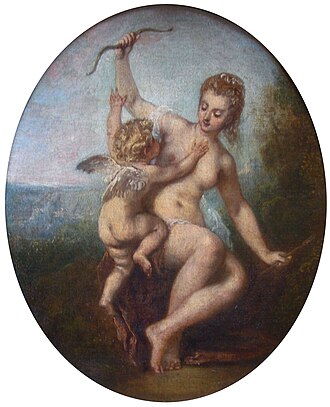
In parallel with this series, Watteau produced a range of other paintings, which dealt with the theme of the mythological nude in this same oval format which was at that time unusual. At first he painted a number of historical images in the classical format, following Italian and Netherlandish classics, after which he next created Jupiter and Antiope, the seasons and three further seasons in the oval format: another Autumn, Venus Disarming Amor and the Morning Toilette.
Models for the painting of Jupiter and Antiope included the paintings of the same name by Antonio da Correggio and Titian as well as the Descent from the Cross of the Dutch painter Anthony van Dyck, from which the arrangement of the satyr's arms is taken.
During his preparation for the Jupiter and Antiope, at least three sketches were created by Watteau, in which he attempted to work the satyr out. These include a drawing of the satyr in kneeling position and one in the reclining pose which he finally selected. No sketches of Antiope are known, but Watteau had already produced a great number of female nudes and studies which he could draw on for this painting. Finally, an image now lost showed the whole image and was used by the engraver Anne-Claude-Philippe, Comte de Caylus as model for a copper engraving which was first published by Jules de Jullienne.
原文较长,这里只摘了前面一部分,摘自英文维基百科「Jupiter and Antiope (Watteau)」(暂时没有中文条目,下面是英文原文),按 CC BY-SA 4.0 使用,去掉了参考文献、外部链接等尾部小节和表格,其余文字未作改动。
相关词条
相关作品