艺廊
作品介绍
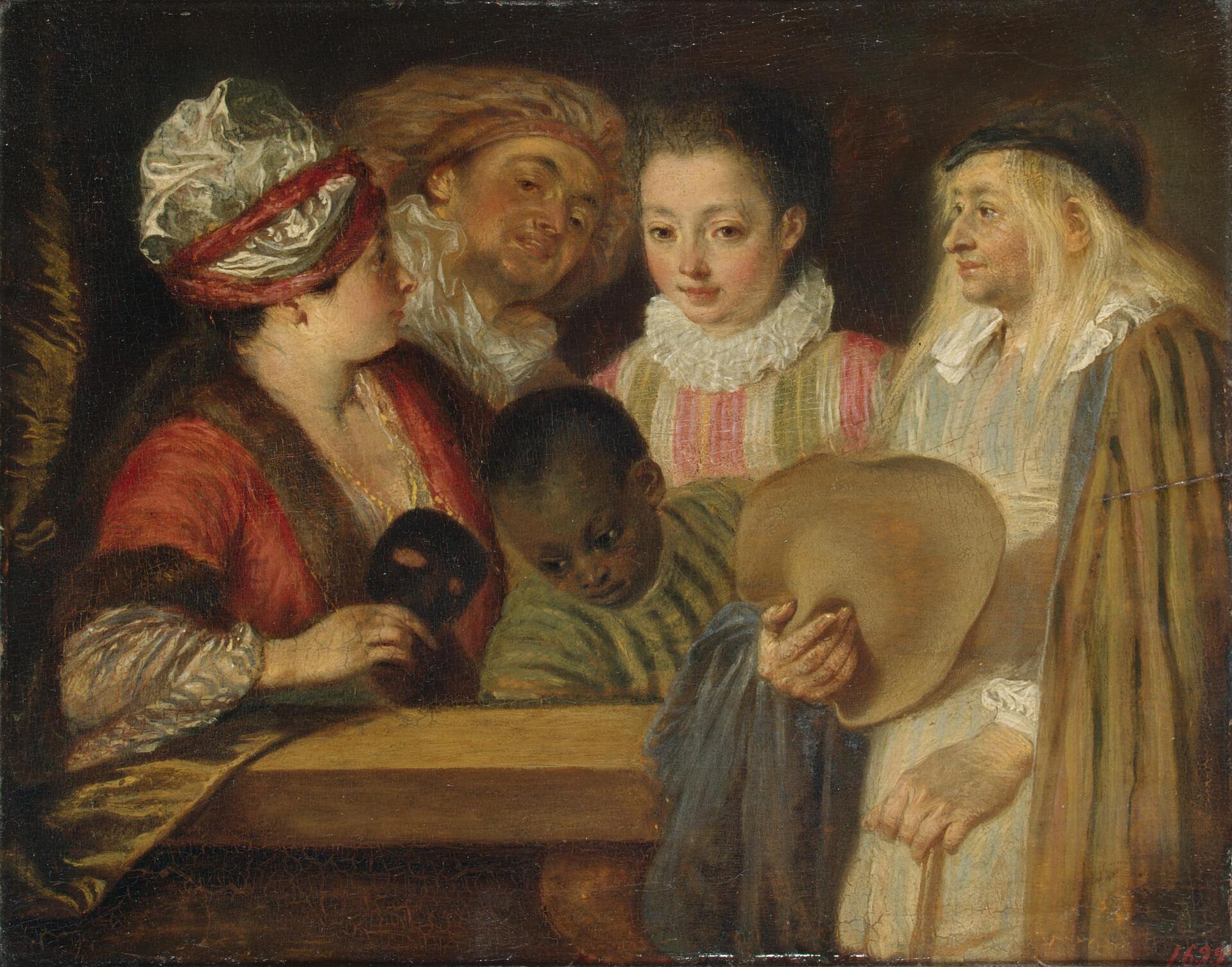
Actors of the Comédie-Française, also traditionally known as The Coquettes (Les Coquettes; from Coquettes qui pour voir), is an oil on panel painting in the Hermitage Museum, Saint Petersburg, by the French Rococo artist Antoine Watteau (1684–1721). Variously dated within the 1710s by scholars, the painting forms a compact half-length composition that combines portraiture and genre painting, notably influenced by Venetian school, the Le Nain brothers, and Watteau's master Claude Gillot; one of the rarest cases in Watteau's body of work, it shows five figures — two women, two men, and a black boy — amid a darkened background, in contrary to landscapes that are usually found in Watteau's fêtes galantes.
For three centuries, there were numerous attempts to identify the subject and the characters represented by Watteau; various authors thought the painting to be either a theatrical scene featuring commedia dell'arte masks, or a group portrait of Watteau's contemporaries. Beginning from the late 20th century, Russian and Western sources accept a theory developed within the Hermitage Museum that holds the painting to be a group portrait of the Comédie-Française players who performed in the playwright Florent Carton Dancourt's play The Three Cousins. Given a variety of available interpretations, the painting has been known under a number of various titles; its traditional naming is derived from anonymous verses, with which the painting was published as an etching in the 1730s.
By the mid-18th century, Actors of the Comédie-Française belonged to Louis Antoine Crozat, Baron de Thiers, a nephew of the Parisian merchant and art collector Pierre Crozat; as part of the Crozat collection, the painting was acquired in 1772 for Empress Catherine II of Russia. Since then the painting was among Russian imperial collections in the Hermitage and, later, in the Gatchina Palace, before entering the Hermitage again in the 1920s; as part of the museum's permanent exhibition, it remains on display in the Winter Palace.
Description
Actors of the Comédie-Française is an oil painting on a pearwood panel that measures approximately 20 by 25 cm. The painting is a compact half-length composition that shows five figures standing around a high wooden balustrade; most of the figures can be related to extant drawings, either directly or through comparable studies in Watteau's body of work. It has been noted by scholars that the half-length representation of Watteau's painting was influenced by Venetian painting; influences from French school such as the Le Nain brothers and Watteau's master Claude Gillot are also cited.
The rightmost figure is an outwardly old man dressed in a skullcap; he leans on a cane in the left hand, while holding a mushroom hat in the right hand. The figure is generally associated with an early full-length sanguine study (PM 64; RP 75), published as an etching engraved by Jean Audran (FDC 157); the earlier version of the subject was introduced by Watteau in Marriage Contract and Country Dancing (now in the Prado, Madrid) and L'Accordee du Village (now in Sir John Soane's Museum, London). It has been noted, however, that the study is probably a reduced version of a larger, more vibrant study drawn from life, similar to other studies such as the ones located in the British Museum, London (PM 84; RP 130), and in the Teylers Museum, Haarlem (PM 53; RP 135), respectively. Given the rendering of the hand holding the cane and the quality of the man's face, it has been suggested that Watteau relied on additional drawings for the painting.
By the balustrade's other side, a young girl is shown in a lightly colored, striped dress with ruff, standing behind a black boy servant in green-striped clothes; over the girl's shoulder, a head of a young man, dressed as Mezzetino, appears in a large motley beret. The girl and the boy's figures are usually related to a Louvre sheet of eight head studies, with the boy's head directly adopted into the Hermitage painting; the girl's figure is also thought to be related to the Louvre drawing, exactly a girl's head notably used in a version of The Embarkation for Cythera located in the Charlottenburg Palace. Young people of color were a recurrent theme in Watteau's paintings and drawings, possibly influenced by works of Paolo Veronese; these are also present in Les Charmes de la vie (Wallace Collection, London), La Conversation (Toledo Museum of Art), and Les Plaisirs du Bal (Dulwich Gallery, London). The head of the young man has no directly related drawings, but is notably present, with slight differences, in The Italian Comedians now in the Getty Museum, Los Angeles; the figure has also been associated by Nemilova with a head on a sheet of studies located in a private collection in New York City (PM 746; RP 456) and, to a lesser success, with a figure from a sheet now in the National Gallery of Art, Washington, D.C. (PM 665; RP 475), while Yuri Zolotov thought the head to be related with Il Capitano's figure present in the Louvre-owned Pierrot.
Opposite to the old man, the leftmost figure is a young woman turned to the right in profile, wearing Polish-styled red dress and white chipper, leaning on the balustrade and holding a black mask in the right hand; from the X-ray analysis, it has been found that she was to be bareheaded, wearing a different attire, and had to have her mask placed on the balustrade rather than holding it. Similarly to the old man's figure, the woman's figure has been related to an early, small, full-length study (RP 44) of a similarly dressed yet differently posed woman, that has been adopted into a more detailed drawing, later used in The Polish Woman, traditionally but not definitively attributed to Watteau (now in the National Museum, Warsaw). Various studies of women's hands holding masks have been related to the painting, with a study in the Kupferstichkabinett, Berlin (PM 828; RP 417), regarded as the closest. There is also a now untraced sanguine and black cha……
原文较长,这里只摘了前面一部分,摘自英文维基百科「Actors of the Comédie-Française」(暂时没有中文条目,下面是英文原文),按 CC BY-SA 4.0 使用,去掉了参考文献、外部链接等尾部小节和表格,其余文字未作改动。
相关词条
相关作品