艺廊
资料卡
- 出生
- 1870 年
- 出生地
- 弗罗茨瓦夫
- 去世
- 1935 年
- 逝世地
- 柏林
- 安葬地
- Wilmersdorfer Waldfriedhof Stahnsdorf
- 国籍
- 德国
- 职业
- 作家、插画家、画家、平面设计师、壁画家、设计师 等 10 项
- 流派
- 表现主义
- 代表作
- Little Peter's Journey to the Moon
- 配偶
- Irene Drösse-Baluschek
资料来自 Wikidata Q313982(CC0)。
生平与创作
Hans Baluschek (9 May 1870 – 28 September 1935) was a German painter, graphic artist and writer.
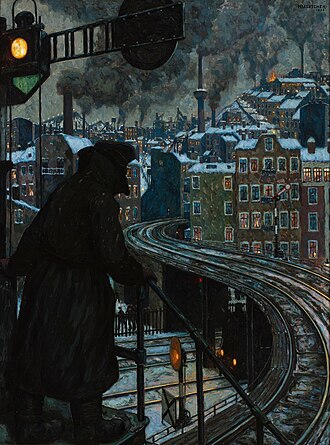
Baluschek was a prominent representative of German Critical Realism, and as such he sought to portray the life of the common people with vivid frankness. His paintings centered on the working class of Berlin. He belonged to the Berlin Secession movement, a group of artists interested in modern developments in art. Yet during his lifetime he was most widely known for his fanciful illustrations of the popular children's book Little Peter's Journey to the Moon (German title: Peterchens Mondfahrt).
Hans Baluschek, after 1920, was an active member of the Social Democratic Party of Germany.
Life
Childhood and youth (1870–1889)
Hans Baluschek was born on 9 May 1870 in Breslau, at the time Germany's sixth-largest city (now Wrocław, Poland), to Franz Baluschek, a surveyor and railway engineer and his wife. He had three sisters, two of whom died of tuberculosis in childhood. After the Franco-Prussian War and foundation of the German Empire in 1871, Franz became an independent engineer for the railways, and lived for a time in the much smaller town of Haynau (now Chojnów, Poland). It was during his childhood that Hans Baluschek developed a fascination with railways that later would be shown in his paintings.
In 1876 the family, with 6-year-old Hans, moved to Berlin, where during the next decade they changed their residence five times, living in a succession of newly built apartments developed expressly for workers. Berlin found itself in the midst of an economic crisis following the Panic of 1873, but Franz Baluschek was fortunate in maintaining railway employment and was able to support his family in kleinbürgerlich (petit bourgeois) style amid the family's less affluent proletarian neighbors.
Following primary school, Hans Baluschek at age 9 entered the Askanische Gymnasium, a secondary school in the Tempelhof-Schöneberg district of Berlin, which offered curricula in the humanities and natural sciences.
During the 1880s, young Baluschek was profoundly impressed by a Berlin exhibition of paintings by Russian artist Vasily Vereshchagin, whose works portrayed the horrors of war, particularly the Russo-Turkish War of 1877–78. These paintings were widely debated in Berlin artistic circles, where their graphic realism came as a shock to some. Baluschek began to copy pictures and to paint his own war scenes in the manner of Vereshchagin, whose influence may be detected in some of Baluschek's later works.
In 1887, his father took a job with the railway on the large German island of Rügen, and the family moved to nearby Stralsund, where Baluschek completed his Gymnasium education. In Stralsund he was influenced by instructor Max Schütte, who taught his students the principles of socialism, particularly emphasizing the relationship between economic and social issues—and who was ultimately dismissed because of his left-wing political views. Baluschek and his classmates devoted themselves to studying the political works of Tolstoy and Zola which were popular at the time. When Baluschek passed his Abitur (school-leaving exam) in 1889 and graduated from the Gymnasium, he stated that he wished to become a painter.
Early years as an artist (1890–1894)
After graduating, Baluschek was admitted to the Berlin University of the Arts (Universität der Künste), where he became acquainted with the German painter Martin Brandenburg, with whom he was to maintain a lifelong friendship. The university, however, remained quite conservative despite many new trends in the arts, such as the widely popular French Impressionism. Instruction focused on traditional techniques and art history.
Baluschek lived in the Schöneberg district of Berlin. His earliest known sketch book dates from 1889 and includes a self-portrait showing him in student dress. Among his early works are military and war scenes, along with portrayals of street life in Stralsund and Berlin. In the 1890s he produced illustrations of class differences and proletarian life in Berlin, in which he finally departed from traditional techniques.
Baluschek left the arts university in 1893 and began to work as an independent artist, now focusing almost exclusively on social-class differences—which made him an outsider in the conservative arts scene of Wilhelmine Germany. Meanwhile, he was reading the left-leaning works of Gerhart Hauptmann, Tolstoy, Ibsen, Johannes Schlaf und Arno Holz and was heavily influenced by the literature of Naturalism.
Artistic development (1894–1914)
The main period of Bakluschek's artistic development began in 1894 and extended for two decades, until the beginning of World War I in 1914. Baluschek identified with opposition to traditional representative art and forged relationships with artists in the circle dominated by impressionist Max Liebermann (later classified by the Nazis as a practitioner of "degenerate art"). Baluschek's paintings from this period show life on the outskirts of Berlin, where construction of factories, apartment complexes and railroads was booming. His favorite themes included factories, cemeteries and above all the common working people of Berlin. For example, his 1894 work Noon (Mittag) depicts women with children bringing lunch baskets to their men employed at the factories, and evokes the "endless drudgery" of working-class life, with its constant repetition of daily tasks. With Railwayman's Evening Free (Eisenbahner-Feierabend) in 1895, this theme is represented by an individual worker who returns exhausted from work against a backdrop of railroad installations, smoke stacks and overhead tram wires, and is greeted by anxious children.
At the time Baluschek maintained a friendly relationship with the avant-garde poet Richard Dehmel, known for poems such as The Working Man (Der Arbeitmann) and Fourth Class (Vierter Klasse). Baluschek produced a cover illustration for Dehmel's Woman and the World (Weib und Welt), a collection of poems that appeared in 1896.
Baluschek developed relationships with several left-leaning writers, among them the poet and playwright Arno Holz, best known for Phantasus (1898), a poetry collection describing the starving artists of the Wedding district of Berlin.……
原文较长,这里只摘了前面一部分,摘自英文维基百科「Hans Baluschek」(暂时没有中文条目,下面是英文原文),按 CC BY-SA 4.0 使用,去掉了参考文献、外部链接等尾部小节和表格,其余文字未作改动。