 艺廊

资料卡
- 出生
- 1857 年
- 出生地
- 莱比锡
- 去世
- 1920 年
- 逝世地
- Großjena
- 安葬地
- Großjena
- 国籍
- 德国
- 职业
- 作家、教授、艺术家、一年志愿兵、画家、雕塑家 等 13 项
- 领域
- 情色艺术
- 流派
- 象征主义
- 老师
- Karl Gussow、Emile Wauters、路德维希·德库德尔
- 代表作
- Paraphrase on the Finding of a Glove
- 就读
- 卡尔斯鲁尔美术学院、普鲁士艺术学院、Petri school Leipzig
- 所属团体
- 维也纳分离派、慕尼黑美术学会、柏林艺术学院、柏林分离派
- 获奖
- 巴伐利亚马克西米兰科学与艺术勋章、Pour le Mérite for Sciences and Arts order
- 配偶
- Gertrud Bock
资料来自 Wikidata Q44252(CC0)。
生平与创作
马克斯·克林格尔 (德语:Max Klinger,1857年2月18日—1920年7月5日)是德国象征主义画家和雕塑家。
克林格尔出生与莱比锡,在卡尔斯鲁厄学习,他最欣赏戈雅和门采尔的蚀刻版画,所以自学成为一名出色的蚀刻版画家。
他最著名的作品是一个系列蚀刻版画《关于寻找一个手套的释义》,是源自他在一个溜冰场寻找手套的梦境,他图解了弗洛伊德对于恋物的研究结果,其中“手套”成为他追求浪漫理想的象征。
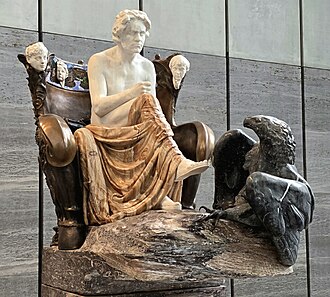
克林格尔在欧洲各个艺术中心到处旅行,直到1893年返回莱比锡,从1897年后,他主要致力于雕塑,他的贝多芬雕像成为1902年维也纳分离派艺术家展览中的主要作品。他对基里科以及其他一些艺术家影响很大,他是19世纪象征主义和20世纪超现实主义运动之间乘前启后的重要代表人物。第22369号小行星是以他的名字命名的†。
摘自维基百科「马克斯·克林格尔」,按 CC BY-SA 4.0 使用,繁体已转简体,去掉了参考文献、外部链接等尾部小节和表格,其余文字未作改动。
中文条目比较短,展开看英文维基百科的条目(英文原文)
Max Klinger (18 February 1857 – 5 July 1920) was a German artist who produced significant work in painting, sculpture, prints and graphics, as well as writing a treatise articulating his ideas on art and the role of graphic arts and printmaking in relation to painting. He is associated with symbolism, the Vienna Secession, and Jugendstil (Youth Style), the German manifestation of Art Nouveau. He is best known today for his many prints, particularly a series entitled Paraphrase on the Finding of a Glove and his monumental sculptural installation in homage to Beethoven at the Vienna Secession in 1902.
Life
Klinger was born in Leipzig, Kingdom of Saxony to a wealthy and prominent family. He enrolled in the Academy of Fine Arts in Karlsruhe in 1874 where he was a pupil of Karl (or Carl) Gussow. When Gussow left Karlsruhe to become the Director of the Academy of Fine Arts in Berlin, Klinger moved to Berlin as well to complete his studies there. Klinger shared a studio with Christian Krohg and the two had a mutual admiration for French naturalist authors like Émile Zola and Gustave Flaubert, who explored the shadowy aspects of urban life and the hypocrisy of society and the bourgeoisie in their novels. At that time realism was the prevailing style in Germany and Arnold Böcklin was one of the few artist active there that Klinger felt a close affinity to. Klinger graduated from the academy in 1877. He was drawn to and studied the etchings and prints of many masters that were more aligned with his sensibilities including Dürer, Rembrandt, Goya, Runge, Menzel, and Rops. He began an apprenticeship studying engraving under Hermann Sagert and soon became a skilled and imaginative engraver in his own right. Klinger visited Brussels for a time in 1879, and the following year he spent time in Munich. He was achieving some notoriety with his pen and ink drawings and prints when in 1881 he published two sets of etchings, including Paraphrase on the Finding of a Glove, which was an immediate success and established his reputation.
With a receptive audience developing in Paris, where the Franco-Uruguayan poet and art critic Jules Laforgue had been celebrating and advocating his prints, Klinger moved to Paris in 1883 where he lived until 1886 or 1887. Klinger first began sculpting about 1883, and sculpture slowly came to dominate his output in his later years. He conceived and started work on his Beethoven sculpture while in Paris but, it was not completed and fully realized until 1902. In 1889 Les XX (The Twenty) invited Klinger to exhibit his work in their annual winter exhibition that year in Brussels. He moved to Rome in 1889, staying until 1893, studying the Italian masters, where the 15th century artists and works from antiquity are said to have been something of a revelation to him. He also intensified his studies of anatomy, the nude, and the representation of mass and volume during this period of his life. It was a productive time in his career. In the 1890s, Klinger continued his gradual shift away from printmaking in favor of sculpting.
Klinger was an accomplished pianist and counted the composer Max Reger among his friends. A friendship with the composer Johannes Brahms developed over a period of 20 years, culminating with Klinger's publication of his print series Brahms Fantasies (1894) and Brahms's dedication of Vier ernste Gesänge (Four Serious Songs), Opus 121, to Klinger in 1896, a year before the composer's death.
In 1906 he founded the Villa Romana Prize. After buying a villa in Florence, complete with 15,000 square meter park, recipients of the prize were given the opportunity to stay for a few months and adsorbed the culture of the city. The first beneficiary of the prize was Gustav Klimt, however Klimt waived his honor and passed it on to Maximilian Kurzweil. Later recipients included Käthe Kollwitz, Max Beckmann, Ernst Barlach and Georg Kolbe.
Elsa Asenijeff (1867–1941) was a writer and poet, as well as a model, muse, and girlfriend of Klinger for about 15 years. They had a daughter Desirée Klinger (1900–1973) but were never married. In 1903 he moved away from Leipzig and bought a vineyard in Großjena [Gross Jena], near Naumburg, Germany, where he settled in his later years.……
节选,摘自英文维基百科「Max Klinger」,按 CC BY-SA 4.0 使用。
师承与影响
同时代的德国画家
流派与收藏
作品(9)



只有资料的作品(1)
- Busto de Richard Wagner1983 年