艺廊
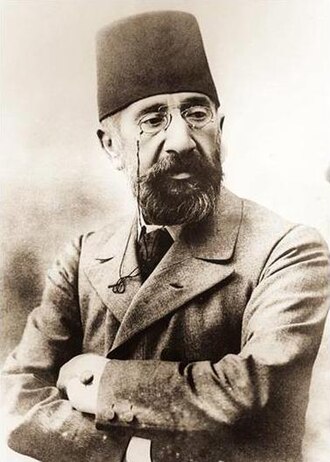
资料卡
- 出生
- 1842 年
- 出生地
- 伊斯坦布尔
- 去世
- 1910 年
- 逝世地
- Kuruçeşme
- 国籍
- 奥斯曼帝国
- 职业
- 政治人物、画家、美术史学家、考古学家、人类学家
- 所属团体
- 皇家艺术学院
- 父亲
- 易卜拉欣·埃德恒帕夏
资料来自 Wikidata Q1190012(CC0)。
生平与创作
奥斯曼·哈姆迪贝伊(1842年12月30日—1910年2月24日)是奥斯曼帝国的管理者、知识分子、艺术专家,也是一位杰出的先锋画家。他也是一位出色的考古学家,被认为是土耳其博物馆馆长职业的先驱者。他是伊斯坦布尔考古博物馆和伊斯坦布尔美术学院(土耳其语为Sanayi-i Nefise Mektebi)的创始人,今天被称为米玛尔希南美术大学。他也是卡德柯伊市的第一任市长。
摘自维基百科「奥斯曼·哈姆迪贝伊」,按 CC BY-SA 4.0 使用,繁体已转简体,去掉了参考文献、外部链接等尾部小节和表格,其余文字未作改动。
中文条目比较短,展开看英文维基百科的条目(英文原文)
Osman Hamdi Bey (30 December 1842 – 24 February 1910) was an Ottoman administrator, intellectual, art expert and also a prominent and pioneering painter. He was the Ottoman Empire's first archaeologist and first museologist and he is regarded as the founding father of museology, archaeology, fine arts education and museum curator's professions in Turkey.
He was also the founder of Istanbul Archaeology Museums and of the Istanbul Academy of Fine Arts (Turkish: Sanayi-i Nefise Mektebi) known today as the Mimar Sinan Fine Arts University. He was also the first mayor of Kadıköy.
Early life
Osman Hamdi was the son of Ibrahim Edhem Pasha, an Ottoman Grand Vizier (in office 1877–1878, replacing Midhat Pasha) who was originally a Greek boy from the Ottoman island of Sakız (Chios) orphaned at a very young age following the Chios massacre there. Ibrahim was adopted by Kaptan-ı Derya (Grand Admiral) Hüsrev Pasha and eventually rose to the ranks of the ruling class of the Ottoman Empire. His mother, Fatma Hanım, was the daughter of Hacı Mustafa Ağa, the steward of the drapers (yağlıkçılar kâhyası) during the reign of Sultan Abdülmecid who had migrated from Isparta to Istanbul. Osman was extremely proud of his Greek descent, often mentioning it in educated circles; this caused him to have a number of Greek collaborators and acquaintances throughout his life, including from the Kingdom of Greece.
Osman Hamdi went to primary school in the popular Istanbul quarter of Beşiktaş; after which he studied law, first in Constantinople (1856) and then in Paris (1860). However, he decided to pursue his interest in painting instead, left the Law program, and trained under French orientalist painters Jean-Léon Gérôme and Gustave Boulanger. During his nine-year stay in Paris, the international capital of fine arts at the time, he showed a keen interest for the artistic events of his day.
His stay in Paris was also marked by the first ever visit by an Ottoman sultan to Western Europe, when Sultan Abdülaziz was invited to the Exposition Universelle (1867) by Emperor Napoleon III. He also met many of the Young Ottomans in Paris, and even though he was exposed to their liberal ideas, he did not participate in their political activities, being the son of an Ottoman pasha who was loyal to the sultan and did not challenge the old absolutist system. Osman Hamdi Bey also met his first wife Marie, a French woman, in Paris when he was a student. After receiving his father's blessings, she accompanied him to Constantinople when he returned in 1869, where the two got married and had two daughters.
Once back in Turkey, he was sent to the Baghdad Vilayet in Ottoman Iraq, as part of the administrative team of Midhat Pasha (the leading political figure and reformer among the Young Ottomans who enacted the First Ottoman Constitution in 1876, Midhat Pasha served as the Grand Vizier between 1876–1877, before being replaced by İbrahim Edhem Pasha, Osman Hamdi Bey's father.) In 1871, Osman Hamdi returned to Istanbul, as the vice-director of the Protocol Office of the Palace. During the 1870s, he worked on several assignments in the upper echelons of the Ottoman bureaucracy. He was appointed as the first mayor of Kadıköy in 1875, and stayed in that position for one year.
Career
Osman Hamdi exhibited three paintings at the 1867 Paris Exposition Universelle. None seem to have survived today, but their titles were Repose of the Gypsies, Black Sea Soldier Lying in Wait, and Death of the Soldier.
An important step in his career was his assignment as the director of the Imperial Museum (Müze-i Hümayun) in 1881. He used his position as museum director to develop the museum and rewrite the antiquities laws and to create nationally sponsored archaeological expeditions. Osman Hamdi focused on building relationships with international institutions, notably the University of Pennsylvania, from which he received an honorary degree in 1894. In 1902, he painted the excavation of Nippur as a gift to the University of Pennsylvania Museum. He also received a diploma by the Archaeological Society of Athens in 1890.
节选,摘自英文维基百科「Osman Hamdi Bey」,按 CC BY-SA 4.0 使用。
师承与影响
同时代的奥斯曼帝国画家
流派与收藏
作品(20)