艺廊
资料卡
- 出生
- 1758 年
- 出生地
- 的里雅斯特
- 去世
- 1834 年
- 逝世地
- 克列梅涅茨
- 国籍
- 俄罗斯帝国、波兰立陶宛联邦
- 职业
- 画家
- 老师
- Heinrich Füger、老约翰·巴普蒂斯特·兰皮、Heinrich Carl Brandt
- 学生
- Jan Ksawery Kaniewski、Bonawentura Klembowski
- 就读
- 维也纳艺术学院
资料来自 Wikidata Q11731155(CC0)。
生平与创作
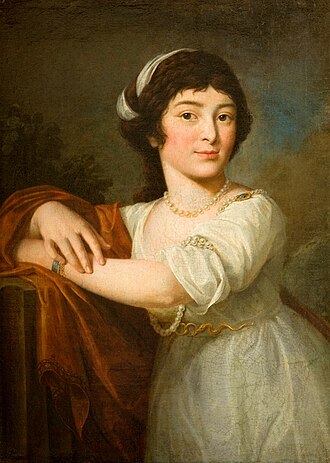
Józef Franciszek Jan Pitschmann, or Franz Joseph Pitschmann (1758 – 1 September 1834) was an Austrian-born Polish portrait painter.
Biography
He was born in Trieste. He began his artistic studies at the Academy of Fine Arts, Vienna, under the direction of Heinrich Carl Brandt, a noted portrait painter. In 1787, he was awarded a gold medal for his depiction of Hercules returning Admetus to Alcestis, and was made a member of the Academy.
In 1788, he moved to Poland at the invitation of Józef Klemens Czartoryski, living in his home in Korzec while working as a portrait painter and art teacher. From 1789 to 1794, he lived in Warsaw where he painted for the nobility and the bourgeoisie; notably several portraits of King Stanisław II August, for which he was awarded a diamond ring. In 1794, he moved to Lwów, where he lived until 1806. While there, he is known to have produced over 300 portraits, including one of Emperor Francis I and his wife.
In 1806, Tadeusz Czacki offered him a position at the new Krzemieniec Lyceum, where he became a drawing teacher. He also gave private lessons. During this time, he created an additional 150 portraits, mostly of the professors at the school and the local nobility, and received several awards from the Emperor. His best-known student was Jan Ksawery Kaniewski.
After his retirement, he remained in Krzemieniec and died there.
摘自英文维基百科「Józef Pitschmann」(暂时没有中文条目,下面是英文原文),按 CC BY-SA 4.0 使用,去掉了参考文献、外部链接等尾部小节和表格,其余文字未作改动。