艺廊

作品介绍
皮蒂圆雕是米开朗基罗的一件圆形大理石浮雕,创作于 1503-1504 年,现藏于佛罗伦萨的巴杰罗美术馆。
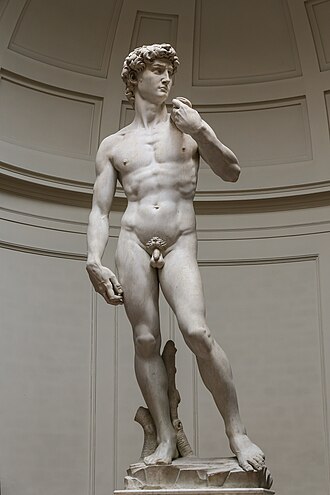
圆雕创作于雕刻大卫像的同一年,是由巴托洛梅奥·皮蒂订制。
1823 年,佛罗伦萨当局以200意大利斯库多的价格买下了圆雕,放置在乌菲兹美术馆,1873 年移至巴杰罗美术馆。
圆雕中,圣母膝盖上放着一本打开的书,望着远方,仿佛在冥思经书上儿子的命运。圣婴耶稣靠在她身上,在背景中可以看到年轻的洗者若翰。
摘自维基百科「皮蒂圆雕」,按 CC BY-SA 4.0 使用,繁体已转简体,去掉了参考文献、外部链接等尾部小节和表格,其余文字未作改动。
中文条目比较短,展开看英文维基百科的条目(英文原文)
The Pitti Tondo (Tondo Pitti) is an unfinished marble relief of the Virgin and Child by Michelangelo in round or tondo form. It was executed between 1503 and 1504 while he was residing in Florence and is now in the Museo nazionale del Bargello in Florence.
History
The tondo was worked on during the year in which Michelangelo sculpted his David, having found the time to dedicate to some other paid private commissions. The work was not completed before Michelangelo left Florence for Rome, and never to return. Many details are missing and the sides of the work are not polished.
This sculpture was commissioned by Bartolomeo Pitti. His son Miniato, a monk at Monte Oliveto, donated it to Luigi Guicciardini (1487–1551). In 1564, the art historian, Benedetto Varchi, saw the work in the house of Guicciardini's nephew, Piero. In 1823, the tondo was bought by the Florentine authorities for 200 scudi, from the shop of the dealer Fedele Acciai.
The tondo entered the collection of the Museo nazionale del Bargello in 1873 and was placed where it resides, in the Galleria degli Uffizi.
Description and style
In the unfinished tondo only the heads of Mary and of the baby Jesus are in high relief. Mary is depicted with an open book on her knees. Detail of her eyes is not complete, as in the typical style of Michelangelo, but interpretations suggest that her gaze seems distracted, as if she is looking into the distance and meditating on the fate of her son that is foretold in the scriptures she is reading. The cherub upon Mary's forehead symbolizes her knowledge of the prophecies, as is found in the terracotta relief, Madonna with Child, that is attributed to Donatello of Padua and dated to c. 1440. The baby Jesus leans on her in a lively contrapposto and just visible emerging in the background, is a young Saint John the Baptist.
Apparently, Michelangelo also was influenced by the now-lost cartoon of Saint Anne by Leonardo da Vinci that was exhibited in Florence at the Santissima Annunziata during the years Michelangelo was working on the sculpture. Both works are based on the interaction between the figures.
The central figure of the composition is Mary, sitting on a cube block (resembling that in Michelangelo's Madonna of the Stairs). Interpretations have suggested that she seems to bend over in order to fill the space allotted by the tondo and that her posture gives an impression that she desires to escape from the scene depicted.
Her head, in high relief, projects both outward and upward beyond the border of the tondo and turns left to break the rigidity of the vertical axis of her body. The contrast between the unfinished figure of John the Baptist and the relief of the Virgin also gives the work depth.
摘自英文维基百科「Pitti Tondo」,按 CC BY-SA 4.0 使用。
相关词条
相关作品