 艺廊
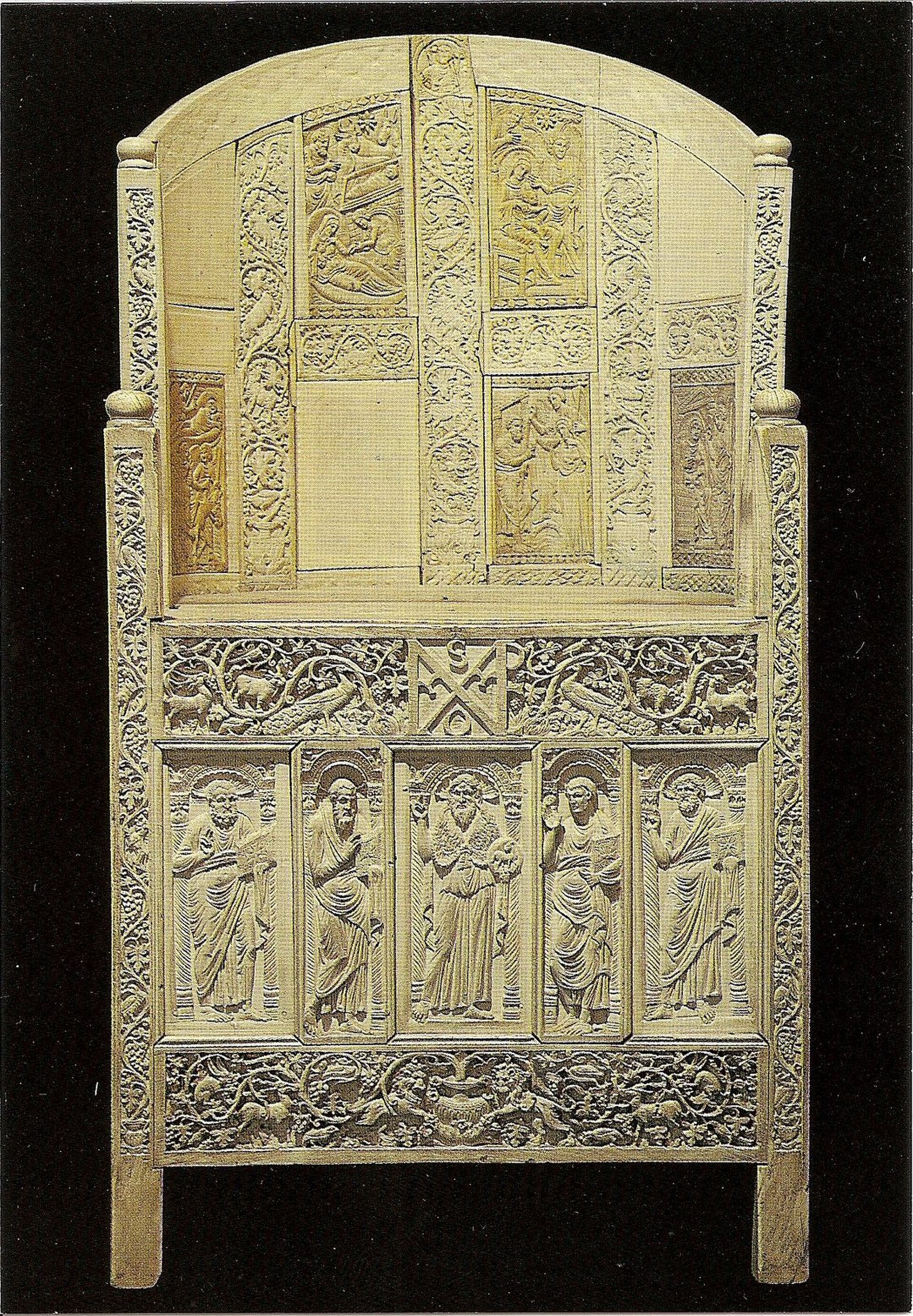
作品介绍
The Throne of Maximian (or Maximianus) is a cathedra (episcopal throne) that was made for Archbishop Maximianus of Ravenna and is now on display at the Archiepiscopal Museum, Ravenna. It is generally agreed that the throne was carved in the Greek East of the Byzantine Empire and shipped to Ravenna, but there has long been scholarly debate over whether it was made in Constantinople or Alexandria.
The style of the throne is a mixture of Early Christian art and that of the First Golden Age of Byzantine art. It is made of carved ivory panels, with frames of winding vines and grapevines, on a wooden frame. The throne itself is large with a high semi-circular back and may have held a jewelled cross or Gospel book for some of the time. The ivory carvings are done in relief and the panels depict important biblical figures. The back of the throne shows scenes of the Life of Christ, the sides include scenes of the Story of Joseph from the Book of Genesis, and on the front of the throne are the Four evangelists around John the Baptist, who is holding a medallion with the Lamb of God and Maximian's name above him.
Historical context
Maximian was "a poor deacon of Pola who rose to a high position through his political adroitness" as a protégé of Justinian I. He had not been wanted as archbishop by the people of Ravenna, but "by shrewd maneuvres he overcame their opposition, and won their respect by his discretion, generosity, and great enterprises of church building and decoration". He is shown, and named in a large titulus, in the famous mosaic in the Basilica of San Vitale of Justinian surrounded by his ministers and bodyguards (matched by a panel for the Empress). His throne can be dated to about 545–553, and is believed to have been carved in Constantinople, and shipped to Ravenna. It was probably commissioned by Justinian as a gift for Maximianus for becoming the new archbishop and to encourage and strengthen his authority because he was not always popular.
The throne portrays Justinian's presence in Ravenna, which had been the western capital of the Roman Empire and the Byzantine Empire. Maximian may well have acted as regent for the Emperor in the remaining Byzantine territory in Italy, and it is possible that it was intended to be left as an empty throne symbolizing the authority of God or the Emperor, or both. Many had also believed that the throne was not intended to be of personal use by the Archbishop, but was to be an empty throne that symbolized the imperial or divine power. The cathedra was positioned in the center of the apse in the cathedral with the benches of assisting priests on either side. The throne was also carried during religious ceremonies. The decorated back and side of the throne suggested that the throne was designed to be moved out of the apse and placed near the chancel while the bishop addressed the congregation, instead of being left stationary against the wall.
The gift was also for the dedication of San Vitale; Justinian hired 6th-century Byzantine artists, who were summoned by the court to Constantinople from around the Empire, to create this piece. The style of the ivories and even the use of ivory itself suggest that the throne belongs to the School of Ivory Carving. It is also suggested, due to differing styles within the throne, that some components or even the entire throne was possibly carved in Alexandria. However, it is argued that the cult of St Menas was not just confined to Egypt, but there was a church dedicated to him in Constantinople. One argument advanced for an origin in Egypt is the local relevance of the story of Joseph, which is given such prominence, but Meyer Schapiro demonstrates an artistic and literary tradition using Joseph, who rose to be minister to his pharaoh, as a symbol for the role a bishop, which at this period typically involved a considerable role in civil government.
Technical analysis
Ivory carving was used in many luxury Byzantine sculptures including diptychs such as that showing the Adoration of the Magi and the Barberini Diptych, representing Justinian as Holy Emperor. The throne is the largest single Late Antique work of art made of ivory, and derives attraction from its simple and proportionate lines along with its elaborate carvings.
The size of the throne and clear stylistic variations between the panels suggest that it involved the work of several 6th century Byzantine artists. The technique of the panels suggests that at least two different artists of unequal skills had executed the carvings due to differing styles. Although the general style of the panels can be recognized, the panels on the front are sketchy compared to the scenes on the side and back of the chair, which are very bold and rather careless.
The dimensions are 22" (0.6m) wide x 4’11" (1.5m) high. Of the panels on the back of the throne, only 16 of the 24 panels have survived or been restored. The piece is currently preserved and displayed in the Museo Arcivescovile, which also holds the Chapel of Sant’Adrea and works from the old cathedral. The Byzantine Church did not favor sculpture in the round, fearing that it would recall idols from Greek and Roman pagan religion. Thus, small carvings in relief were created and allowed. This style of carving involves carving figures that project slightly from the background rather than free standing. This creates a piece with a mixture of 2 and 3 dimensionality.
The two different techniques of two different artists could be possibly explained by the pandemic plague that raged that time (c.ad.540, the Plague of Justinian). The plague spread to the Roman Empire from the East Africa through the Ivory route and the ivory workshop artists could be among early victims of the disease. The deterioration of the technique therefore could be explained by the decease of the initial principal master and the possible desire of the Emperor to finish the piece as soon as possible anyway.
Formal and stylistic analysis
The Throne of Maximianus is a key work in what has been called the "Justinianic style" of early Byzantine art. The ivory exterior of the throne is conceived as a series of framed panels, though the apparent structural roles of the sections does not entirely reflect their actual function.……
原文较长,这里只摘了前面一部分,摘自英文维基百科「Throne of Maximian」(暂时没有中文条目,下面是英文原文),按 CC BY-SA 4.0 使用,去掉了参考文献、外部链接等尾部小节和表格,其余文字未作改动。