艺廊
作品介绍
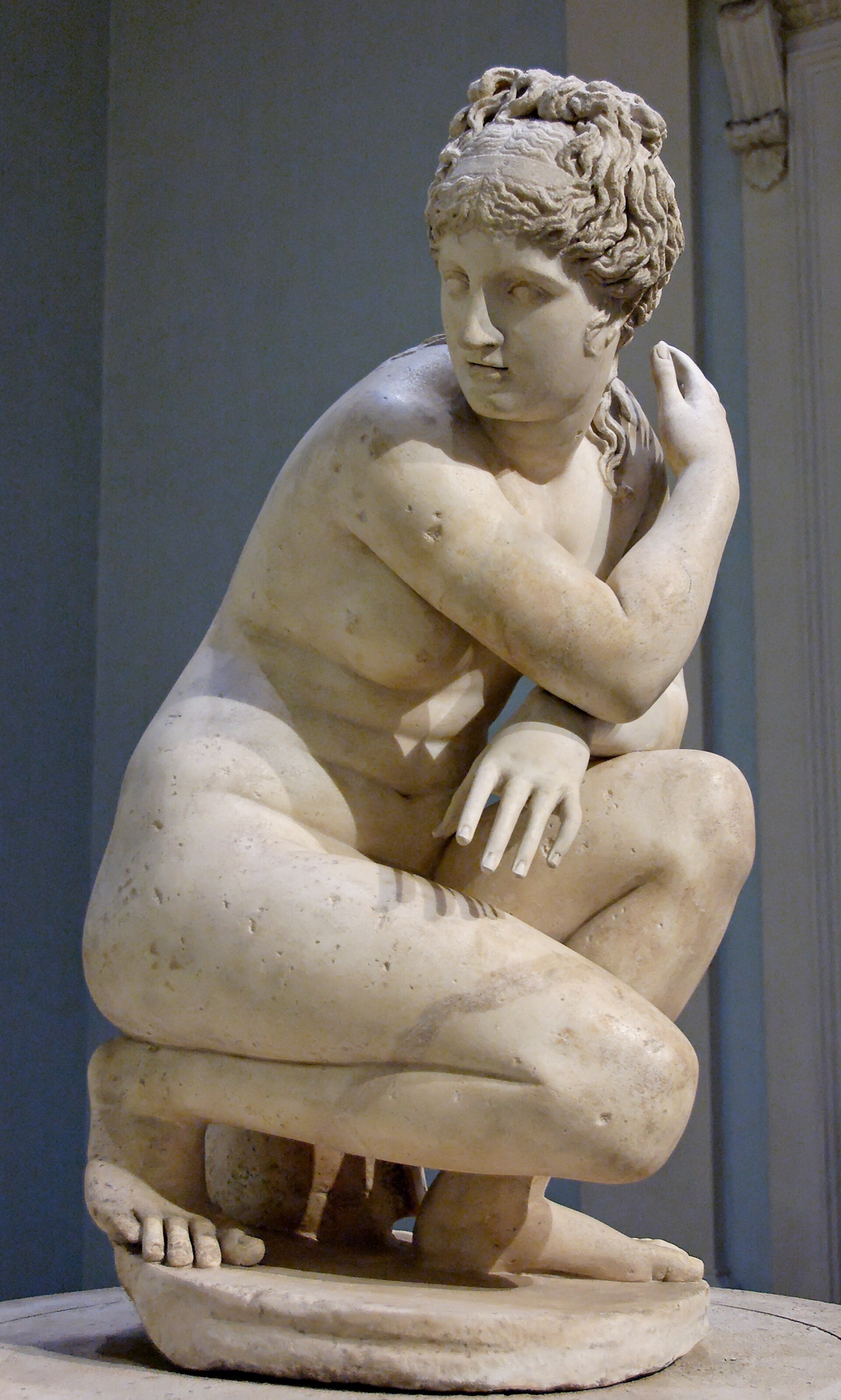
The Lely Venus is a Roman marble statue of the goddess Venus. It was sculpted in the second century CE, probably as a version of a Greek statue from the Hellenistic period (323–30 BCE). It is an example of the Crouching Venus type, which developed from the Knidian Aphrodite type sculpted by the Athenian Praxiteles around 350 BCE, and is characterised as a more sensual and sexualised development of earlier poses in which Venus, or her Greek counterpart Aphrodite, had been depicted.
The sculpture is approximately 112 centimetres (44 in) in height, and set on an ovoid base. It has remained mostly intact since antiquity, apart from restorations to the lower parts of both arms. From some time after 1502, it was owned by the Gonzaga ruling family of the Italian city of Mantua. It has been credited as an influence on several Renaissance and early modern artists active in Italy, including Raphael, Marcantonio Raimondi, and the Flemish Peter Paul Rubens, who painted several figures, including Venus herself, in the pose of the statue.
In 1629, the statue was sold to Charles I of England, along with several other artworks and antiquities from the Gonzaga collection. After Charles's execution in 1649, it was sold to Robert Houghton, formerly the king's brewer, to pay debts owed to him by the Crown, and it came into the possession of the painter Peter Lely. It was returned to the Royal Collection in 1682, after Lely's death, and displayed in the Palace of Whitehall. It was saved from the fire that destroyed most of the palace in 1698, but stolen afterwards; it returned to royal possession in 1702. The statue was moved to Windsor Castle in 1902, and lost at some point afterwards. Following its rediscovery in the 1950s, it was placed on permanent loan to the British Museum in 1963. It has since featured in exhibitions at the British Museum, at the National Gallery, and at the Ashmolean Museum at the University of Oxford.
The Crouching Venus type
The Lely Venus is an example of the "Crouching Venus" or "Crouching Aphrodite" type. The Crouching Venus was a style of statue of the Graeco-Roman goddess Venus (equivalent to the Greek Aphrodite) depicting her in a crouched position, often in the act of bathing. Images of nude female figures, including goddesses, are known in this position from the sixth century BCE, though life-size versions of Aphrodite in this position are known only from the Hellenistic period (323–30 BCE) and onwards. Art historians mostly date the origin of the Crouching Aphrodite to the third century BCE, though Andreas Linfert dates it to the middle of the second century BCE. The art historian Geoffrey Waywell calls the Lely Venus "arguably the finest version of this much copied statue type".
The Crouching Aphrodite was a development of the Knidian Aphrodite type, or Venus Pudica ("Venus Ashamed"), first sculpted by the Athenian Praxiteles around 350 BCE. It bears similarities to the standing Capitoline Aphrodite type, a descendant of the Knidian type known from Roman versions of Hellenistic sculptures, and may have been a development of it. In the early twentieth century, the art historian Gerhard Krahmer argued that the archetype of the form was a sculpture made by a sculptor named Diodalsas for Nicomedes I of Bithynia (d. c. 247 BCE); modern scholars reject this view.
The Crouching Venus form was widely adapted and imitated by sculptors of the Italian Renaissance, including Pier Jacopo Alari Bonacolsi ("L'Antico), Andrea Riccio and Giambologna. It was also used, particularly in the first half of the sixteenth century, as inspiration for paintings, prints and drawings, though this trend declined after 1550 and, in the words of the art historian Selma Hoyo, "an esoteric and empty cliché" by the last third of the century. It remained a highly visible fixture of European art into the nineteenth century.
The art historian Christine Havelock suggests that it made "a more outspoken statement about the ripened female body" than standing types, via "the heavy weight of the pear-shaped body, the pendulous breasts, and the ample rolls of flesh around the abdomen". The classicist Sophie Schoess characterises it as "a statue type that simultaneously seduces the viewer and holds them at bay".
Description
The Lely Venus is a marble statue posed in a crouched position, in or around the act of bathing. The figure's head is turned to the right; its right arm is lifted towards the head, as if in the act of adjusting its hair, while the left arm is rested on its left thigh. The statue is approximately 112 centimetres (44 in) in height, 43 centimetres (17 in) in width, and 58 centimetres (23 in) in depth. It is set on an ovoid base, approximately 86 centimetres (34 in) in circumference, and weighs around 600 kilograms (1,300 lb). It is similar to another Crouching Venus, held by the National Archaeological Museum, Naples; both are known by the traditional label of "Diodalsas type", after the sculptor once thought to have executed the Greek original. The art historians Ian Jenkins and Victoria Turner call it "a teasing composition" in which "from whichever viewpoint she is seen, some aspect of Aphrodite's sexuality is always tantalizingly obscured".
The statue is considered to date from the second century CE, during the Roman period, and to be based on an earlier Greek statue of the Hellenistic period, executed either in marble or bronze. The fingers of the right hand have been restored since antiquity, as has the left arm from the elbow downwards. The art historian Cornelius C. Vermeule has argued, by analogy with other examples of the Crouching Venus type, that the restoration of the right arm is incorrect, and that the hand should be set closer to the figure's hair. The statue is otherwise largely intact.
Modern history
The statue belonged to the Italian aristocrat and condottiere (mercenary commander) Guidobaldo da Montefeltro from the end of the fourteenth century until 1502; in that year, it was briefly owned by Cesare Borgia, who occupied Guidobaldo's duchy of Urbino on 21 June and seized his palace there, but soon returned to Guidobaldo. A little after 1502, Isabella d'Este, the marchioness consort of the Italian city of Mantua, purchased it for the city's Ducal Palace. It was recorded in the 1631 inventory of the collections of the city's Gonzaga rulers.
原文较长,这里只摘了前面一部分,摘自英文维基百科「Lely Venus」(暂时没有中文条目,下面是英文原文),按 CC BY-SA 4.0 使用,去掉了参考文献、外部链接等尾部小节和表格,其余文字未作改动。
相关词条
相关作品