艺廊
作品介绍
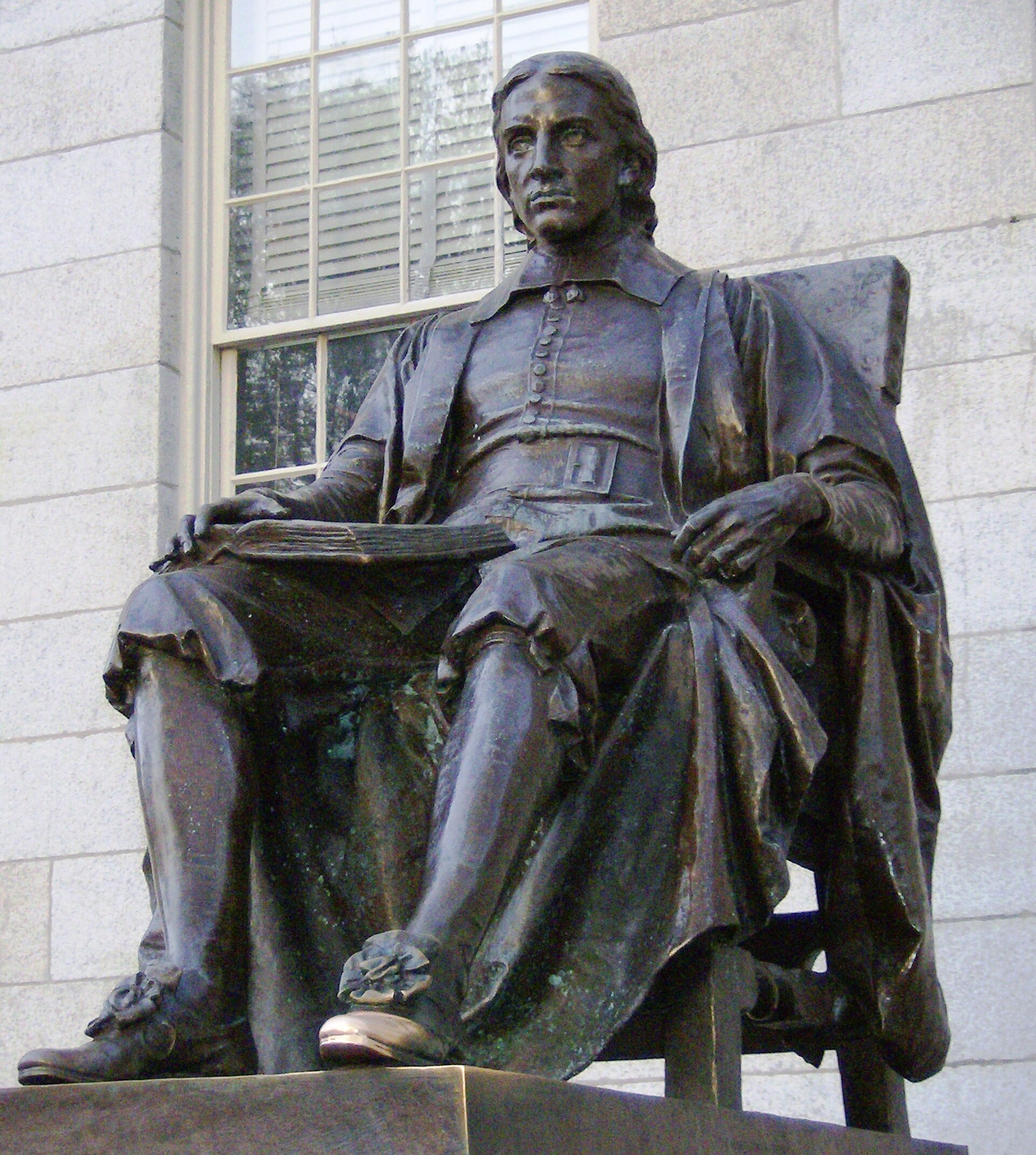
John Harvard is an 1884 sculpture in bronze by Daniel Chester French at Harvard University in Cambridge, Massachusetts. It honors clergyman John Harvard (1607–1638), whose substantial deathbed
bequest to the
"schoale or Colledge"
recently undertaken by the Massachusetts Bay Colony was so gratefully received that the Colony resolved
"that the
Colledge
agreed upon formerly to
bee
built at
Cambridg shalbee
called Harvard
Colledge."
There being nothing to indicate what John Harvard had looked like, French took inspiration from a Harvard student collaterally descended from an early Harvard president.
The statue's inscription—JOHN HARVARD • FOUNDER • 1638—is the subject of an arch polemic
traditionally recited for visitors,
questioning whether John Harvard justly merits the honorific founder.
According to a Harvard official, the founding of the college was not the act of one but the work of many, and
John Harvard is therefore considered not the founder, but rather a founder, of the school, though the timeliness and generosity of his contribution have made him the most honored of these.
Tourists often rub the toe of John Harvard's left shoe for luck in the mistaken belief that doing so is a Harvard student tradition.
Composition
The New York Times described the statue at its unveiling:
The young clergyman is represented sitting, holding an open [book] on his knee. The costume is the simple clerical garb of the seventeenth century ... low shoes, long, silk hose, loose knee breeches, and a tunic belted at the waist, while a long cloak, thrown back, falls in broad, picturesque folds.
John Harvard's gift to the school was £780 and—perhaps more importantly[M]—his 400-volume scholar's library:
Partly under the chair, within easy reach, lie a pile of books.
That he had died of tuberculosis, at about age thirty,
was one of the few things known about John Harvard at the time of the statue's composition; as dedication orator George Edward Ellis put it:
Gently touched by the weakness which was wasting his immature life, he rests for a moment from his converse with wisdom on the printed page, and raises his contemplative eye to the spaces of all wisdom.
Historian Laurel Ulrich suggests that John Harvard's general composition may have been inspired by Hendrik Goltzius' engraving of Clio (the Greek muse of history), and that the figure's collar, buttons, tassel, and mustache may have been taken from a portrait of Plymouth Colony Governor Edward Winslow.
History
On June 27, 1883,
at the Commencement Day dinner of Harvard alumni a letter was read[M]
from "a generous benefactor, General Samuel James Bridge, an adopted alumnus of the college":
To the President and Fellows of Harvard College.Gentlemen, — I have the pleasure of offering you an ideal statue in bronze, representing your founder, the Rev. John Harvard, to be designed by Daniel C. French of Concord ... I am assured that the same can be in place by June 1, 1884.[M]
Bridge specified an "ideal" statue because there was then (as now)
nothing to indicate what John Harvard had looked like;
thus when French began work in September he used Harvard student Sherman Hoar as inspiration for the figure's face.
"In looking about for a type of the early comers to our shores," he wrote, "I chose a lineal descendant of them for my model in the general structure of the face. He has more of what I want than anybody I know."
(Through his father Ebenezer Rockwood Hoar—chairman[M] of Harvard's Board of Overseers—Sherman Hoar was descended from a brother of Harvard's fourth president Leonard Hoar,
as well as from Roger Sherman, a signer of the United States Declaration of Independence and the United States Constitution.)
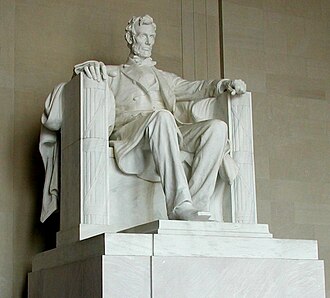
The commission weighed heavily on French even as the figure neared completion. "I am sometimes scared by the importance of this work. It is a subject that one might not have in a lifetime," wrote the sculptor—who thirty years later would create the statue of Abraham Lincoln for the Lincoln Memorial—"and a failure would be inexcusable. As a general thing, my model looks pretty well to me, but there are dark days."
French's final model was ready the following May and realized in bronze by the Henry-Bonnard Bronze Company over the next several months.
The cost was reportedly more than $20,000 (equivalent to $700,000 in 2025).
The statue was installed—"looking wistfully into the western sky", said Harvard president
Charles W. Eliot[M]—at
the western end of Memorial Hall on the triangular city block then known as the Delta.
At its October 15, 1884 unveiling[M] Ellis gave
"a singularly felicitous address, telling the story of the life of John Harvard, who passes so mysteriously across the page of our early history."
In 1920 French wrote
to Harvard president Abbott Lawrence Lowell desiring that the statue be relocated; in 1924
it was moved from Memorial Hall (then the college dining hall—a
Harvard Lampoon drawing showed John Harvard dismounting his plinth, chair in tow, and holding his nose because he "couldn't stand the smell of 'Mem' any longer")
to its current location on the west side of Harvard Yard's University Hall, facing Harvard Hall, Massachusetts Hall, and the Johnston Gate.
Later that year the Lampoon imagined the frustrations of the metallic, immobile John Harvard surrounded by Harvard undergraduates—
Great men arise / Before my eyes / From yonder pile I foundedWhile I must sit / Quite out of it / My jealousy unbounded
—though twelve years later David McCord portrayed the founder as satisfied in his stationarity:
"Is that you, John Harvard?" / I said to his statue."Aye, that's me," said John, / "And after you're gone."
A photograph of the statue appeared on the cover of the May 5, 1941 issue of Life magazine.
Sometime in the 1990s tour guides began encouraging visitors to emulate a "student tradition"—nonexistent—of rubbing the toe of John Harvard's left shoe for luck, so that while the statue as a whole is darkly weathered the toe now "gleams almost throbbingly bright, as though from an excruciating inflammation of the bronze."
原文较长,这里只摘了前面一部分,摘自英文维基百科「Statue of John Harvard」(暂时没有中文条目,下面是英文原文),按 CC BY-SA 4.0 使用,去掉了参考文献、外部链接等尾部小节和表格,其余文字未作改动。
相关词条
相关作品