艺廊
作品介绍
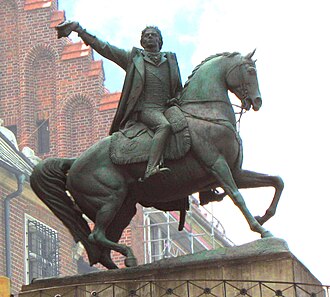
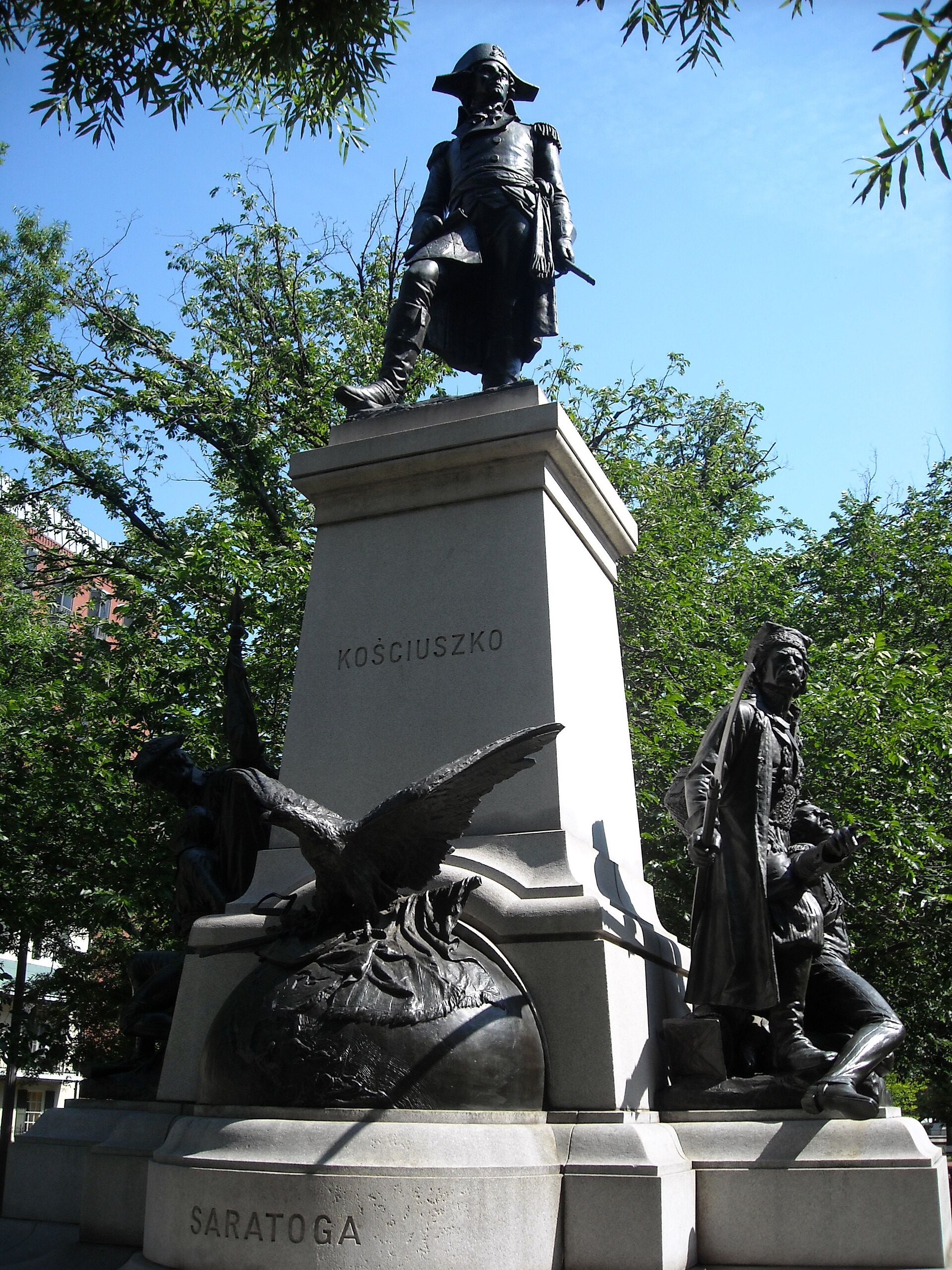
Brigadier General Thaddeus Kościuszko is a bronze statue honoring Polish military figure and engineer Tadeusz Kościuszko. The sculpture was dedicated in 1910, the third of four statues in Lafayette Square, Washington, D.C., to honor foreign-born heroes of the American Revolutionary War. Born in the Polish–Lithuanian Commonwealth in 1746, Kościuszko later received education at a Jesuit school before attending the Corps of Cadets in Warsaw. He later traveled to France where he studied in military academy libraries and adopted views of human liberty during the Age of Enlightenment. He moved to the Thirteen Colonies in 1776, where the war with the Kingdom of Great Britain had already begun. Kościuszko served as an engineer in the Continental Army, earning the praise of his superiors, including General George Washington.
After his important assistance during the war, Kościuszko traveled back to his homeland, where he led the Kościuszko Uprising against Prussia and the Russian Empire. He was unsuccessful and spent time in prison for two years. He was freed on the condition he return to the United States, which he did in 1797. He returned to Europe the following year using an alias, and died in Switzerland in 1817.
In the early 1900s, the Polish National Alliance asked the U.S. Congress if a memorial to Casimir Pulaski could be erected in Lafayette Square. President Theodore Roosevelt preferred a statue of Kościuszko, and the Pulaski statue was installed nearby. After a competition amongst sculptors, Roosevelt's favorite pick, Antoni Popiel, was chosen to design the statue. It was completed in 1908 and the base statues, which are on all sides of the memorial, completed by 1909. It was dedicated on the same day the equestrian statue of Casimir Pulaski was unveiled. Approximately 15,000 Polish Americans attended the ceremonies, where President William Howard Taft spoke.
Kościuszko's statue is one of 14 American Revolution Statuary in Washington, D.C., that were collectively listed on the National Register of Historic Places in 1978 and the District of Columbia Inventory of Historic Sites the following year. In addition, the statue is a contributing property to the L'Enfant Plan and the Lafayette Square Historic District, a National Historic Landmark. There are many other statue and memorials to Kościuszko located throughout the country, and a replica of the statue in Washington, D.C., stands in Warsaw.
History
Biography
Tadeusz Kościuszko, born Andrzej Tadeusz Bonawentura Kościuszko, was born in 1746 near Kosava, Polish–Lithuanian Commonwealth. His father, who had minor landholdings, died when Kościuszko was a young teenager. He was sent to receive education at a Piarist school and later attended the Corps of Cadets in Warsaw, where Kościuszko was promoted to captain. After leaving the Corps of Cadets, he traveled to France and attended the Royal Academy of Painting and Sculpture.
While in Paris, Kościuszko also studied in military academy libraries, and became a strong believer in human liberty during the Age of Enlightenment. Recalling his time while in France and other countries, Kościuszko stated: "During the five years of my life spent in foreign countries, I have endeavored to master those arts which pertain to solid government, aiming at the happiness of all, also economics and military art; I earnestly tried to learn this, inasmuch I had a natural passion for these things."
After briefly returning to his homeland, Kościuszko came back to France before moving to the Thirteen Colonies in 1776, a few months before the United States Declaration of Independence was signed. Although he had received some military training earlier in his life, Kościuszko was eager to assist the Continental Army. He was commissioned a colonel of the army's engineer division. In 1777, Kościuszko joined General Horatio Gates who was fighting in the Northern theater, and who wrote to another officer a letter praising Kościuszko's skills. His engineering skills were put to use at Fort Ticonderoga, Mount Independence, and during the Battles of Saratoga. General George Washington praised Kościuszko's skill after the latter. The following year Kościuszko assisted with engineering and building of defenses at West Point.
When Gates was stationed to the Southern theater, Washington agreed to let him bring along Kościuszko. General Nathanael Greene and other officers considered Kościuszko to be one of the Army's best engineers. After assisting with various campaign in the South, Kościuszko returned to New York with Greene, and in 1783, became one of the founders of the Society of the Cincinnati. Following the defeat of the Kingdom of Great Britain, Kościuszko was promoted to brigadier general on the recommendation of Washington.
After the war, Kościuszko returned to Poland, where he spent a few years in retirement. This ended when he assisted in leading the Kościuszko Uprising against Prussian and the Russian Empire's influences on the Commonwealth. The Polish were defeated and Kościuszko spent two years in a Russian prison. Sick and frail, he was released on the condition he return to the United States. He reached the U.S. in 1797, where he stayed for one year. He returned to Europe under an alias and died in Switzerland in 1817.
Memorial
In the 1890s, plans were made to erect statues in Lafayette Square honoring foreign heroes of the American Revolutionary War. The first one was installed in 1891 and second in 1902. Soon thereafter, the Polish National Alliance (PNA) requested to the U.S. Congress the installation of an equestrian statue of Casimir Pulaski. President Theodore Roosevelt responded "that the very patriotic offer of the Polish organizations be accepted," but that the statue to be installed in Lafayette Square be one of Kościuszko. Funding for an equestrian statue of Pulaski was approved the following year.
There was a design competition held for the Kościuszko statue, with 20 participants submitting models. Roosevelt took great interest in the competition and his opinion that Polish sculptor Antoni Popiel should win played a large role in his selection.……
原文较长,这里只摘了前面一部分,摘自英文维基百科「Statue of Tadeusz Kościuszko (Washington, D.C.)」(暂时没有中文条目,下面是英文原文),按 CC BY-SA 4.0 使用,去掉了参考文献、外部链接等尾部小节和表格,其余文字未作改动。