艺廊
作品介绍
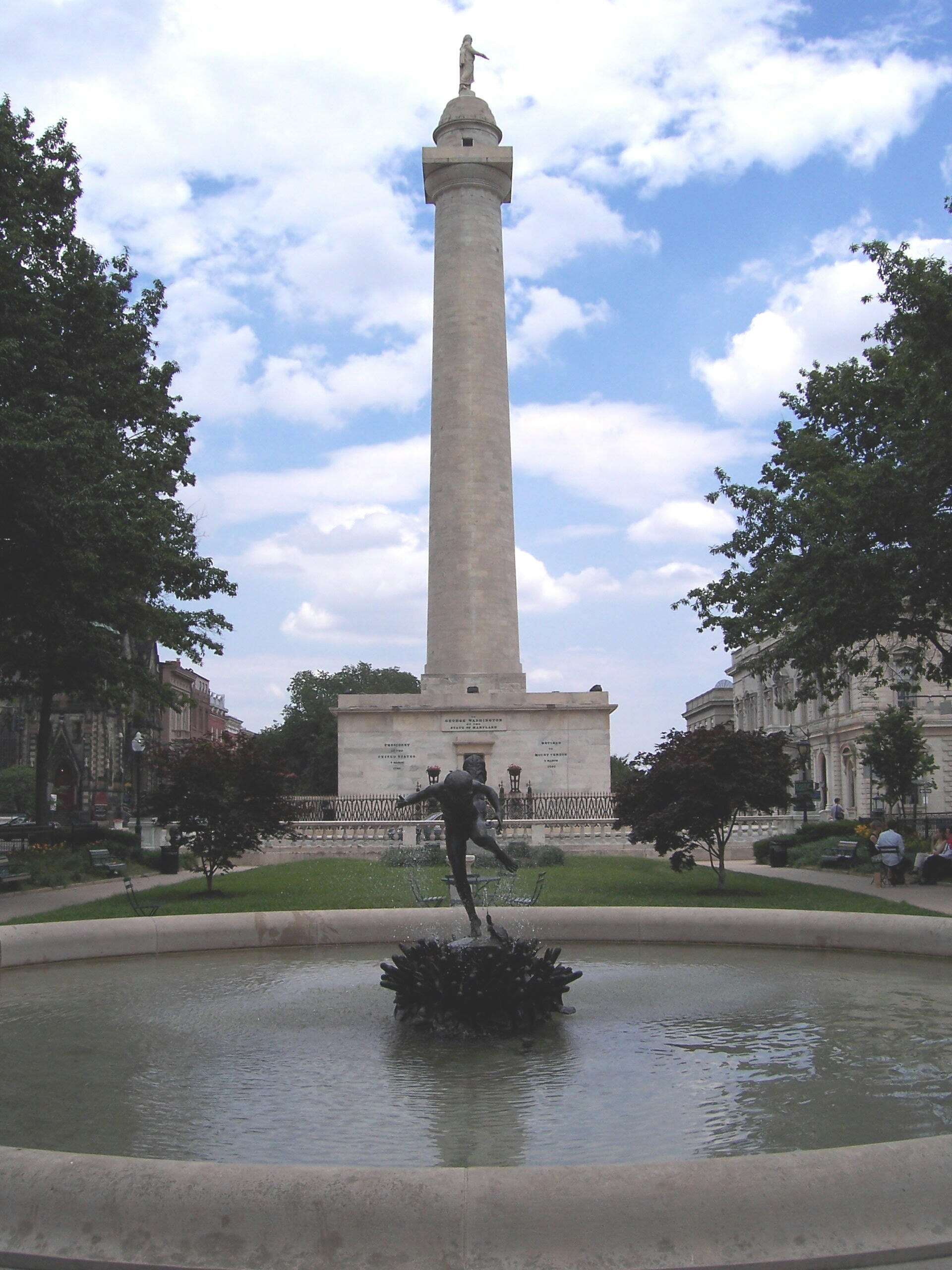
华盛顿纪念碑(Washington Monument)位于美国马里兰州巴尔的摩市中心以北的弗农山-贝尔维迪尔街区(Mount Vernon-Belvedere),弗农山广场(Mount Vernon Place)和华盛顿广场 (Washington Place)十字中心的城市广场。这是第一个纪念乔治·华盛顿 (1732–1799)的重要纪念碑,用白色大理石建造,高178英尺8英寸(54.46米)。
历史
华盛顿纪念碑于1815年开工建造,完成于1829年,是一根宏伟的多立克圆柱,由美国建筑师罗伯特米尔斯(Robert Mills,1781–1855)设计,他后来又设计了华盛顿哥伦比亚特区国家广场(National Mall)的华盛顿纪念碑。
华盛顿纪念碑位于弗农山广场公共广场的核心,那里也是1971年弗农山广场国家历史地标区的中心。 这个历史区又位于弗农山街区以及巴尔的摩国家遗产区(Baltimore National Heritage Area)内。
摘自维基百科「华盛顿纪念碑 (巴尔的摩)」,按 CC BY-SA 4.0 使用,繁体已转简体,去掉了参考文献、外部链接等尾部小节和表格,其余文字未作改动。
中文条目比较短,展开看英文维基百科的条目(英文原文)
The Washington Monument is the centerpiece of intersecting Mount Vernon Place and Washington Place, an urban square in the Mount Vernon-Belvedere neighborhood north of downtown Baltimore, Maryland. It was the first major monument to honor George Washington (1732–1799).
History
The Monument, a colossal landmark column, was designed by American architect Robert Mills (1781–1855), who also designed the later Washington Monument on the National Mall in Washington, D.C. Construction began in 1815 on land donated by Colonel John Eager Howard (1752–1827), from his extensive "Belvidere" estate just north of Baltimore Town, and the masonry work was completed by 1829. The 178 foot, 8 inch doric column holds a ground-floor gallery offering digital exhibits about the construction of the Monument, the history of Mount Vernon and Washington Places neighborhood and of the life and accomplishments of General and President George Washington. Climbing the 227 steps to the top provides a view of the city from the historic neighborhood where it is located. Its neighbors and cultural institutions within a few blocks include the Peabody Institute, the Walters Art Museum, the Central Library of the Enoch Pratt Free Library, the Maryland Center for History and Culture with its Enoch Pratt Mansion, the Basilica of the National Shrine of the Assumption of the Blessed Virgin Mary (old Baltimore Cathedral), and the Baltimore School for the Arts (public high school).
The glorification of Washington began long before his death at his Mount Vernon estate, along the Potomac River in Virginia in December 1799. The old Confederation Congress (1781–1789 under Articles of Confederation and Perpetual Union) had first announced a desire for a sculpture in his honor in 1783 after the end of the War and of General Washington's resigning of his commission and after his death, revived the idea of a memorial. However, these expressions of honor in the national capital floundered and would not be realized for decades. A monument honoring Washington in Baltimore, then an up-and-coming rising town, the third largest in North America, was first proposed as early as 1807, and in 1809 a Board of Managers of private citizens formed to commission and fund the monument intended to be erected in the old former colonial-era Courthouse Square on North Calvert Street, between East Lexington and East Fayette Streets (today's location of the Battle Monument Square, constructed simultaneously 1815–1822). In 1810, the first lottery authorized by the General Assembly of Maryland, was held. In 1813, an architectural competition was announced with a $500 prize to design and build the Monument at a cost of $100,000. Mills's design was chosen in 1814, the architect having taken pains to demonstrate to the Board of Managers that he was the first native born American with architectural training. The cornerstone was laid with great ceremony on Independence Day, July 4, 1815.
Mills's competition-winning designs included rich ornamentation, six iron galleries (balconies) dividing the exterior shaft into seven sections with text and images on each level highlighting important moments in Washington's life. An interior spiral staircase led to the top, where surmounting the column Washington was depicted in a quadriga. Concerns over the expense of this design, as well as its projected height caused later changes in not only its design, but location. Residents of old Courthouse Square feared the tall column would fall on their houses in the event of some natural disaster, so a new location was found in Howard's Woods, north of the city, on the "Belvidere" estate and with a 200 square feet of surrounding land for future public squares/parks, which was donated by noted leading citizen, American Revolutionary War hero, Col. John Eager Howard, (1752–1827) of the famed "Maryland Line" regiment of the Continental Army.
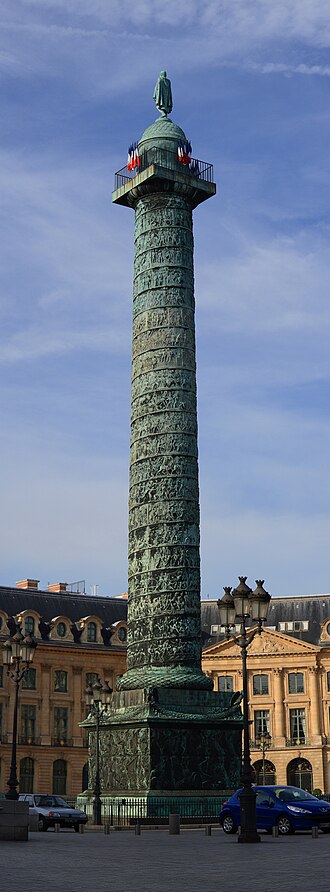
By the time the Monument's cornerstone was laid in Howard's Woods in 1815, Mills had significantly simplified the original elaborate design as depicted in an account of the Fourth of July ceremony. The design of the completed column is very similar to the Colonne Vendôme in Paris, which ultimately derived from Trajan's Column in Rome and was adopted in this time of the increasing popularity of Neoclassicism in American architecture.
节选,摘自英文维基百科「Washington Monument (Baltimore)」,按 CC BY-SA 4.0 使用。