艺廊
作品介绍
《龙虾电话》(英语:Lobster Telephone),又称《春药电话》(英语:Aphrodisiac Telephone)是西班牙超现实主义艺术家萨尔瓦多·达利于1936年为英国诗人、超现实主义艺术收藏家爱德华·詹姆斯所作的作品。达利在他的自传《萨尔瓦多·达利的秘密生活》中以戏谑的口吻透露该作品的创作动机:“我很好奇:为什么每次我在餐厅点烤龙虾,送来的却都不是烤电话?”
达利总共制作11组《龙虾电话》,分为彩色版本与灰白版本:彩色版本5组,其中有4组分别在英国伦敦达利宇宙展、泰特现代艺术馆、德国法兰克福通信博物馆、澳洲国立美术馆展出,还有1组为爱德华·詹姆斯基金会所有;灰白版本6组,分别于美国明尼阿波利斯美术馆、圣彼德斯堡达利博物馆、葡萄牙里斯本贝伦文化中心、南非约翰内斯堡艺廊、荷兰鹿特丹博伊曼斯·范伯宁恩美术馆展出。2018年12月,爱德华·詹姆斯基金会将其所有《龙虾电话》售予苏格兰国立美术馆,该作品目前在苏格兰国立现代艺术美术馆出展。
摘自维基百科「龙虾电话」,按 CC BY-SA 4.0 使用,繁体已转简体,去掉了参考文献、外部链接等尾部小节和表格,其余文字未作改动。
中文条目比较短,展开看英文维基百科的条目(英文原文)
Lobster Telephone (also known as Aphrodisiac Telephone) is a Surrealist object, created by Salvador Dalí in 1936 for the English poet Edward James (1907–1984), a leading collector of surrealist art. In his 1942 book The Secret Life of Salvador Dalí, Dalí wrote teasingly of his demand to know why, when he asked for a grilled lobster in a restaurant, he was never presented with a boiled telephone.
Description
The work is a composite of an ordinary working telephone and a lobster made of plaster. It is approximately 15 × 30 × 17 cm (6 × 12 × 6.6 inches) in size.
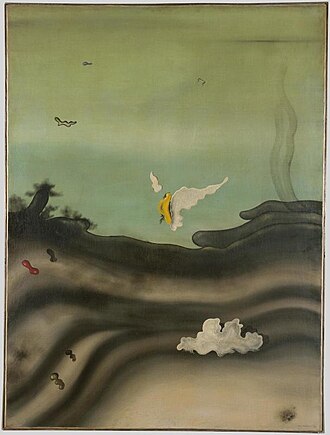
This is a classic example of a Surrealist object, made from the conjunction of items not normally associated with each other, resulting in something both playful and menacing. Dalí believed that such objects could reveal the secret desires of the unconscious. Lobsters and telephones had strong sexual connotations for Dalí. The telephone appears in certain paintings of the late 1930s such as Mountain Lake (Tate); further, the lobster appears in drawings and designs, usually associated with erotic pleasure and pain. For the 1939 New York World's Fair, Dalí created a multi-media experience entitled Dream of Venus, which consisted in part of dressing live nude models in "costumes" made of fresh seafood, an event photographed by Horst P. Horst and George Platt Lynes. A lobster was used by the artist to cover the female sexual organs of his models. Dalí often drew a close analogy between food and sex. In Lobster Telephone, the crustacean's tail, where its sexual parts are located, is placed directly over the mouthpiece.
In 1935, Dalí was commissioned by the magazine American Weekly to execute a series of drawings based on his impressions of New York. One drawing was given the caption 'NEW YORK DREAM - MAN FINDS LOBSTER IN PLACE OF PHONE'. In the Dictionnaire Abrégé du Surréalisme of 1938, Dalí contributed an entry under 'TÉLÉPHONE APHRODISIAQUE' which is accompanied by a small drawing of a telephone, its receiver replaced by a lobster surrounded by flies. A similar drawing is printed in The Secret Life of Salvador Dalí which contains the following:
"I do not understand why, when I ask for a grilled lobster in a restaurant, I am never served a cooked telephone; I do not understand why champagne is always chilled and why on the other hand telephones, which are habitually so frightfully warm and disagreeably sticky to the touch, are not also put in silver buckets with crushed ice around them. (...)"
"Telephone frappé, mint coloured telephone, aphrodisiac telephone, lobster-telephone, telephone sheathed in sable for the boudoirs of sirens with fingernails protected with ermine, Edgar Allan Poe telephones with a dead rat concealed within, Boecklin telephones installed inside a cypress tree (and with an allegory of death in inlaid silver on their backs), telephones on the leash which would walk about, screwed to the back of a living turtle ... telephones ... telephones ... telephones ..."
Present locations
Dalí produced four examples of the color version of his lobster telephone, currently displayed as part of the four following collections:
Museum für Kommunikation Frankfurt, Germany
National Gallery of Australia
Tate Modern, London
West Dean College, UK
Off-white versions
Dalí also produced an off-white version of his telephone. The six examples are displayed as following:
Salvador Dalí Museum in St. Petersburg, Florida
Centro Cultural de Belém, in Portugal
Johannesburg Art Gallery, in South Africa
Minneapolis Institute of Art, in the United States
Museum Boijmans Van Beuningen, in Rotterdam
Scottish National Gallery of Modern Art, in Edinburgh
相关词条
相关作品