 艺廊
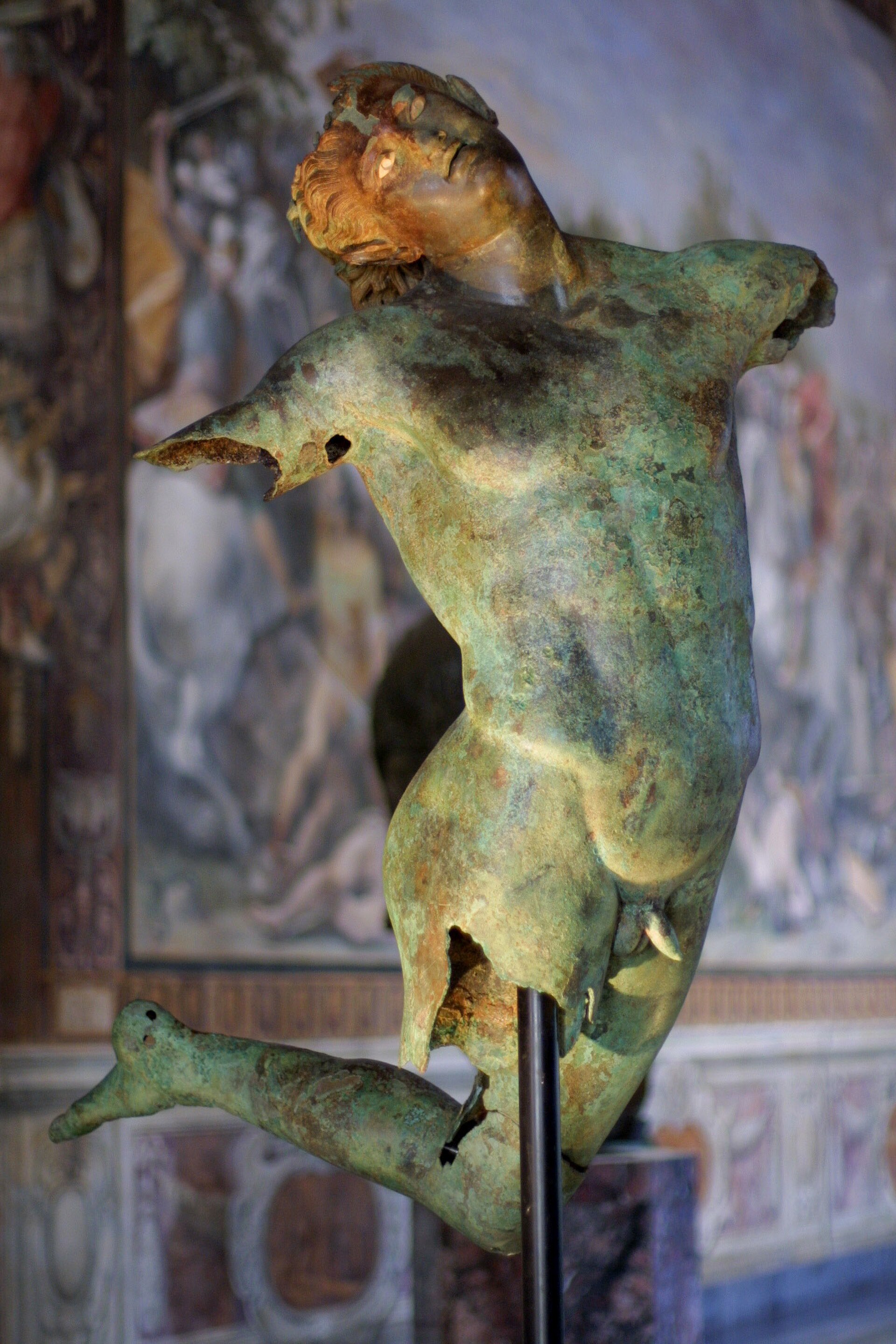
Dancing Satyr of Mazara del Vallo
- 年代
- 公元前 4 世纪
- 地点
- Museum of the Satyr
- 材质
- 青铜
The Dancing Satyr of Mazara del Vallo is a fragmentary over-lifesize ancient Greek bronze statue, of Magna Graecia whose refinement and rapprochement with the manner of Praxiteles has made it a subject of discussion. It is an example of a dancing satyr, a sculptural archetype in Hellenistic and Roman art. Another well-known example is the Faun from the House of the Faun, Pompeii.
In its present state it is 2 meters high (6 ft 6 in); originally it would have been about 2.4 meters (7 ft 10 in).
It was recovered from the sea floor off Sicily in 1998, and is now on display in the church of Sant'Egidio, Mazara del Vallo, Sicily. Though some have dated it to the 4th century BCE and said it was an original work by Praxiteles or a faithful copy, it is more securely dated either to the Hellenistic period of the 3rd and 2nd centuries BCE, or possibly to the Roman "Atticising" phase in the early 2nd…
摘自英文维基百科「Dancing Satyr of Mazara del Vallo」(CC BY-SA 4.0),暂时没有中文条目。