艺廊
作品介绍
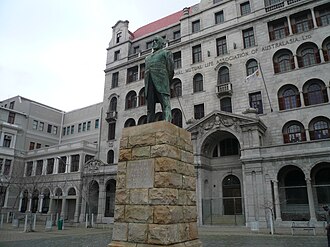
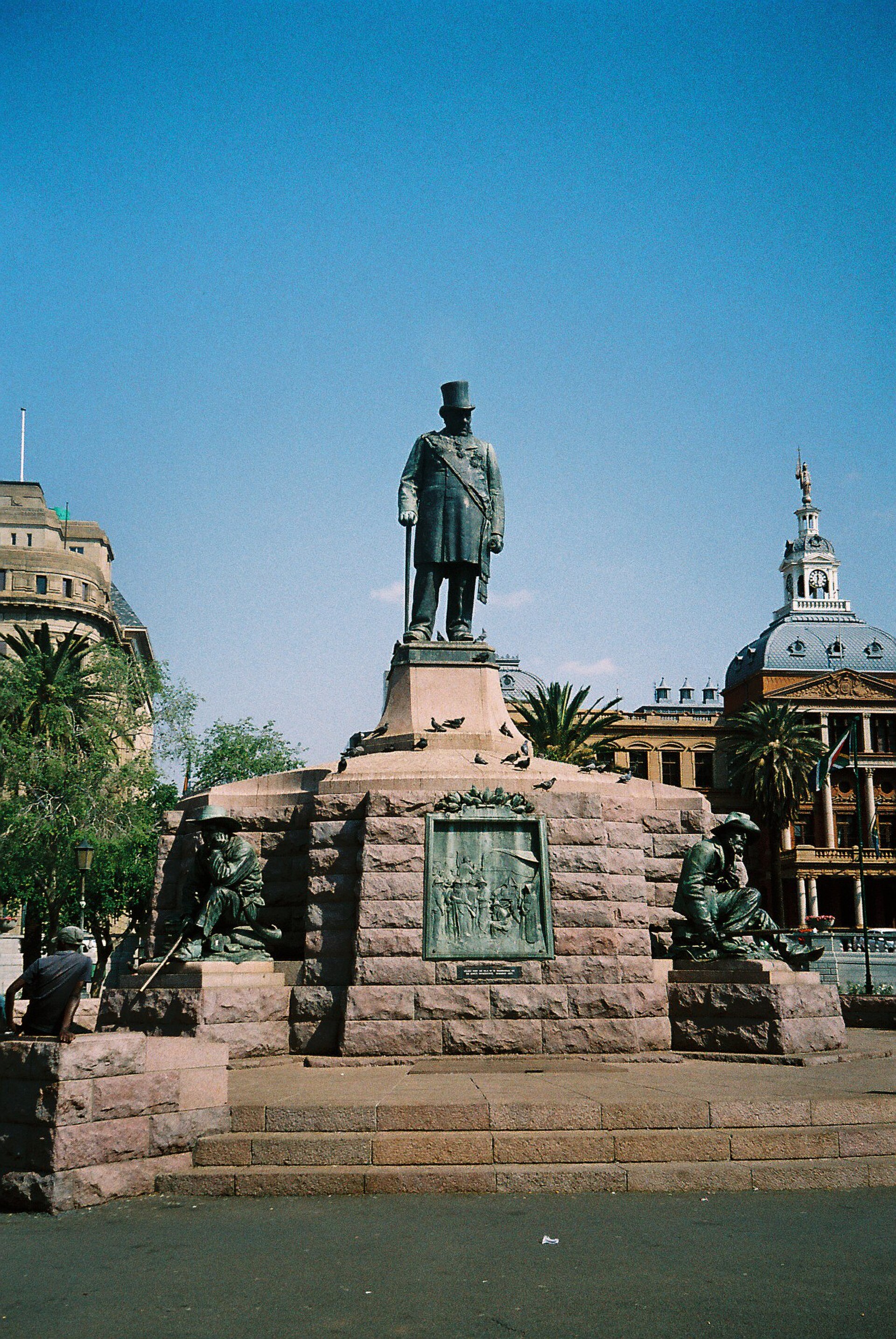
The Statue of Paul Kruger (Afrikaans: Krugerstandbeeld) is a bronze sculpture located in Church Square in Pretoria, South Africa. The statue depicts Paul Kruger, the Boer political and military leader and President of the South African Republic from 1883 to 1900, and four unnamed Boer soldiers. The Statue of Paul Kruger was sculpted in 1896 and was installed in its current location in Church Square in 1954.
History
The statue was first sculpted in 1896 by Anton Van Wouw following a commission by Sammy Marks, an industrialist who made his fortune in the South African Republic, who was an enthusiastic supporter of President Paul Kruger. The statue was first installed at Prince's Park and was then moved to a location outside Pretoria railway station. The statue portrays Paul Kruger wearing a top hat and presidential sash with a cane on a plinth. Along with Paul Kruger, the sculpture has four unnamed Boer soldiers at the corners below the main plinth. In 1956, the statue was moved to its current location at Church Square with a new pedestal and was unveiled there by Daniel François Malan.
Background
In August 1895, the Kruger government was unpopular among the uitlander mining managers and capitalists of Johannesburg. He has been described by some as autocratic, narrow-minded, and ruthless; rumor had it that the "oligarchy" (as the government was called then) would soon be overthrown in Pretoria.
Marks had his chief accountant draft a proposal to the President and Executive Council offering £10,000 to the city of Pretoria to build a marble statue of Kruger at a place of its subject's choice. However, Marks stipulated that "if possible," the statue should be commissioned directly from him, simply requiring whoever was interested to say in whose name and in what bank the money should be deposited. On 5 September Marks got his reply: the Government thanked him "for his rich gift" and informed him that Kruger deemed Burgers Park an ideal site and pledged for any surplus money to be spent to found the Pretoria Zoo. The money was deposited in a dedicated account at the National Bank of the South African Republic in the name of the Treasurer-General.
The Cabinet chiefs and other officials of the Republic debated the finer points of the statue. Dr. Nico Mansvelt, Superintendent of Education and an art expert, considered bronze preferable to marble given the latter's lesser ability to handle the Transvaal climate; Mansvelt also believed the Government should approve the order rather than leaving it up to Marks himself. Marks agreed and soon they settled on Van Wouw, a completely unknown figure in the art world.
Van Wouw and his design
The Dutchman Van Wouw came to the ZAR as a young man and settled in Pretoria, teaching drawing classes at the state gymnasium and a girls' school after a brief stint as a store clerk. An admirer of Kruger's like Marks, Van Wouw considered the President's tailcoat and top hat an inseparable part of him, something which critics would later lambaste Van Wouw for portraying. To them he replied: "Without them I would not recognize him! With the tailcoat and top hat, I would! "Van Wouw tried to portray the "everyday" Kruger: Kruger on his porch, with citizens at 6:00 in the morning seeking him out not necessarily to discuss politics but perhaps simply to seek advice on healing a sick cow or consolation on a recent loss. For Van Wouw, Kruger was the cornerstone of independence, and the monument should therefore reflect his "everyday" qualities.
His sketch model portrayed Kruger in formal state attire, standing quietly on the pedestal, in what Van Wouw considered a paternal attitude. Two of the four Boers portrayed below his statue were from the Voortrekker time and two were from Van Wouw's epoch, and each surveyed to one of the four cardinal directions. They were meant not to be trained soldiers but typical citizen militias: sedentary but watchful, surrounding Van Wouw's central figure and symbol of Kruger's position as father in the heart of his people and of the Republic's freedom. Marks and members of the Volksraad and Executive Council of the Republic came to view the sketch, which was approved.
On 7 October 1896, more than thirteen months after Marks' initial donation, he and Kruger agreed to have Van Wouw leave for Europe to supervise the work in France and Italy. He remained abroad until 1 April 1898, when he returned to Pretoria. In the meantime, he worked on the monument for £40 a month on a two-year deadline (along with reimbursement for forging and casting expenses). His family was also granted free travel to and from Europe, including work sites there. By December 1896, he was in Europe, first discussing his proposals with the Envoy of the Republic and experts on modeling and casting in the Netherlands. The Envoy, J. G. T. Beelaerts van Blokland, worried that the top hat would cast a shadow over Kruger's face and hide his features, to which Van Wouw held firm, explaining that it would be unthinkable for a Transvaal Boer such as Kruger to stand hat-less under the African sun. The Envoy's only contribution to the final work was a Bible quote on one side of the pedestal, namely Psalm 91:15-16:
He will call on me, and I will answer him; I will be with him in trouble, I will deliver him and honor him. With long life I will satisfy him and show him my salvation.
According to the Envoy, Kruger was partial to the verses, but Kruger was unhappy with praise to him given his belief that such should only go to God, therefore asking to substitute Psalm 105:4-5:
Look to the Lord and his strength; seek his face always. Remember the wonders he has done, his miracles, and the judgments he pronounced.
Due to the circumstances under which the monument was raised, this wish went unfulfilled and no text appeared on the pedestal.
The search for inspiration
When Van Wouw began modeling the Voortrekker figures under fire, he did not know what they looked in full regalia, unlike the familiar Kruger himself and the two modern Boers he simply showed as he had seen them since arrival, namely with a beard, a bandolier, and a Martini–Henry gun.……
原文较长,这里只摘了前面一部分,摘自英文维基百科「Statue of Paul Kruger, Church Square」(暂时没有中文条目,下面是英文原文),按 CC BY-SA 4.0 使用,去掉了参考文献、外部链接等尾部小节和表格,其余文字未作改动。