艺廊
作品介绍
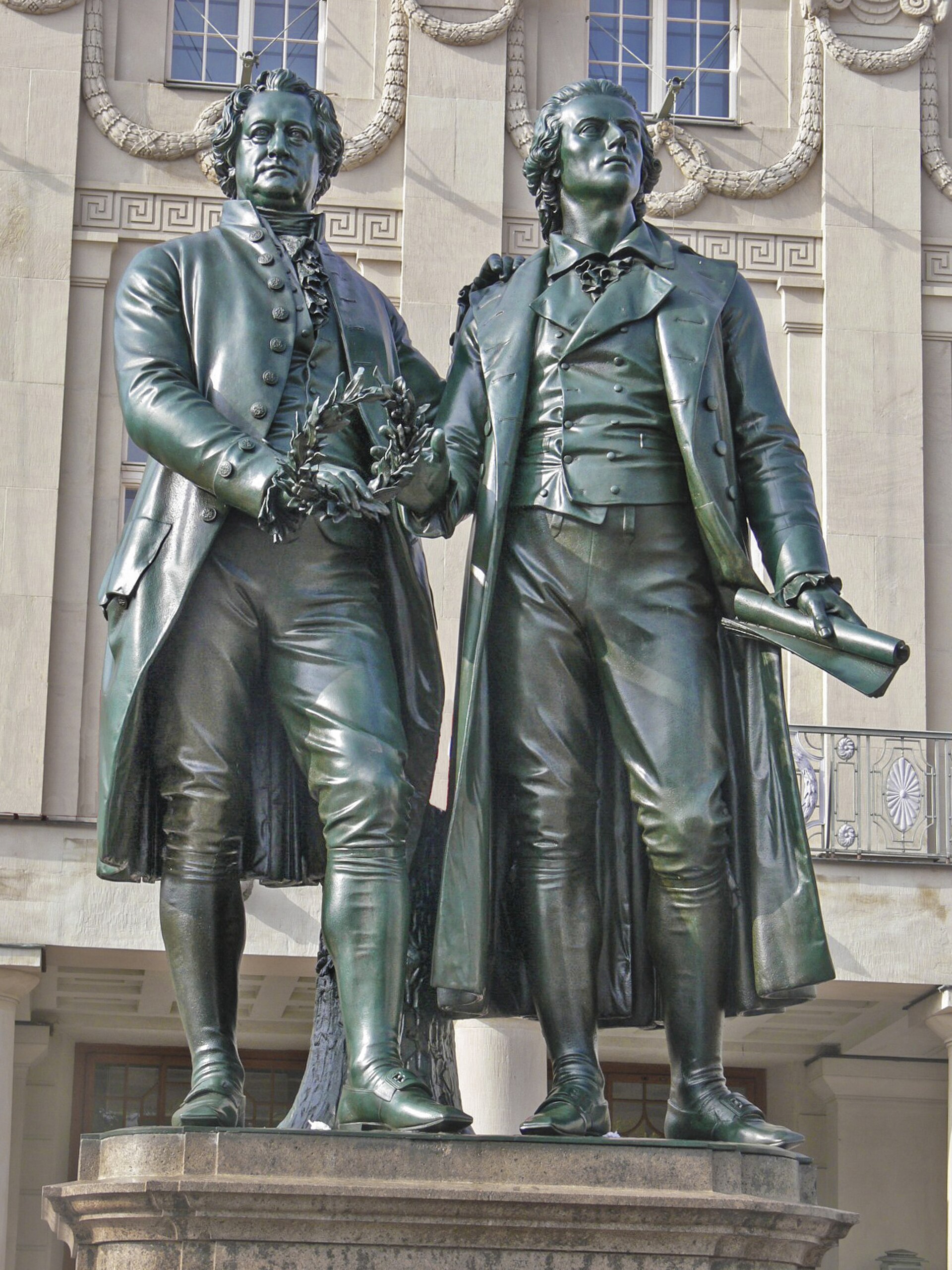
The original Goethe and Schiller Monument (German: Goethe-Schiller-Denkmal) is in Weimar, Germany. It incorporates Ernst Rietschel's 1857 bronze double statue of Johann Wolfgang von Goethe (1749–1832) and Friedrich Schiller (1759–1805), who are probably the two most revered figures in German literature. The monument has been described "as one of the most famous and most beloved monuments in all of Germany" and as the beginning of a "cult of the monument". Dozens of monuments to Goethe and to Schiller were built subsequently in Europe and the United States.
Goethe and Schiller had a remarkable friendship and collaboration that was "like no other known to literature or art." Both men had lived in Weimar, and were the seminal figures of a literary movement known as Weimar Classicism. The bronze figures of the Goethe–Schiller statue are substantially larger than life-size; notably, both are given the same height, even though Goethe was nearly 20 cm shorter than Schiller.
The figures were mounted on a large stone pedestal in front of the Court Theater that Goethe had directed, and that had seen premieres and countless performances of Schiller's plays. Goethe is on the left in the photograph, his left hand resting lightly on Schiller's shoulder. Goethe grasps a laurel wreath in his right hand, and Schiller's right hand is stretched out toward the wreath. Goethe wears the formal court dress of the era; Schiller is in ordinary dress.
Four exact copies of Rietschel's statue were subsequently commissioned by German-Americans in the United States for the Goethe–Schiller monuments in San Francisco (1901), Cleveland (1907), Milwaukee (1908), and Syracuse (1911). 65,000 people attended the dedication of the Cleveland monument. A fifth copy of reduced size was installed in Anting, China, in 2006; Anting New Town is a "German-themed" town near Shanghai that was developed around 2000.
The Weimar monument
The project of creating a Goethe–Schiller monument in Weimar was sponsored by Karl Alexander August Johann, the Grand Duke of the Saxe-Weimar-Eisenach Duchy, and by a citizen's commission. The dedication of the monument was planned to coincide with the centennial celebrations of the birth of the earlier Grand Duke Karl August, who had brought Goethe to Weimar in 1775. Goethe lived most of his adult life there, and Schiller the last six years of his life. The site for the monument was the city square that fronted the Court Theater (German: das Hoftheater) where Goethe was managing director from 1791 to 1815; Goethe later wrote that he had "tried to elevate the masses intellectually with Shakespeare, Gozzi, and Schiller". Goethe arranged for the theater to premiere Schiller's last four plays (Mary Stuart, The Bride of Messina, The Maid of Orleans, and William Tell). By the time of their monument's dedication in 1857, the theater had seen countless performances of all Schiller's plays.
Christian Daniel Rauch was invited to prepare a design for a double statue (German: Doppelstandbild); Rauch was perhaps the most prominent sculptor working in German-speaking Europe in the first half of the 19th century. Rauch's design has the two men clad in antique dress; while the convention of creating sculptures of heroic figures in antique dress was well established, it was rejected in this case. Ernst Rietschel, another prominent sculptor who had been Rauch's student, made a design with the two men in contemporary dress that was accepted, and a contract was signed with Rietschel in December 1852.
Rietschel needed four years to complete the full-size model for the statue. The actual casting in bronze was done remarkably quickly by Ferdinand von Miller at the Royal Foundry in Munich. The finished monument was dedicated on 4 September 1857, as part of the celebrations for the centenary of the birth of Grand Duke Karl August. Hans Pohlsander has written, "The monument was the first double statue on German soil, and was widely, and rightly, proclaimed a masterpiece."
The U.S. monuments
In 1895 in San Francisco, California, the Goethe–Schiller Denkmal Gesellschaft (Goethe–Schiller Monument Company) was formed for the purpose of raising a version of the Weimar Monument in Golden Gate Park. Instead of the Munich foundry used to cast the original statue, the foundry in Lauchhammer was contracted to make a new bronze casting. The molds were prepared from Rietschel's original forms at the Albertinum in Dresden; the work was supervised by Rudolf Siemering, a Berlin sculptor. The statue was installed on a granite pedestal and steps that closely copied those of the Weimar original. The monument was dedicated on 11 August 1901, with 30,000 people in attendance according to the souvenir book published shortly thereafter. The festivities continued throughout the day and evening.
Three additional monuments based on Rietschel's bronze were raised over the next decade. The Cleveland, Ohio monument in Wade Park was dedicated on 9 June 1907. Wilhelm II, the German Emperor, sent a congratulatory cable, to which the head of the Goethe–Schiller Memorial Committee responded, "Emperor Wilhelm, Berlin. Goethe–Schiller Memorial unveiled in presence of 65,000 persons. In this sacred hour American citizens of Cleveland of German origin respectfully thank Your Majesty for his good wishes." The Milwaukee, Wisconsin monument in Washington Park was dedicated on 12 June 1908 before 35,000 people. The bronze statues for the Cleveland and Milwaukee monuments had also been cast by the Lauchhammer foundry. The statue for the Syracuse monument is electrotyped copper, and not a bronze casting. It was sited in Schiller Park, which had been renamed in 1905 to honor the centennial of Schiller's death. The monument was dedicated on 15 October 1911.
All of the American monuments were sited in city parks, whereas the Weimar monument is in a city square. As can be seen from the antique postcards, the stonework of the San Francisco, Cleveland, and Syracuse monuments is similar to the Weimar original. The Syracuse monument is on a steep slope, and is distinguished by a formal stone stairway approaching the statue.……
原文较长,这里只摘了前面一部分,摘自英文维基百科「Goethe and Schiller Monument」(暂时没有中文条目,下面是英文原文),按 CC BY-SA 4.0 使用,去掉了参考文献、外部链接等尾部小节和表格,其余文字未作改动。