 艺廊
作品介绍
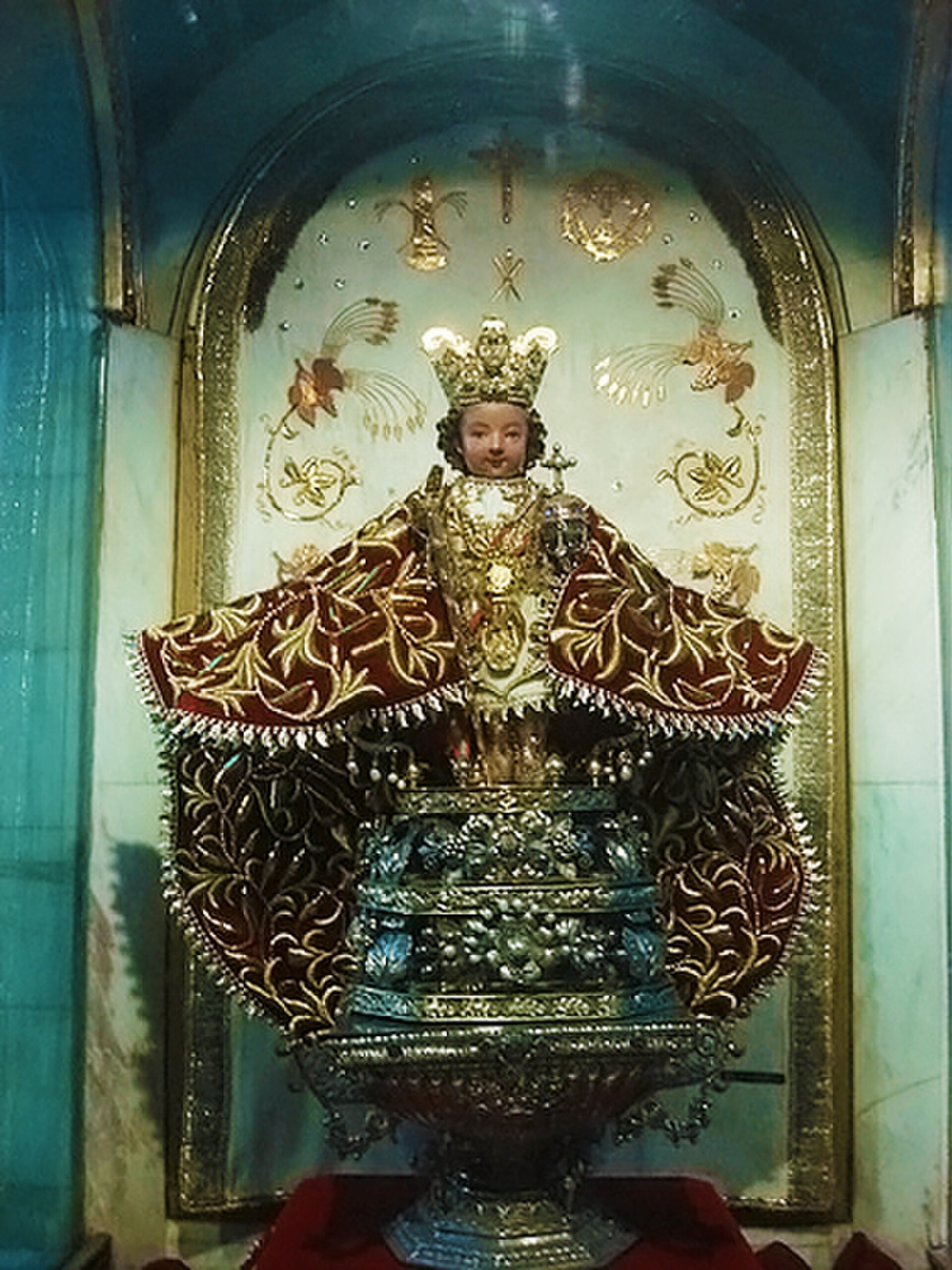
The Señor Santo Niño de Cebú (lit. 'Lord Holy Child of Cebu'), or simply the Santo Niño, is a Catholic title of the Child Jesus associated with a religious image widely venerated as miraculous by Filipino Catholics. It is the oldest Christian artifact in the Philippines, originally given as a gift by Ferdinand Magellan to Rajah Humabon and his wife and chief consort, Hara Humamay, on the occasion of their Christian baptism in 1521. The image is the only canonically crowned image of Jesus in the Philippines.
Description
The dark wood statue measures approximately 12 inches (30 cm) tall, and carved in the Flemish style. It depicts the Child Jesus, with a serene countenance, in the attitude and dress of a Spanish monarch. The statue bears imperial regalia, including a golden crown, Toisón de oro, globus cruciger, and various sceptres, wears fine vestments, and possesses jewelry mostly offered by devotees over several centuries.
The image is replicated in various parts of the country with different titles, and the Christ Child has become one of the most beloved and recognizable Filipino cultural icons. The annual dancing feast of Sinulog is held on the third Sunday of January every year in His honor. Today, the original image is permanently encased behind bulletproof glass inside its chapel within the Basilica del Santo Niño.
History
The Santo Niño de Cebú was originally produced by Flemish artisans, according to a hagiography, based on a vision of Teresa of Ávila, the 16th century Discalced Carmelite mystic.
In early 1521, a Spanish expedition ordered by Holy Roman Emperor Charles V and led by Ferdinand Magellan was on a voyage from Spain to find a westward route to the Spice Islands. After crossing the Atlantic and Pacific Oceans, on April 7, 1521, they landed in Limasawa, Southern Leyte, and met a local ruler named Raja Kulambu, who introduced him to Rajah Humabon, ruler of Cebu Island, and his chief consort, Hara Humamay. On April 14, Magellan presented them with three gifts: a bust of Christ as the Ecce Homo, an image of the Blessed Virgin Mary, and the Santo Niño as part of their baptism and strategic alliance.
As Humabon adopted the Catholic faith, he took the Christian name of "Carlos", after Charles I. Humamay was christened "Juana", after Joanna of Castile, Charles' mother. According to Antonio Pigafetta – Magellan's memoir writer, along with the ruler, about 500 males along with the Queen and 40 women were also converted by Father Pedro Valderrama. At the ceremony, Raja Kulambu of Limasawa also converted and was given the name Don "Juan", while his Muslim captain was named Don "Cristobal".
A few days after the mass baptism, Magellan undertook a war expedition on the behalf of the newly named King Carlos, attacking Mactan Island and burning down hamlets which resisted. The residents, led by Lapu-Lapu, defended against Magellan’s attack with force, and Magellan died on April 27 during the Battle of Mactan, about three weeks after he arrived in the Philippines. After Magellan's death, his Spanish colleagues left. The image of Christ was left behind but the locals still worshiped it, but in the native manner, a rite known as the Sinulog.
The next Spanish expedition arrived on April 27, 1565, led by Miguel López de Legazpi, again to gain a foothold for a colony to trade spices. He attempted a peaceful colonization, but these efforts were rejected. As a result, he opened fire on Cebu and burnt the coastal town down destroying 1,500 homes and possibly killing 500 people. In the ruins of this destruction, on April 28, the Spanish mariner Juan Camus found the image of the Santo Niño in a pine box. According to the local legend, the survival of the statue was seen as a sign of miracle by the colonizers, and ever since it has been believed to have miraculous powers.
The image of the Santo Niño is the oldest surviving Catholic relic in the Philippines, along with Magellan's Cross. A church to house Santo Niño was built on the spot where the image was found by Juan Camus. The church was originally made of bamboo and nipa palm, and is thought to be the oldest in the Philippines. The structure was destroyed several times and was finally rebuilt as a permanent structure using coral stone, which is the present basilica.
During World War II, Japanese forces bombed all of Cebu, including the basilica. A bomb fell in the church and greatly damaged the roof but, miraculously, did not explode. When Augustinian friars inspected the immediate aftermath, they found the Santo Niño had been hurled from the high altar, and was dangling by its cape caught on a nearby electric candle. After seeing the image displaced from the altar with the rest of the church in great disrepair, and for fear of more bombings in the vicinity, the friars decided to flee.
They sought refuge with the Redemptorist brothers at the Parish of Our Lady of Perpetual Help, (known locally as “Redemptorist Church”), and the friars hid the image in a metal vault beneath the icon of Our Lady for seven months. After the war, the friars removed the image from the vault for public veneration, and discovered its dark paint peeling off, revealing a lighter underpainting. The image was venerated with this fair complexion for some time, until it was repainted with a more brown complexion.
Pope Paul VI elevated the church to the rank of Minor Basilica on its 400th anniversary (Spanish: Basílica Menor del Santo Niño). As part of the Culmination for the 400th Commemoration of the Christianization of the Philippines, the image of the Santo Niño was canonically crowned. The basilica was declared a National Cultural Treasure of the Philippines as one of the highlights of the celebration of the 500 Years of Christianity in the Philippines and the 2021 Quincentennial Commemorations in the Philippines.
Name
The name "Santo Niño" was taken from the Spanish words santo ("holy") and niño ("child"). This Christological title is thus translated in Philippine English as "Holy Child".
In the Spanish translation of the New International Version, Luke 1:35 (the Annunciation of Mary) reads:
原文较长,这里只摘了前面一部分,摘自英文维基百科「Santo Niño de Cebú」(暂时没有中文条目,下面是英文原文),按 CC BY-SA 4.0 使用,去掉了参考文献、外部链接等尾部小节和表格,其余文字未作改动。