艺廊
作品介绍
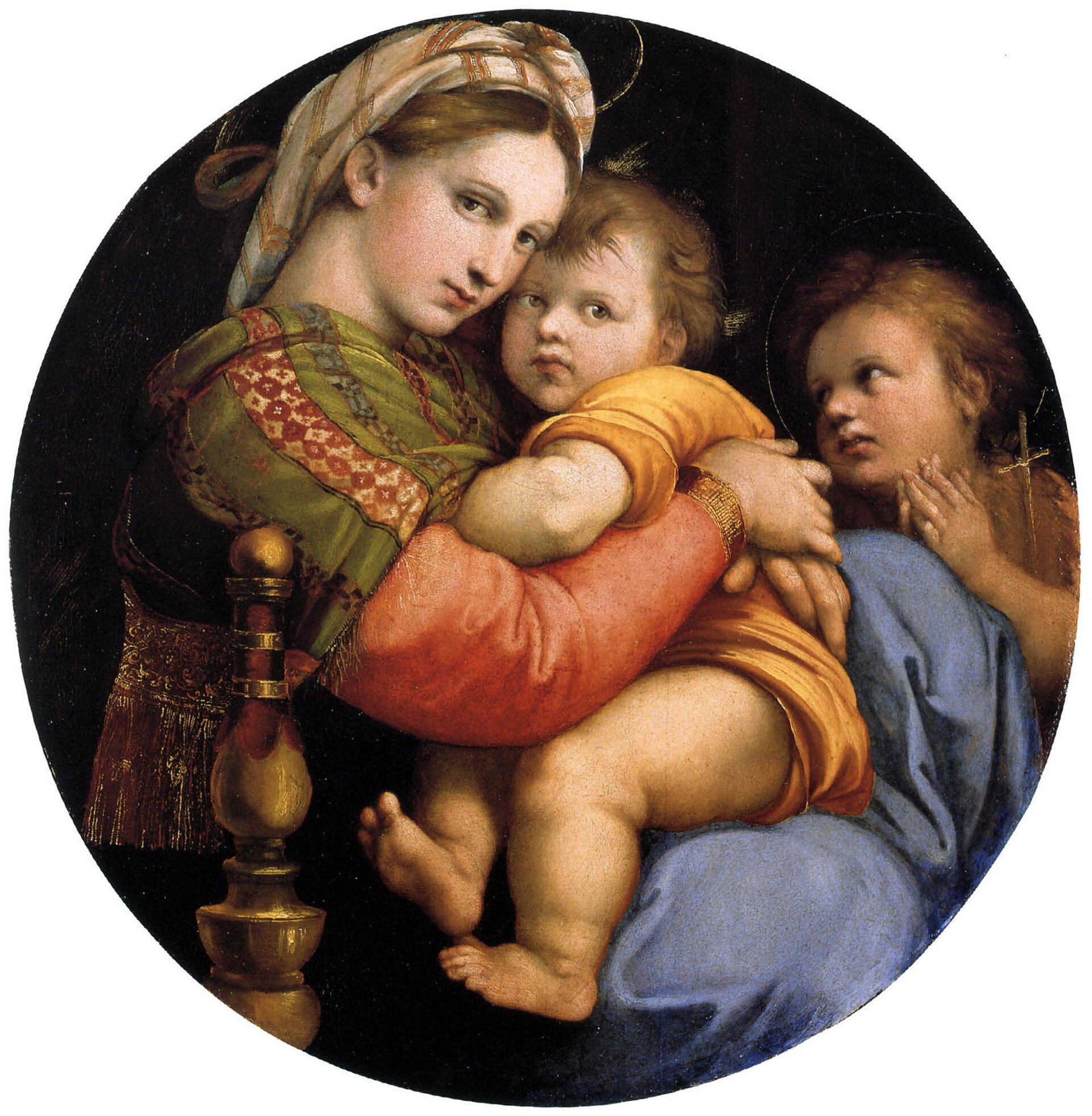
《椅中圣母》(意大利语:Madonna della seggiola)是意大利文艺复兴艺术大师拉斐尔的一幅木板油画,直径71厘米,绘制于1513-1514年,现藏于意大利佛罗伦萨的彼提宫。自 16 世纪以来,这幅画一直属于美第奇家族。
摘自维基百科「椅中圣母」,按 CC BY-SA 4.0 使用,繁体已转简体,去掉了参考文献、外部链接等尾部小节和表格,其余文字未作改动。
中文条目比较短,展开看英文维基百科的条目(英文原文)
The Madonna della Seggiola or The Madonna della Sedia (28" in diameter (71 cm)) is an oil on panel Madonna painting by the High Italian Renaissance artist Raphael, executed c. 1513–1514, and housed at the Palazzo Pitti Collection in Florence, Italy. Although there is documentation on its arrival to its current location, Palazzo Pitti, it is still unknown who commissioned the painting; however, it has been in the Medici family since the 16th century.
It depicts Mary embracing the Christ Child while sitting in a chair as the young John the Baptist devoutly watches. The Madonna della Sedia is one of the single most important of Raphael's Madonnas. The painting also showcases Raphael's use of the tondo form and his naturalistic approach to depicting the Madonna.
Description
The Madonna della Sedia is Raphael's most humanistic form of the Madonna. Throughout Raphael's life, this humanistic representation of the Madonna occupied his mind. The Madonna della Sedia is the incarnation of a realistic mother and child, representing human motherhood. Painted during his Roman period, this Madonna does not have the strict geometrical form and linear style of his earlier Florentine treatments of the same subject. The Madonna is portrayed subtly and naturalistically, including the drapery, her anatomy, and the movement of her body, as if it was a result of an immediate action. The Madonna della Sedia balanced simplification and detail with the treatment of her embroidered shawl, the directness of the figures and the touching of the two heads (Madonna and Christ child). Raphael dressed the Madonna in the Italian clothing of the time. Mary is depicted wearing a striped headdress, which falls down behind her back and compliments her richly colored ornamental dress with fringe.
The Madonna's image also shows less attention to careful selections, which takes the focus off refinement, and shifts it to more of a rapid representation of an observation or attitude. The Christ child and Mary are both in profile view in order to balance the composition, which resolved the issue of overcrowding. Mary is sitting in a position that is not easily replicated in reality, which allows the Christ child to sit comfortably, while balancing the figures in regards to the painting's round shape. The curvature of the two arms of Mary and Christ child in the foreground also lend themselves to a spherical form, which rounds out the composition. The chair dictates the outer limits of the composition and is the painting's namesake.
The colors play an important role in this painting, from the green embroidered garment to the cerulean blue or the juxtaposition of the Madonna's red sleeve with the Christ child's orange drapery, which adds an extra element of enrichment and a vibrancy to the color palette. The warmer colors seem to suggest the influence of Titian and Raphael's rival Sebastiano del Piombo.
Provenance
Unfortunately, the Madonna della Sedia's commission is undocumented despite it being created while Raphael was spending a relatively well-documented period of twelve years in Rome. The painting was painted during the same time Raphael was working on the frescoes in the Vatican Stanze and loggia of the Vatican, including the paintings Incendio del Borgo, Battle of Ostia, and Coronation of Charlemagne. Most of Raphael's commissions for this period were under the strict guidance of Pope Leo X (Giovanni di Lorenzo de' Medici), who was known to be one of Raphael's biggest patrons at the time. While under Leo's patronage, Raphael rarely got commissions from outside of the pope's immediate circle. Leo X was also the successor to Pope Julius II (Giuliano della Rovere) who was another major patron of Raphael and a central contributor to the High Renaissance. However, it has been speculated that the painting was painted for Leo X, which also connects the painting to the Medici family during the sixteenth century while in Rome. The chair's finial in the Madonna della Sedia is evidence that supports the idea that the painting could have been commissioned for Pope Leo X. The finial takes on the form of a round ball, similar to the Medici's heraldic symbol, the palle, which is also seen in Leo's coat of arms. On the other hand, the chair's finial could also be a symbol for Pope Julius II and his family's symbol, the Della Rovere oak acorn, further adding to the mystery of the unidentified patron.
节选,摘自英文维基百科「Madonna della Seggiola」,按 CC BY-SA 4.0 使用。