艺廊
作品介绍
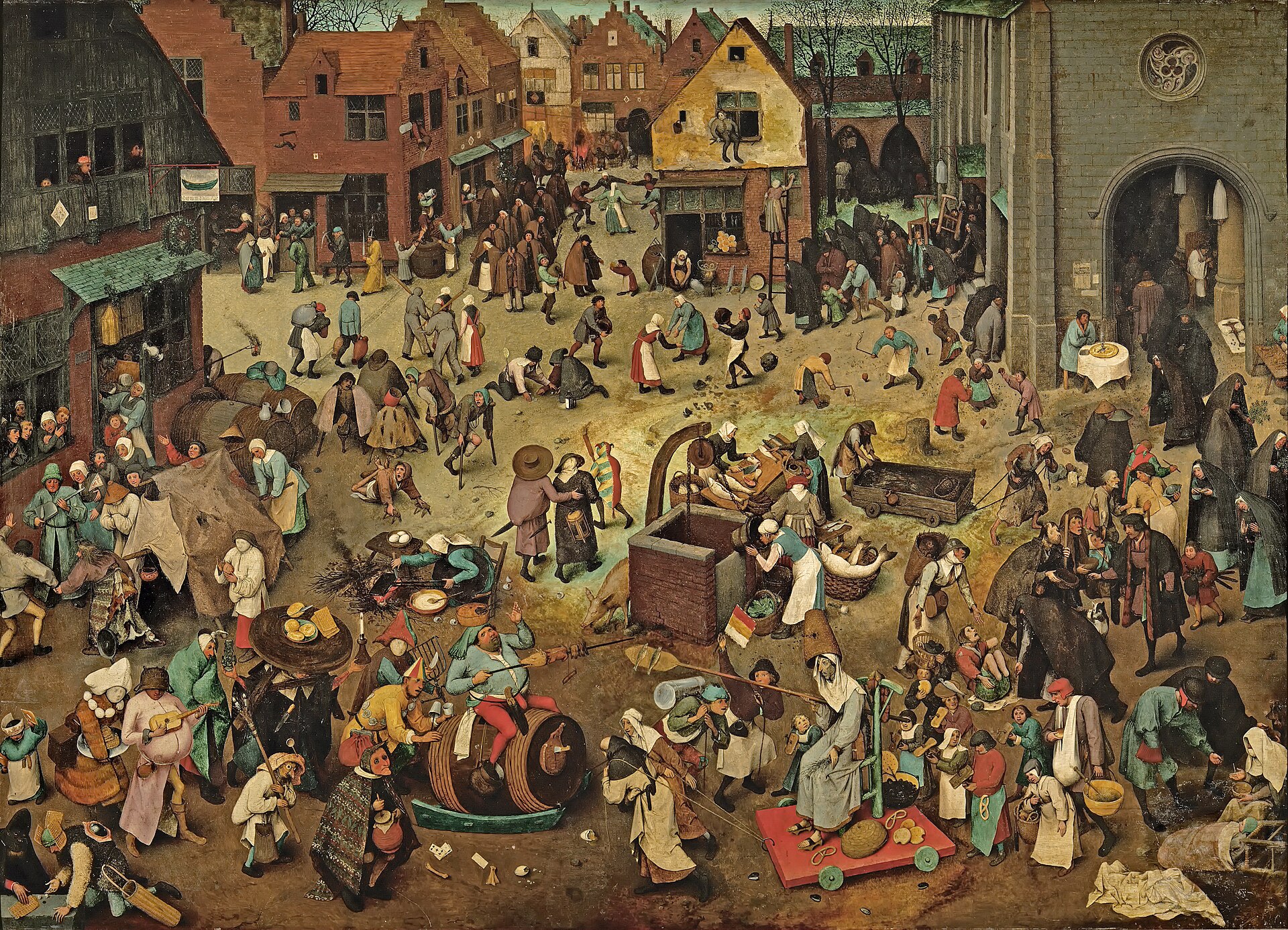
The Fight Between Carnival and Lent (Dutch: De strijd tussen Vasten en Vastenavond) is an oil-on-panel painting executed by the Dutch and Flemish Renaissance painter Pieter Bruegel the Elder in 1559. It is a panorama of contemporary life in the Southern Netherlands. While the painting contains nearly 200 characters, it is unified under the theme of the transition from Shrove Tuesday to Lent, the period forty days before Easter.
History
The literary theme of the struggle between personifications of Shrove Tuesday and Lent dates as far back as the year 400 with the Psychomachia. The 13th-century French poem La Bataille de Caresme et de Charnage describes a symbolic battle between different foods, meat against fish. A likely graphic precursor of the painting is Lent and Carnival, a 1558 etching by Hieronymus Cock after Frans Hogenberg, in which the personifications of lean and fat are driven together on carts by their supporters. The supporters attack each other with fish, waffles, cookies and eggs.
Also in 1559, Bruegel produced a series of prints of the Seven Virtues, which have formal similarities: an allegorical figure, against a background with a high horizon line, is surrounded by a crowd of figures who carry out various activities related to the subject. In the same year, Bruegel painted Netherlandish Proverbs, also modelled on a print by Hogenberg. The following year he produced Children's Games. These three works are closely related, each forming a catalogue of folk customs. The works mark the transition of Bruegel from draughtsman to the painter of grand panels for which he is now known.
Composition
In the foreground is the battle itself: the two opponents, Carnival and Lent, pulled and pushed and accompanied by supporters, are about to meet. Carnival is seated on a large beer barrel and Lent is opposite him seated on a shallow pull cart. The painting does not present either side as being better than the other, but presents both sides as extremes of the human experience.
It is typical of the world landscape style, in which an imaginary panoramic landscape is seen from an elevated viewpoint. The horizon is high in the picture, giving the viewer a bird's eye view of the scene. The physical painting is large, and the characters are small, which means that nearly 200 characters fit into the scene, mostly in groupings.
A market square of an unspecified village in the Netherlands is shown. Themes in the scene would have been nostalgic for contemporary viewers, since it depicts an older and more rural style of improvised celebration, in contrast to the highly organized professional processions which would have been seen at that time in Antwerp.
The spectacle is divided into two halves, and framed by two buildings: the inn on the left, the church on the right, which gives it the character of a scene in a stage show. The left side of the sprawling canvas depicts the Carnival, the right side, Lent. The boundary is not sharply defined, however, and in several places the followers of Lent and Shrove Tuesday invade each other's space. The painting depicts different times of year. Barren, wintery, trees on the left hint at the winter, while the budding trees of the churchyard's lenten side hint at a burgeoning spring.
Foreground
In the foreground, the two antagonists, Carnival and Lent, are in a parody of a late medieval joust. The two opponents do not ride head-on into each other, but rather pass each other by, trying to lift each other out of the saddle.
They are borne on what resemble contemporary carnival floats. Both characters wear a headdress which makes it clear that they are allegorical characters. Carnival wears a poultry pie with the legs of a crow sticking out. Lent wears a beehive, a common symbol for the church at the time.
Carnival is a fat butcher, with his pouch of knives, straddling a beer barrel on a blue sled. A pork chop is attached to the front of the barrel, and a cooking pot serves as a stirrup. His weapon is a rotisserie carrying the head of a suckling pig, poultry and sausages. Two men pull his sled. One of them waves a red-gold-white flag, the then typical carnival colors. Carnival's followers form a procession of figures wearing masks, bizarre headgear and household objects as props or improvised musical instruments, in a reversal of the normal order. The followers are provided with wafers and cakes. In the foreground are bones, egg shells, and playing cards.
Lent is a thin woman, seated on a hard three-legged chair, and armed with a baker's spatula called a peel, on which lie two herring. She is surrounded by pretzels, fish, fasting breads, mussels, and onions, all typically consumed during Lent. Lent is laboriously drawn by a monk and a nun. Her entourage consists of children, who, like Lent, have the ash cross of Ash Wednesday on their foreheads. They make noise with clappers. A church minister accompanies the children, carrying a bucket with a holy water brush and a bag for donations, which include dry rolls, pretzels and shoes.
Left side
The left side is dominated by an inn, which according to its signboard is called the Blau Schuyt (Blue Barge), referencing a Middle Dutch poem popular during Lenten celebrations, in which the bourgeois world was turned upside down. In and around the inn, there is heavy drinking. Through an upper floor window we see an encounter between two lovers. To the left, a musician with his bagpipes hangs out of the window to vomit.
In front of the inn, actors perform The Dirty Bride, a play in which a peasant in a drunken stupor agrees to marry, but upon sobering up discovers how his bride looks. The painting shows the bride and groom dancing, while a masked member of the company collects money with a piggy bank.
Across the street, another group of dramatists performs The Catch of the Wild Man. Above Carnival, a woman bakes waffles. A procession of lepers, led by a bagpiper, winds past.
Right side
Just inside the church a veiled statue is visible. It was customary in Roman Catholic churches to cover artwork from Passion Sunday to Easter. Outside, a man sits at a table with a relic that the pious can pay to touch. A woman at a stall sells votive offerings. A man and a woman pray kneeling against the wall of the church.
原文较长,这里只摘了前面一部分,摘自英文维基百科「The Fight Between Carnival and Lent」(暂时没有中文条目,下面是英文原文),按 CC BY-SA 4.0 使用,去掉了参考文献、外部链接等尾部小节和表格,其余文字未作改动。
相关词条
相关作品