艺廊

作品介绍
Meadows near Rijswijk and the Schenkweg is a watercolor by the Dutch painter Vincent van Gogh that he made in January 1882, shortly after taking up residence in The Hague.
It shows the view from his studio window on the outer reaches of The Hague at the Schenkweg, then undergoing a period of urban development. The view is across the Schenkweg ditch towards the newly constructed Rijnspoor railway station, built for the Utrecht-Gouda-The Hague railway, and now the Den Haag Centraal railway station. Rijswijk was then a small rural community to the south, bordering Delft but stretching all the way to The Hague. The land on which the Rijnspoor was built was ceded to The Hague by Rijswijk. It is now a suburb of The Hague.
The painting is amongst the very first paintings by van Gogh. Although he had been drawing for many years and occasionally applied watercolor washes, he did not take up painting proper until his study visit to his cousin-in-law and mentor Anton Mauve at The Hague in December 1881.
Background
At the end of August 1881, van Gogh visited his cousin-in-law Anton Mauve, a noted and successful painter and a leading member of the Hague School, and showed him some studies and drawings he had made. Mauve encouraged him and suggested that he now start painting. At the end of the following November, van Gogh returned to the Hague for a month to take painting lessons from Mauve, during which time he saw him almost daily.
He returned to his family home in Etten at Christmas with the intention of setting up a studio there, but quarreled disastrously with his father, a pastor, over his refusal to attend church on Christmas Day. This, in turn, was a consequence of his bitterness over his spurned love for his widowed cousin Kee Vos Stricker that had led to so much family tension that year. He left home that same Christmas Day and returned to The Hague, resolved to set up his studio there.
At Schenkweg
The Schenkweg lay a little less than a mile to the east of the centre of The Hague. At that time it was open countryside, a polder reclaimed in medieval times, but the land was increasingly being sold for development. These new developments were cheaply constructed, and they attracted a less affluent class of people. Today the urban conurbation extends a further three miles east, although there remains an extensive park and woodlands just north of the Schenkweg called the Haagse Bos, one of the last remaining stretches of ancient forest in the Netherlands, where van Gogh painted some early studies in August 1882.
Van Gogh was familiar with the meadows at Rijswijk. An aunt of his cousin Kee Vos Stricker lived at the Huis te Hoorn in Rijswijk, and van Gogh was a frequent guest of the family when he was working at the art dealership Goupil & Co., whose Hague branch his uncle Cent, Vincent van Gogh (a namesake), had helped found. On one such occasion he walked into Rijswijk with his brother Theo, probably to attend the 80th birthday party of his great-uncle Johannes Andricus Stricker. The walk seems to have cemented his relationship with his younger brother as he often subsequently referred to it in his letters. Evidently they discussed the possibility of becoming painters together. The family photo taken at the time (right) is said to include both Vincent and Theo, as well as their cousin Kee Vos Stricker and the Haanebeek sisters, Caroline and Annet, for which Vincent and Theo harboured unrequited youthful loves respectively.
Studio
Van Gogh rented his studio at 136 Schenkweg, about 10 minutes walk from Mauve's studio at Uilebomen 198 (now the Boomsluiterskade). The studio was actually on a side street, called the Schenkstraat, off the Schenkweg. The Rijnspoor station lay about a quarter mile to the north-west. Today there are railway tracks coming up from the south into the station from Amsterdam, but these were laid much later in the 1970s when the Centraal station was constructed. In van Gogh's time the only tracks came into the station from the east from Utrecht, and he would have had an uninterrupted walk to Mauve.
Van Gogh wrote that the studio faced "more or less" south. It follows that the view in Meadows near Rijswijk and the Schenkweg was from the back window facing north, which would indeed have been where van Gogh would have posed his models for preference, as artists prefer the light from the north because it is more constant.
The studio cost 7 guilders a month to rent, and Mauve lent van Gogh 100 guilders to furnish it, insisting he had to have a bed. Van Gogh decorated the studio with his own studies, with prints from a complete set of The Graphic between 1870 and 1880 that he had acquired at a bargain price, and with flowers and a couple of boxes of bulbs. He declared himself happy and content with the result. Nevertheless, the accommodation was of the simplest kind. Arnold Pomerans remarked that it was the beginning of a long series of plainly furnished rooms, of which the Bedroom in Arles would eventually become a world-famous symbol.
Van Gogh used his studio to draw from models, either directly at the studio or for finishing sketches he called "scratches" that he made on the street and in other locations, including especially the Geest, a working-class district in The Hague. In these expeditions he often accompanied his contemporary George Hendrik Breitner, although Breitner's subject was the city itself rather than the figure.
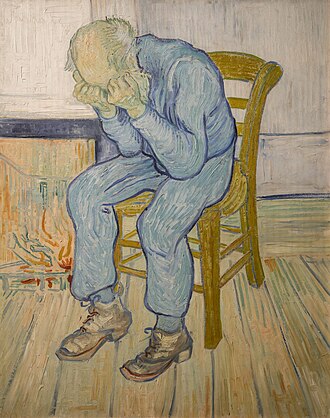
Mauve had introduced van Gogh to the Pulchri Studio, The Hague's leading art society. As an associate member van Gogh had the right to draw from the figure two evenings a week, but he appears to have made scant use of this facility. Instead he relied on a stream of models he found in such places as soup kitchens and almshouses, spending on them a significant part of the allowance Theo sent him. Amongst these models were his mistress Sien Hoornik, model for Sorrow, and Adrianus Jacobus Zuyderland, model for At Eternity's Gate. His obsessive insistence on drawing from models brought him into conflict with both Mauve and his influential patron Hermanus Tersteeg, head of The Hague's branch of Goupil he had once worked for. Mauve visited the studio at the end of January, and his subsequent coolness towards van Gogh appears to have stemmed from that visit, made awkward by the unexpected arrival of one of van Gogh's models.
原文较长,这里只摘了前面一部分,摘自英文维基百科「Meadows near Rijswijk and the Schenkweg」(暂时没有中文条目,下面是英文原文),按 CC BY-SA 4.0 使用,去掉了参考文献、外部链接等尾部小节和表格,其余文字未作改动。