艺廊
作品介绍
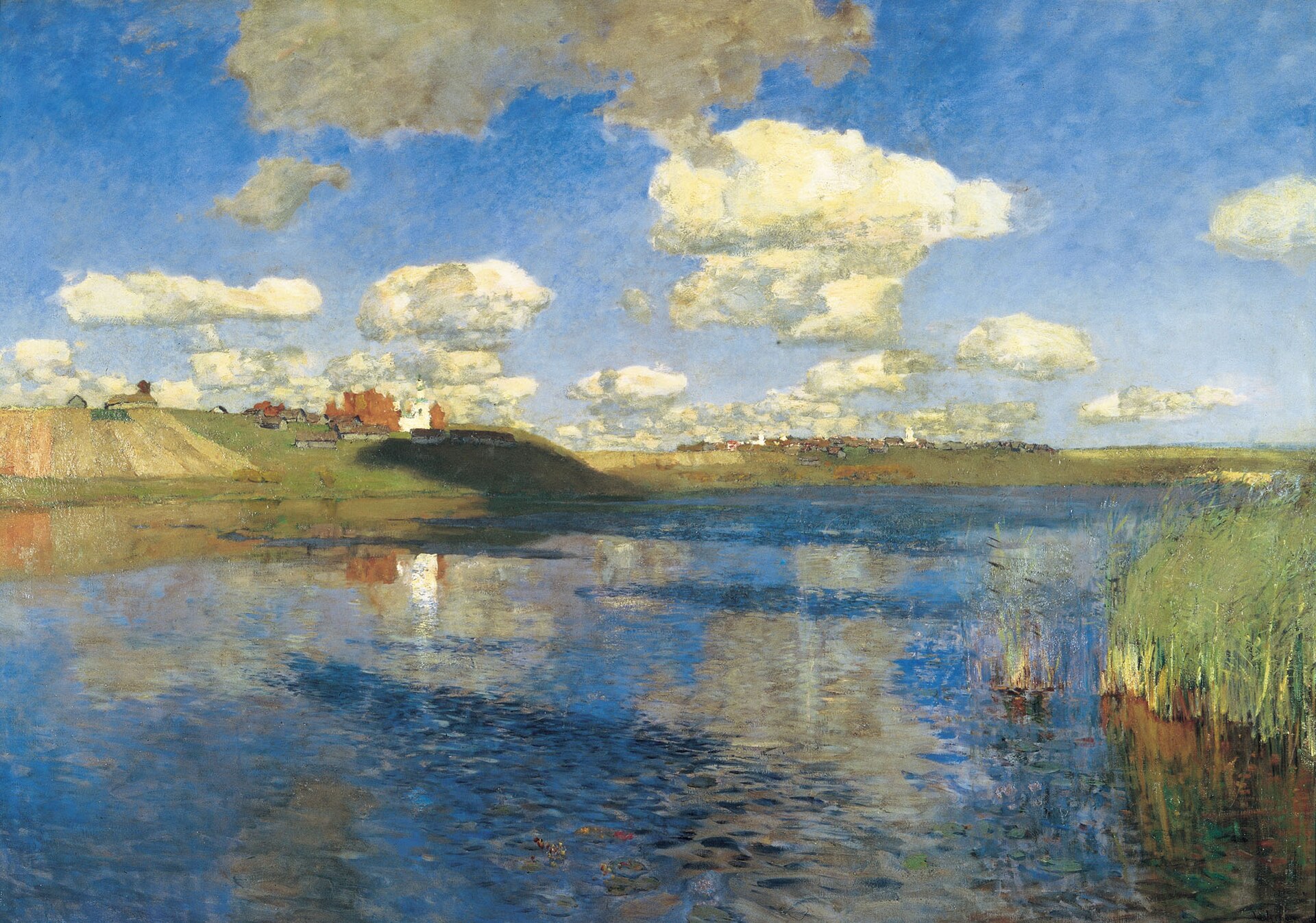
Lake is a painting by the Russian artist Isaac Levitan (1860–1900), which he worked on in 1899–1900. It is currently held in the State Russian Museum in Saint Petersburg (Inventory Zh-4262). The painting measures 149 × 208 cm. It is also known by other names, including Lake. Rus and Sunny Day. Lake.
The painting Lake was Levitan's last major work, which he painted shortly before his death. Although unfinished, this canvas is considered the main work of the late Levitan and is often referred to as his 'swan song'. The painting was first exhibited under the title 'Sunny Day' at Levitan's posthumous exhibition held in Saint Petersburg and Moscow in 1901.
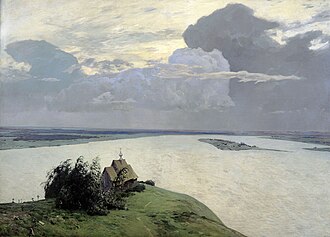
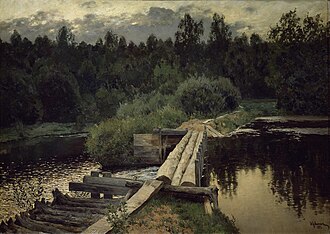
The painting Lake is one of the artist's three largest works, along with At the Pool (1892) and Over Eternal Peace (1894), which echoes the latter in subject matter. During the process of creating the painting, Levitan used numerous sketches and studies, including a large sketch, held in the Nizhny Novgorod State Art Museum and a small preliminary version of the painting, kept in the State Tretyakov Gallery.
Art historian Aleksei Fedorov-Davydov considered the painting Lake to be 'a remarkable creation by Levitan' and wrote that it 'immediately makes a great and strong impression on the viewer, as a powerful and beautiful image of Russian nature.' According to art historian Mikhail Alpatov, in the painting Lake Levitan managed to give 'a collective image of his homeland' – in it you can see 'the past of Russia, its present, nature, and man', in this work 'both the personal experiences of the artist, and the very festive beauty of the world merged.'
History
Preceding events and work on the painting
Levitan was interested in the subject of the lake from the early 1890s. In 1893, he painted a relatively large canvas titled At the Lake (oil on canvas, 109 × 163 cm, Radishchev Art Museum). In 1894, Levitan completed the painting Over Eternal Peace (oil on canvas, 150 × 206 cm, State Tretyakov Gallery), which depicted a wide expanse of water. It is unclear whether it was a lake or a river. The artist worked on this canvas on Lake Udomlya near Vyshny Volochok. The theme of the lake appears in several of the artist's works following his visit to Lake Como in northern Italy. These include Lake Como (oil on canvas, 1895, 96 × 128 cm, State Russian Museum), Gloomy Day (pastel, 1895, 48 × 62 cm, State Russian Museum), and Forest Lake (oil on canvas, 1890s, 48 × 80 cm, Rostov Regional Museum of Fine Arts).
During the summer of 1898, Levitan resided in the Bogorodskoye estate, situated in Klinsky Uyezd, Moscow Governorate, in close proximity to the Podsolnechnaya railway station (now within the city limits of Solnechnogorsk), on the shores of Senezh Lake. The estate was owned by the Olenin family – Vladimir Alexandrovich (great-grandson of Alexey Olenin, State Secretary and President of the Imperial Academy of Arts) and his wife Elizaveta Dmitrievna, née Skaryatina. In a letter to the writer Anton Chekhov dated 23 June 1898, Levitan reported: 'I live in a wonderful place here: on the shore of a very high huge lake, with forests all around me, and the lake is teeming with fish...' A similar description can be found in Levitan's letter to the artist Elena Karzinkina, dated 5 July 1898: 'I live in a very nice place: a big lake, mountains, forests, complete silence, even too much (but soon all this will be gone – the owners, the Olenins, will come), but still, it's very nice here.'
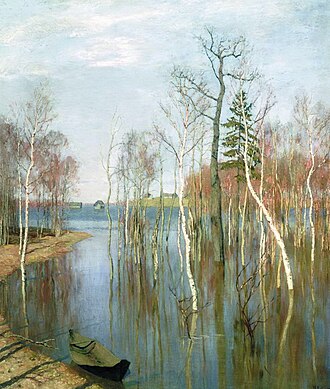
In Bogorodskoye, Levitan painted several landscapes, including the painting Lake. Spring (canvas, oil, 1898, 91 × 59 cm, Penza Regional Art Gallery named after K. A. Savitsky). Researchers consider this painting as one of the preparatory works for the future painting Lake. Art historian Aleksei Fedorov-Davydov recognised the complex and synthetic nature of the image presented by Levitan on the canvas Lake, and the composition of the landscape depicted on it. Fedorov-Davydov wrote that this landscape 'appears much more natural' than in the painting Over Eternal Peace. According to him, in the painting Lake, Levitan 'unconsciously reproduced <...> some kind of experienced visual impression', which could be 'the general experience he had at the Senezh Lake in the summer of 1898.'
Levitan began teaching at the Moscow School of Painting, Sculpture and Architecture (MUZHVZ) in September 1898, where he led the landscape class. According to the memories of one of Levitan's pupils, the artist Boris Lipkin, in early 1899, Levitan assigned his students the task of creating an illustration for Alexander Pushkin's poem 'The Cloud.' In the same year, in preparation for the student exhibition, Levitan showed Lipkin a large sketch made for the painting Lake, noting that it related to the same theme for which he had given the assignment. According to Lipkin's recollections, Levitan told him: 'I've been working on this subject for a long time, I wanted to call this thing 'Rus', but maybe it's a bit pretentious, it's better to keep it simple somehow.' According to literary scholar Andrei Turkov, Levitan's idea may have been connected to his work on illustrating the collection of Pushkin's works. This edition was being prepared by Pyotr Konchalovsky for the 100th anniversary of the poet's birth. Aleksei Fedorov-Davydov disagreed with Lipkin's claim that Levitan's sketch was thematically linked to Pushkin's 'The Cloud'. Fedorov-Davydov argued that 'the image of the painting in no way resembles this poem,' as the artist depicted light clouds rather than a cloud or the state of nature after a thunderstorm. According to Fedorov-Davydov, the landscape was 'least of all illustrative' and 'looked like real nature above all.'
In April 1899, Levitan travelled to the village of Okulovka in Krestetsky Uyezd, Novgorod Governorate. He spent the remainder of spring and most of the summer there, creating paintings such as Twilight. Moon, Twilight. Stacks, Summer Evening, and Twilight. Levitan also worked on preparatory sketches for the future canvas Lake. In August of the same year, the artist returned to Moscow.
原文较长,这里只摘了前面一部分,摘自英文维基百科「Lake (painting)」(暂时没有中文条目,下面是英文原文),按 CC BY-SA 4.0 使用,去掉了参考文献、外部链接等尾部小节和表格,其余文字未作改动。
相关词条
相关作品