艺廊
作品介绍
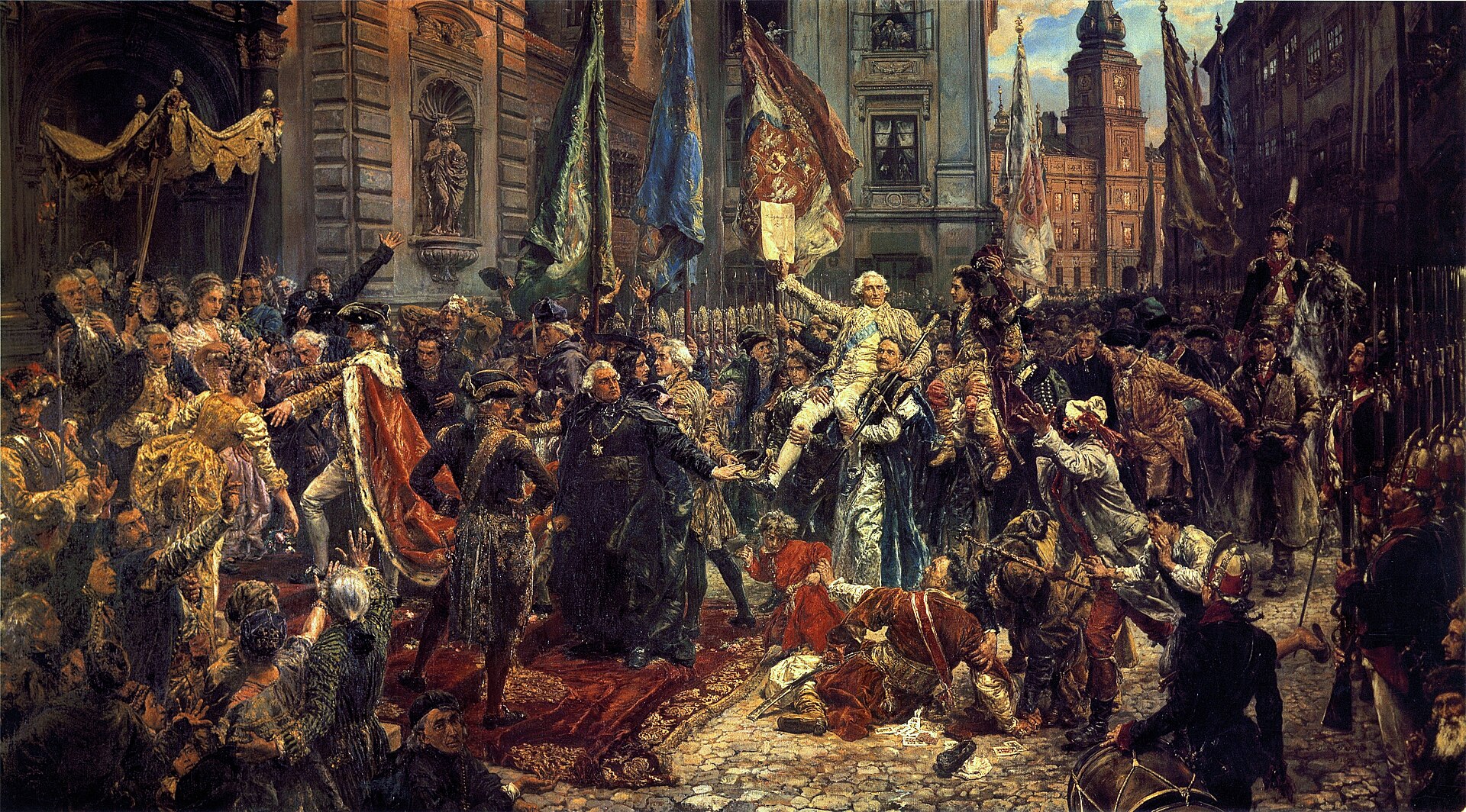
The Constitution of 3 May 1791 (Polish: Konstytucja 3 Maja 1791 roku) is an 1891 oil painting on canvas by the Polish artist Jan Matejko. It is a large piece, and one of Matejko's best known. The Romantic painting memorializes the Polish Constitution of 3 May 1791, a milestone in the history of the Polish–Lithuanian Commonwealth and a high point of the Polish Enlightenment.
Like many Matejko works, the picture presents a grand scene populated with numerous historic figures, including Poland's last King, Stanisław August Poniatowski; Marshals of the Great Sejm Stanisław Małachowski and Kazimierz Nestor Sapieha; co-authors of the Constitution such as Hugo Kołłątaj and Ignacy Potocki; and other major contemporary figures such as Tadeusz Kościuszko. Some twenty individuals have been identified by modern historians; another ten or so who had been reported in older sources as being present, await definitive identification.
The picture was painted between January and October 1891 to commemorate the Constitution's centenary. It was one of the last works by Matejko, who died in November 1893. The painting was displayed in Lwów (now Lviv, Ukraine) until 1920, when it was moved to Kraków. It was hidden during World War II and later moved to Warsaw, where it now hangs in the Royal Castle.
Constitution of 3 May 1791
The Constitution of 3 May 1791 was adopted as a "Government Act" (Polish: Ustawa rządowa) on that date by the Sejm (parliament) of the Polish–Lithuanian Commonwealth. It has been called "the first constitution of its type in Europe" and the world's second oldest constitution.
It was designed to redress long-standing political defects of the Polish–Lithuanian Commonwealth. The Commonwealth's system of "Golden Liberty", which conferred disproportionate rights on the nobility, had increasingly corrupted the Commonwealth's politics. The Constitution sought to supplant the existing anarchy fostered by some of the country's magnates with a more democratic constitutional monarchy. It introduced political equality between townspeople and nobility (szlachta) and placed the peasants under the protection of the government, thus mitigating the worst abuses of serfdom. The Constitution abolished pernicious parliamentary institutions such as the liberum veto, which at one time had put the Sejm at the mercy of any deputy who might choose, or be bribed by an interest or foreign power, to undo the legislation adopted by that Sejm.
The adoption of the 3 May Constitution met with hostile political and military responses from the Commonwealth's neighbors. In the Polish–Russian War of 1792 (sometimes called the "War in Defense of the Constitution"), the Commonwealth was attacked by Catherine the Great's Imperial Russia allied with the Targowica Confederation, a coalition of Polish magnates and landless nobility who opposed reforms that might weaken their influence. The Commonwealth's ally Prussia, under Frederick William II, broke its alliance, and the Commonwealth was defeated. In the end, the Constitution of May 3 remained in force for little more than one year. Despite the Commonwealth's defeat in the Polish–Russian War and the ensuing partitions which eliminated the Commonwealth, the May 3 Constitution remained for more than 123 years a beacon in the struggle to restore Polish sovereignty. In the words of two of its co-authors, Ignacy Potocki and Hugo Kołłątaj, it was "the last will and testament of the expiring Country."
History
A sketch of the work was presented in the cycle History of Civilization in Poland.
Matejko began work on the painting in mid–January 1891, to coincide with the Constitution's centenary. Although the painting was not finished until October, by 3 May it was sufficiently advanced to be shown at the anniversary exhibition in Kraków's Sukiennice. On 7 April 1892, Matejko transferred the painting to Prince Eustachy Stanisław Sanguszko, marshal of the Galician Sejm in Lwów, and it was displayed in the Sejm building (now the main building of Lviv University). The painting was one of the last by Matejko, who died in November 1893.
In 1920, two years after Poland regained independence, the painting was moved to Kraków, where from 1923 it was displayed in the building of the Polish Sejm. The painting was hidden by the Polish resistance during World War II, when Poland was occupied by the Germans. After the war the painting was transferred to the National Museum in Warsaw, and occasionally displayed in the Sejm building. Since 1984 the painting has been in the collection of the Royal Castle in Warsaw, where Matejko himself declared he would like the painting to be shown. The painting is displayed in the anteroom of the Chamber of Senators, where the Constitution was adopted. The painting was restored in 2007.
Significance and historiography
The painting is one of Matejko's best known works and today it is commonly seen as one of his masterpieces, an "education in national history." However, it was less well received by his contemporaries, with turn-of-the-century reviews criticizing it for being "too crowded" and with unclear composition; supporters of Matejko's previous works were much more guarded in their praise of this painting.
Matejko's technique in this painting was subtly but noticeably different compared to his other paintings; authors Wrede et al. attribute this to Matejko's exploration of new techniques, but note that contemporary critiques saw this departure from his old style as the weakening form of the dying master, and did not applaud the changes. They also note that Matejko usually dedicated two years to paintings of that size; this one was completed in less than a year, during a period in which Matejko was working on other projects and suffering from stress and depression. Matejko himself was not fond of the 18th century and the Polish Enlightenment, remarking that he "would rather prefer to paint any other century". He felt compelled, however, by the anniversary of the Constitution to create an artwork commemorating the event, which he recognized as historically significant.
原文较长,这里只摘了前面一部分,摘自英文维基百科「Constitution of 3 May 1791 (painting)」(暂时没有中文条目,下面是英文原文),按 CC BY-SA 4.0 使用,去掉了参考文献、外部链接等尾部小节和表格,其余文字未作改动。
相关词条
相关作品