艺廊

作品介绍
现藏于罗马多利亚·潘菲利美术馆 的《莎乐美》是文艺复兴晚期威尼斯画家提香的一幅早期油画作品。绘制于1515 年左右。画作描绘莎乐美 手捧施洗约翰的头颅,但也有人认为描绘的是友弟德。
摘自维基百科「莎乐美 (1515年)」,按 CC BY-SA 4.0 使用,繁体已转简体,去掉了参考文献、外部链接等尾部小节和表格,其余文字未作改动。
中文条目比较短,展开看英文维基百科的条目(英文原文)
Salome, or possibly Judith with the Head of Holofernes, is an oil painting which is an early work by the Venetian painter of the late Renaissance, Titian. It is usually thought to represent Salome with the head of John the Baptist. It is usually dated to around 1515 and is now in the Doria Pamphilj Gallery in Rome. Like other paintings of this subject, it has sometimes been considered to represent Judith with the head of Holofernes, the other biblical incident found in art showing a female and a severed male head. Historically, the main figure has also been called Herodias, the mother of Salome.
Sometimes attributed to Giorgione, the painting is now usually seen as one where Titian's personal style can be seen in development, with a "sense of physical proximity and involvement of the viewer", in which "expert handling of the malleable oil medium enabled the artist to evoke the sensation of softly spun hair upon creamy flesh".
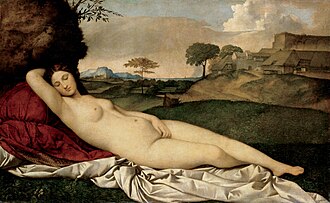
Erwin Panofsky suggested the head of John the Baptist might be a self-portrait, and it is possible that Titian was alluding to his private life with the model, anticipating Cristofano Allori's, Judith with the Head of Holofernes (1613, Royal Collection, and other versions), where the severed head was a self-portrait and Judith and the maid portraits of his ex-mistress and her mother. The model here, allowing for a degree of idealization, has been said to be the same used in the Dresden Venus (Giorgione and Titian, c. 1510) and Venus and Cupid (c. 1510–1515). It has been said that around this time depictions of Salome moved from a passive to a more seductive figure.
This composition was copied many times, in at least some cases by Titian's workshop.
Salome, Judith, or Herodias?
The possible provenance of the painting begins in 1533, with a Judith by Titian recorded in the collection of Alfonso I d'Este, Duke of Ferrara, a very important patron of Titian. No other surviving Titian painting seems to fit this record, so if it is not the painting now in Rome, it must be lost. In 1592 Duke Alfonso's granddaughter, Lucrezia d'Este (1535–1598) owned a painting described as a "Herodias" (Salome's mother). What is certainly the Doria Pamphilj painting belonged by 1603 to Cardinal Pietro Aldobrandini before passing to his niece Olimpia Aldobrandini, whose second husband was the ex-cardinal Camillo Pamphilj; since then it has passed by descent through the family. In the 18th century the painting was called a Herodias, but a number of foreign visitors who saw it record thinking the main figure to be Judith.
If the painting's main figure was Herodias, traditionally seen as the prime mover of the conspiracy to get John the Baptist executed, the younger woman next to her would be intended to represent her daughter Salome, here shown as a figure in thrall to her more glamorous mother. The identification as Herodias seems to have no recent supporters, but that as Judith does.
A medieval addition to the Salome legend held that, as well as her mother's hatred of John for his preaching against her, Salome was also motivated by a frustrated love for John, to which the cupid might refer. Her face is turned away from his head, but her eyes look back to it. Panofsky describes her as: "Meditative, sad and a little benumbed, she seems to recoil from the face of St. John which yet attracts her sidelong glances with irresistible force". Meanwhile, the maid "looks at the heroine with the eyes of a faithful dog who feels and shares his master's distress without comprehending its cause". Thus, in the pyramidal group of figures, the glances flow from the maid on the left, up to Salome at centre, and down to John at right, whose dead eyes are closed.
The use of erotic allure on male figures of power is the core of both stories, but to the church and Titian's contemporaries, Herodias and Salome were bad, but Judith a heroine. Both stories were part of the repertoire of the Power of Women topos, mainly a feature of German art in this period, but whose subjects were also depicted in Italy.……
节选,摘自英文维基百科「Salome (Titian, Rome)」,按 CC BY-SA 4.0 使用。