艺廊
作品介绍
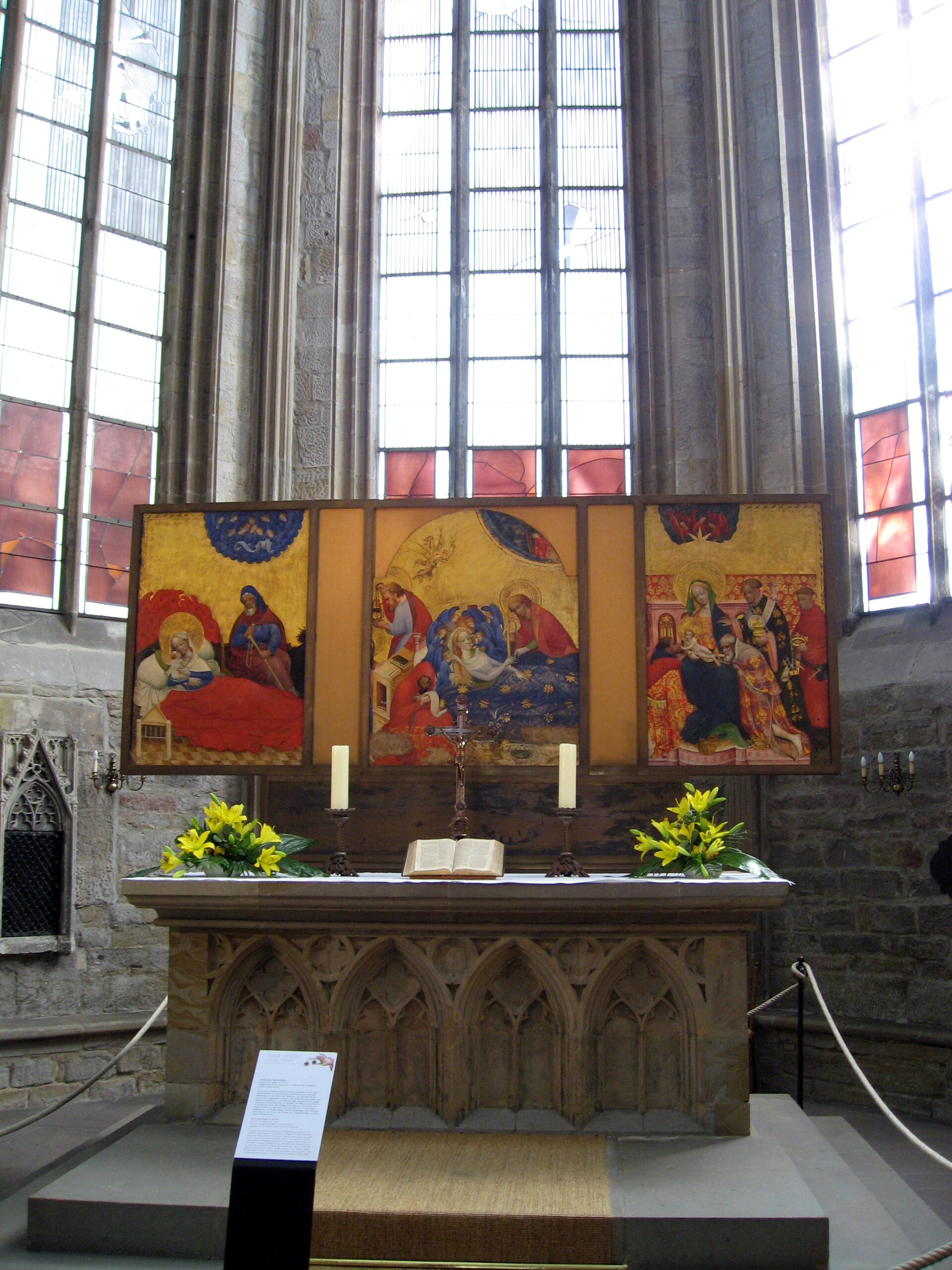
The Marienaltar by Conrad von Soest is a late Gothic altar retable located in the Marienkirche in Dortmund, Germany, dating from around 1420. Executed as a triptych, it is regarded as the painter's most important surviving work and the main altar of the church. The altarpiece, completed shortly before von Soest’s death, is a major example of the International Gothic or courtly style in northern German painting, notable for its refined use of color, gilding, and narrative scenes from the life of the Virgin Mary. Although originally a richly detailed winged altar, the work has been significantly altered over time—particularly in 1720, when it was cut down and incorporated into a Baroque altar structure, resulting in the loss of substantial portions of the original panels. Despite these changes, the surviving fragments are considered a masterpiece of medieval art and remain central to the artistic heritage of Dortmund.
History
Over the centuries, the altar has been subjected to rough handling, and only fragments survive. Originally designed as a lockable altar retable, the panels on the exterior can now be viewed from the rear. In contrast to the interior, they are heavily weathered.
The paintings were originally part of a Gothic winged altar. In order to fit the panels into a Baroque altar structure – approximately 16 meters high, donated to the parish by Dortmund mayor Dethmar Wessel Nies – they were trimmed and partially hammered in 1720. This process, unthinkable today given the quality of the artwork, involved the removal of portions of the paintings. The paintings were arranged differently in the carved Baroque altar. The two outer panels were positioned in the lower portion of the altar, with the central panel above them in a vaulted arch. The two lower panels were covered by a lunette. (See also the comments on the individual panels.) At the lower edge, the panels were painted over with banners approximately 20 cm high that placed Jesus at the center of the action and were likely intended to relativize the veneration of Mary. In 1848, the back was covered with newspaper to protect it from final destruction.
In 1890, Carl Baumann documented the baroque altar photographically, while Wolfgang Rinke analyzed the foundation of Mayor Nies on the basis of existing documents. In 1926, the outer panels were to be sawn off during restoration work. The parish of St. Mary had made the Berswordt and Marian altars available for the large "Millennium Exhibition of the Rhineland" in Cologne. The curator of the Wallraf–Richartz Museum, Otto H. Förster, then proposed to the parish that the museum would undertake the complete restoration in exchange for the separation and retention of the outer panels. It was only after the panels had been delivered to the restorer, Robert Hieronymi, that the municipality decided to retain them.
The panels were not divided and sold, and it was only after the war that it became known that they had been saved from final destruction. This was due to X-ray photographs of the panel paintings of the left and right wings, which Ernst Fritz's son, museum director Rolf Fritz, had taken after the war. These photographs revealed that the individual boards from which the panels are composed are held together inside the wood, invisible to the eye, by iron dowels. "If the frame saw had struck such an iron dowel when sawing the panels, the panels would have shattered immediately." (Letter from Rolf Fritz to City Councillor Hansmeyer dated May 9, 1957)
The bombing raids of the Second World War posed a new threat. At the initiative of the Dortmund museum directors Rolf Fritz (Museum of Art and Cultural History) and Leonie Reygers (Museum am Ostwall), the panels were secured in the depot of the German museums at Langenau Castle in Rhineland-Palatinate. According to Rinke's research, the baroque high altar was destroyed in a bombing raid between November 29, 1944 and March 12, 1945. The additions from the 18th and 19th centuries, which had not been removed and were therefore not accepted as artistic achievements during the Second World War, were also lost.
In 1948, the altar was initially moved to Cappenberg Castle in the rooms of the Museum of Art and Cultural History. In 1957, the paintings were placed in modern metal frames and put back in their original order. Today, the panels are displayed in Marienkirche above a Gothic mensa.
The paintings
The two outer panels are 1.40 meters high, the middle panel slightly lower due to the sawing out. In addition to the reduction in size, all the panels show minor damage from earlier overpainting and restoration work. On the panels on the back, the former outer side of the closed altar, the paint is badly damaged and is missing completely in some places, especially in the Annunciation. The panels only depict motifs from the life of Mary, an exclusivity of subject matter unprecedented in northern German painting.
The birth of Jesus
The colors gold, blue and red dominate the left front panel, which depicts the birth of Jesus. A woven fence behind Mary's bed suggests the stable where Jesus was born. This symbolic allusion is all that remains, as the floor tiles in the room show. However, according to Rolf Fritz's reconstruction based on a copy of the Marienaltar for St. Walpurgis in Soest (today in the Westphalian State Museum in Münster), there was a depiction of a stable with a crib, an ox, and a donkey on the right-hand side of the lost panel.
Upon closer inspection, the fiery red ring behind the bed turns out to be a cloud of angels. The singing of the blue angels high above the bed is indicated by a scroll. The similarity of the angels' faces is striking. The writing in the halos of the Mother and Child is difficult to decipher (Mary: "Sancta Maria, mater Cristi vir(go)" (Holy Mary, Mother of Christ, Virgin); Jesus: "Jesus Christ" (partly in Greek letters)). Against the golden background of the halo, the intimate eye contact between mother and child is clearly visible, emphasized by the uniformity of their brown eyes.……
原文较长,这里只摘了前面一部分,摘自英文维基百科「Marienaltar (Conrad von Soest)」(暂时没有中文条目,下面是英文原文),按 CC BY-SA 4.0 使用,去掉了参考文献、外部链接等尾部小节和表格,其余文字未作改动。
相关词条
相关作品
同流派 / 同题材的作品