艺廊
作品介绍
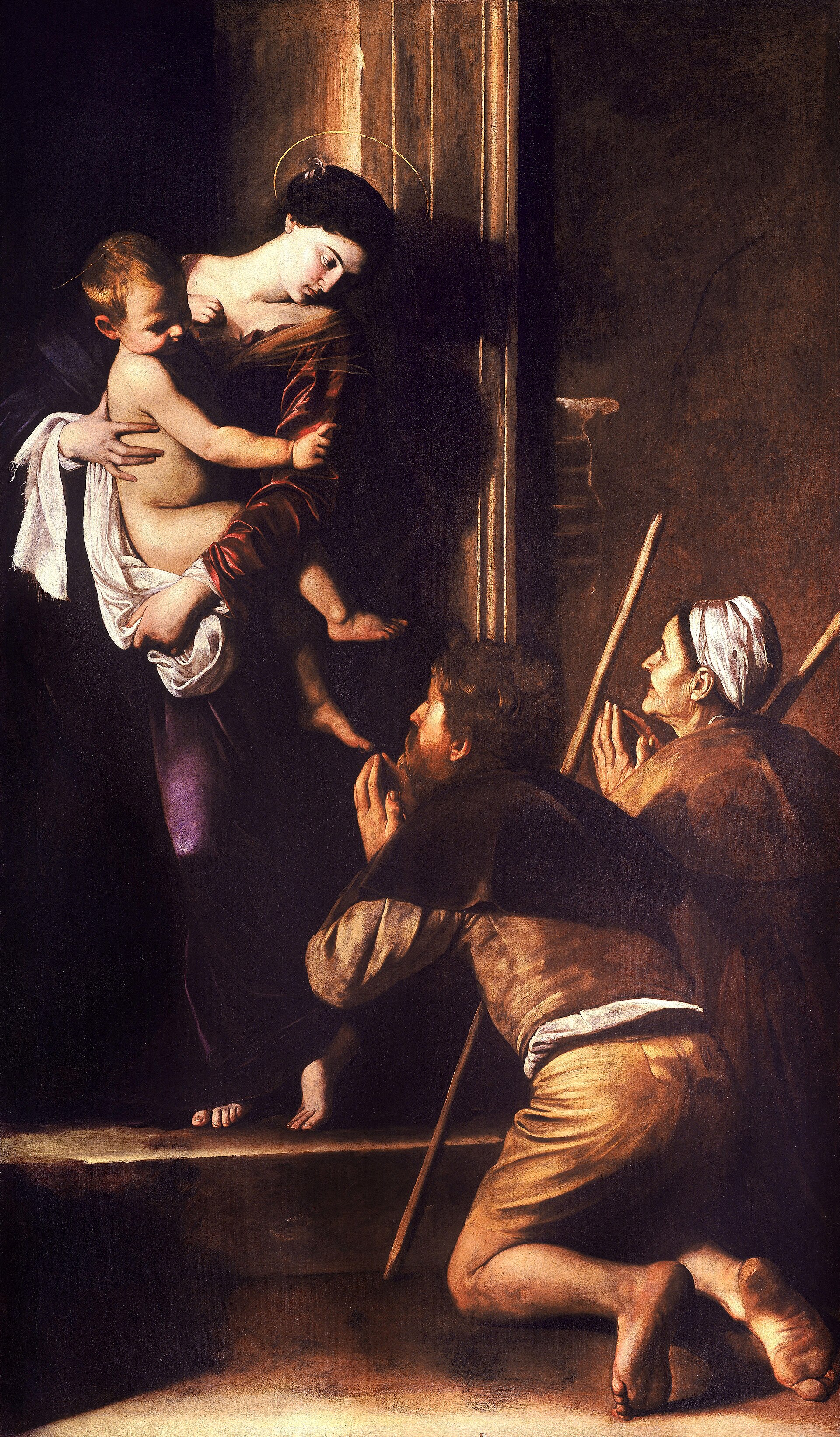
《洛雷托圣母》是意大利巴洛克大师卡拉瓦乔的一幅布面油画,绘制于1604-1606年,位于罗马纳沃纳广场东北部圣奥斯定圣殿的卡瓦莱蒂小堂。画作描绘赤脚的圣母 抱着赤裸的孩子站在门口,面前跪着两个朝圣的农民。
1602 年 7 月 21 日埃尔梅特·卡瓦莱蒂侯爵去世,1603 年,他的继承人订制了一幅以洛雷托圣母为主题的画作,来装饰家族小堂。 根据侯爵的遗嘱,卡瓦莱蒂家族于 1603 年 9 月 4 日在罗马的圣奥斯丁堂购买了一座小堂。
卡拉瓦乔的竞争对手乔瓦尼巴廖内的诽谤使卡拉瓦乔入狱。因为画中的圣母平凡无奇,赤着脚,砖墙破旧剥落,从阴影中走出来,如同卡拉瓦乔的其他画作,如《圣保禄的归化》或《圣玛窦蒙召》。圣母的女穆特似乎与卡拉瓦乔在博尔盖塞美术馆的画作《教宗御座轿夫圣母》(1605)中是同一人。
摘自维基百科「洛雷托圣母 (卡拉瓦乔)」,按 CC BY-SA 4.0 使用,繁体已转简体,去掉了参考文献、外部链接等尾部小节和表格,其余文字未作改动。
中文条目比较短,展开看英文维基百科的条目(英文原文)
The Madonna di Loreto or Pilgrims' Madonna is a painting created c.1604–1606 by the Italian Baroque master Caravaggio, located in the Cavalletti Chapel of the church of Sant'Agostino, just northeast of the Piazza Navona in Rome. It depicts the barefoot Virgin holding her naked child in a doorway before two kneeling peasants on a pilgrimage.
In 1603 the heirs of marquis Ermete Cavalletti, who had died on 21 July 1602, commissioned a painting on the theme of the Madonna of Loreto to decorate a family chapel. As instructed by the marquis's will, the Cavaletti's purchased a chapel in the church of Sant'Agostino in Rome on 4 September 1603.
The painter Giovanni Baglione, a competitor who had successfully ensured Caravaggio was jailed during a libel trial, said that the unveiling of this painting "caused the common people to make a great cackle (schiamazzo) over it". The uproar was not surprising. The Virgin Mary, like her admiring pilgrims, is barefoot. The doorway or niche is not an exalted cumulus or bevy of putti, but a partly decrepit wall of flaking brick. Only a slim halo indicates her saintly status. While beautiful, the Virgin Mary could be any woman emerging from the shadows. Like many of Caravaggio's Roman paintings, such as the Conversion on the Way to Damascus or the Calling of St Matthew, the scene is a moment where an ordinary person encounters the divine, whose appearance is equally ordinary. The woman modelling Mary appears to be the same as that in Caravaggio's canvas in the Galleria Borghese: The Madonna and Child with St. Anne (Dei Palafrenieri) (1605).
Critic Robert Hughes has stated:…his [Caravaggio’s] project was to give traditional motifs the immediacy of real life, rather than dignify the actual with fragments of the Classical. And once there was a perfect standoff between the two: this Madonna [di Loreto], leaning very elegantly against a pilaster with those two wrinkled and almost incongruously and devout plebians adoring her. Compared to the pilgrims, the Madonna looks wooden; but perhaps she was meant to since the cult of the shrine of the Madonna at Loreto centered around a miraculous statue of the Virgin Mary which, like a benevolent female version of Mozart’s Commendatore, was said to come alive when venerated.
It has been suggested that Caravaggio's composition is at least in part derived from a detail of a 1574 engraving, Adoration of the Magi, after Rosso Fiorentino, by Caravaggio's friend Cherubino Alberti (1553–1615).
相关词条
相关作品