艺廊

作品介绍
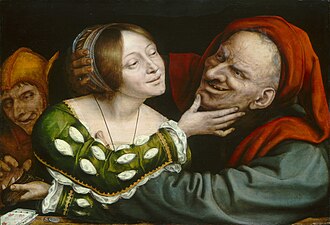
《丑陋的公爵夫人》(The Ugly Duchess)是一幅讽刺肖像画,由佛兰德斯艺术家昆丁·马西斯(Quinten Matsys)创作于1513年左右。
这幅油画绘于橡木板上,尺寸为62.4x45.5公分。画中描绘的是一位皮肤皱巴巴、乳房萎缩的老妇人。她戴着年轻时佩戴的贵族角形头饰(escoffion),这种头饰在创作时期已不再流行。她右手握著一朵红花,这朵花在当时象征订婚,暗示她正在努力吸引追求者。然而,这朵花也被描述为“可能永远不会绽放”的花蕾。这幅作品是马西斯最著名的画作。
长期以来,人们一直认为这幅画作源自列奥纳多·达·芬奇的一幅假定已佚作品,因为它与两幅普遍认为是这位意大利艺术家创作的头像漫画惊人地相似。然而,现在人们认为这些漫画是基于马特西斯的作品,众所周知,昆丁·马西斯曾与达芬奇交换画作。
这幅画现在收藏于伦敦国家美术馆,由珍妮·路易莎·罗伯塔·布莱克于1947年遗赠给美术馆。 《丑陋的公爵夫人》原本是一幅双联画的一半,另一幅是《老男人肖像》。
摘自维基百科「丑陋的公爵夫人」,按 CC BY-SA 4.0 使用,繁体已转简体,去掉了参考文献、外部链接等尾部小节和表格,其余文字未作改动。
中文条目比较短,展开看英文维基百科的条目(英文原文)
The Ugly Duchess (also known as A Grotesque Old Woman) is a satirical portrait painted by the Flemish artist Quinten Matsys around 1513.
The painting is in oil on an oak panel, measuring 62.4 by 45.5 cm. It shows an old woman with wrinkled skin and withered breasts. She wears the aristocratic horned headdress (escoffion) of her youth, out of fashion by the time of the painting, and holds in her right hand a red flower, then a symbol of engagement, indicating that she is trying to attract a suitor. However, it has been described as a bud that will 'likely never blossom'. The work is Matsys' best-known painting.
The painting was long thought to have been derived from a putative lost work by Leonardo da Vinci, on the basis of its striking resemblance to two caricature drawings of heads commonly attributed to the Italian artist. However the caricatures are now thought to be based on the work of Matsys, who is known to have exchanged drawings with Leonardo.
A possible literary influence is Erasmus's essay In Praise of Folly (1511), which satirizes women who "still play the coquette", "cannot tear themselves away from their mirrors" and "do not hesitate to exhibit their repulsive withered breasts". The woman has been often identified as Margaret, Countess of Tyrol, claimed by her enemies to be ugly; however, she had died 150 years earlier.
The painting is in the collection of the National Gallery in London, to which it was bequeathed by Jenny Louisa Roberta Blaker in 1947. It was originally half of a diptych, with a Portrait of an Old Man. In a private collection, it has a study in the Musée Jacquemart-André, Paris, which was lent to the National Gallery in 2008 for an exhibition in which the two paintings were hung side by side.
The portrait is thought to be a source for John Tenniel's 1865 illustrations of the Duchess in Alice's Adventures in Wonderland.
A 1989 article published in the British Medical Journal speculated that the subject might have suffered from Paget's disease, in which the victim's bones enlarge and become deformed. A similar suggestion was made by Michael Baum, emeritus professor of surgery at University College London.
Description
The painting is in oil on an oak panel, measures 62.4 by 45.5 cm. It shows an old woman depicted with exaggerated features. She has a short nose with upturned flared nostrils. Her philtral area is elongated, and her lips appear thin and pinched. The skin of her cheeks, neck and jaw hang loose on her face. The rest of her skin is wrinkled and pocked, and she has a wart on the right side of her face. Her thinning hair, concealed by an escoffion or horned headdress, is swept behind protruding ears. Despite her seemingly "ugly" visage, she wears aristocratic fashion that is more relevant to her youth rather than her advanced age. Her clothing is an adaptation of traditional Burgundian fashion, popular between 1400 and 1500. By the time Matsys completed this work, in 1513, this style of dress was already out of fashion. Her dress, with tightly laced corseted front, pushes her wrinkled breasts up beyond propriety standards for the period. Her shoulders are covered by a white veil, that falls from her escoffion headdress. It is decorated in roses and ornamented by a large gold and pearl brooch. Her fine, but out of fashion, clothing suggests she was a wealthy woman. Additionally, she holds a red flower in her right hand. At one time a red flower symbolized engagement, or courting. With her ugly features and advanced age, this red flower only adds to the satirical nature of Matsys's work.
Technical analysis
The painting technique reflects Matsys himself and is similar to his other work. The paint is worked in many places wet-in-wet and has been dragged and feathered. Matsys popularly used feathering to soften and blend transitions of tone. The hair near the Duchess's right ear and the embroidery on her right cuff are rendered in sgraffito, a technique done by scratching through a layer of wet paint to show the underlying layers. Matsys achieved the uneven appearance of her flesh by layering the basic pink with red and white dots in sporadic dashes and blotches. Matsys displays finer attention to detail through his brushwork when looking at the ornamental brooch. In the brooch are at least five shades of brown, orange, pink and yellow to achieve its golden hue.
节选,摘自英文维基百科「The Ugly Duchess」,按 CC BY-SA 4.0 使用。
相关词条
相关作品