艺廊
作品介绍
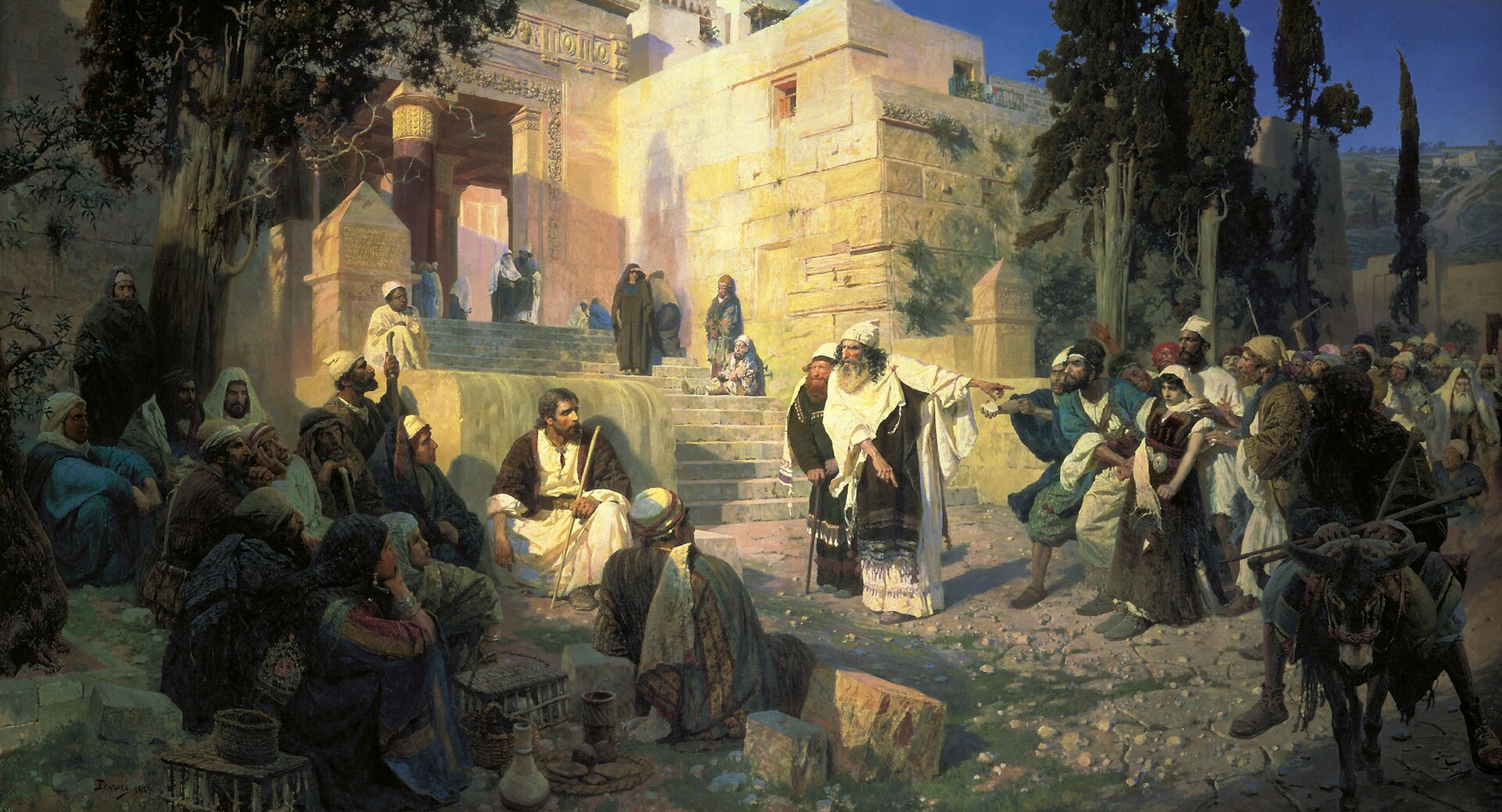
Christ and the Woman Taken in Adultery (He That Is Without Sin?) (Russian: «Христо́с и гре́шница» («Кто без греха́?»)) is a large oil painting by the Russian artist Vasily Polenov (1844–1927), dated 1888. The painting is now in the State Russian Museum in Saint Petersburg (Inventory Zh-4204). Measuring 325 × 611 cm, it depicts the story of Christ and the woman taken in adultery, described in the Gospel of John.
The painting was conceived by the artist in the late 1860s, with the first sketches appearing in the early 1870s. Some fifteen years passed before the final version of the canvas was completed. While working on the painting, Polenov travelled to the Middle East (1881–1882) and Italy (1883–1884).
The canvas was presented at the 15th Exhibition of the Society for Travelling Art Exhibitions (Peredvizhniki), which opened in Saint Petersburg on 25 February 1887. At the exhibition, the painting was purchased by Tsar Alexander III. The painting was then kept in the Winter Palace, and when the Russian Museum was founded, it became part of its collection in 1897.
On the one hand, the painting is seen as an attempt at a realistic interpretation of the image of Christ and the Gospel story. On the other hand, art historians have also identified the influence of late academicism on the painting, noting that among the attempts to revive large-format academic historical painting, "Polenov's painting is the most significant and serious".
Conception and work on the painting
The concept for the future canvas, entitled Christ and the Woman Taken in Adultery, was first conceived in 1868, influenced by Alexander Andreyevich Ivanov's painting The Appearance of Christ Before the People. Polenov set himself the task of creating "Christ not only coming, but already in the world, making his way among the people". The book The Life of Jesus by the French philosopher and writer Ernest Renan, which emphasised the human nature of Christ, had a significant influence on the interpretation of the subject. By the time work on the painting began, Russian painting had already produced such famous canvases on Gospel themes as the Last Supper by Nikolai Ge and Christ in the Desert by Ivan Kramskoi.
The initial sketches and studies for the painting were created in the 1870s. Of these, two are particularly noteworthy – the 1873 sketch, which aligns with the original concept of the painting, and the 1876 sketch, which is closer to the final composition of the canvas. After that, work on the painting came to a standstill, but in 1881, when the artist's sister Vera Dmitrievna Polenova (the twin of Vasily Polenov) was dying, she made her brother promise to resume work on the painting and also asked that the canvas be large. By then, Polenov had become quite successful in the genre of landscape painting, but, fulfilling the promise to his sister, he returned to historical painting.
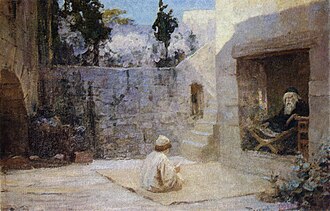
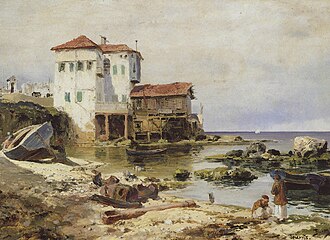
In 1881–1882, Polenov undertook a journey to the Middle East, which was largely associated with the work on Christ and the Woman Taken in Adultery. He travelled to Constantinople, Alexandria, Cairo, and Aswan, visited Palestine and Syria, and also stopped by Greece. Polenov's travelling companions were the linguist and archaeologist Semyon Abamelek-Lazarev and the art historian Adrian Prakhov. The trip provided Polenov with a substantial corpus of observations pertaining to the nature and architecture of Palestine, as well as the appearance and customs of its population. The artist subsequently employed these techniques to achieve greater realism in his depictions of the Gospel narrative. However, the outcomes of the journey did not significantly advance Polenov's progress towards the realization of his intended painting of Christ and the Woman Taken in Adultery, as he devoted minimal time to making sketches and studies during the expedition.
In the spring of 1883, already a teacher at the Moscow School of Painting, Sculpture and Architecture, Polenov finally began work on a large painting. However, it became evident that the material collected during his trip to the Middle East was insufficient for the task at hand. While he had landscape sketches and architectural sketches, he lacked sufficient images of people. To address this deficiency, Polenov took a year's leave from his academic position and, accompanied by his wife, Natalia Vasilyevna, departed for Rome at the end of October 1883. Their itinerary included visits to Vienna, Venice, and Florence. Consequently, in the 1883–1884 period, Polenov continued his work on the painting in Rome. He proceeded to refine the sketches and also produced images of Italian Jews. In a letter to his sister Elena Dmitrievna, Natalia Vasilievna described the Roman period of Polenov's activity: "He works very much, but whether he is successful or not is again terribly difficult to say; it seems to me that he looks for too much and too little in his work, and it is terribly tiring." She reported that Polenov drew one or two sketches from nature every day, and said that she "would be calmer at heart if the sketches were half as many and more in content". In April 1884, Polenov was visited in Rome by the businessman and patron Savva Mamontov, with whom the artist was well acquainted from the Abramtsevsky Circle. According to Natalia Vasilyevna, "Savva treated his work very kindly and examined his sketches sincerely and not empty-handedly", which "gave Vasily new zeal".
In May 1884, the Polenovs returned to Russia from Italy. In the summer of 1885, the artist worked at the Menshovo estate near Podolsk, where he created a full-length sketch for Christ and the Woman Taken in Adultery, executed in charcoal on canvas. The final version of the painting was completed by Polenov in 1886–1887 in Savva Mamontov's study within his residence on Sadovaya-Spasskaya Street in Moscow. In addition to his immediate family and Savva Mamontov, Polenov consulted with the artists Konstantin Korovin and Viktor Vasnetsov, as well as the physiologist Pyotr Spiro, during the painting process.
原文较长,这里只摘了前面一部分,摘自英文维基百科「Christ and the Woman Taken in Adultery (Polenov)」(暂时没有中文条目,下面是英文原文),按 CC BY-SA 4.0 使用,去掉了参考文献、外部链接等尾部小节和表格,其余文字未作改动。
相关词条
相关作品