艺廊

下十字架 (安杰利科修士)
Deposition of Christ
- 年代
- 1423–1432 年
- 收藏
- 国立圣马可美术馆
- 地点
- Pilmgrims' Guesthouse - Angelico Gallery
- 题材
- 宗教艺术
- 材质
- tempera、画板
- 尺寸
- 275 × 285(高 × 宽,多为厘米)
- 描绘对象
- 耶稣、男人、天使、亚利马太的约瑟、尼哥底母、下十字架
- 主题
- 下十字架
- 委托人
- Palla Strozzi
- 著录 / 文献
- Lives of the Most Excellent Painters, sculptors and architects、Museum von San Marco、Gentile da Fabriano (c. 1390-1427):International Style and Court Culture
作品资料来自 Wikidata(CC0)。
作品介绍
下十字架(Deposition from the Cross)是一幅基督下十字架题材的画作,由意大利文艺复兴大师安杰利科修士绘于1432年至1434年之间,现在保存在国立圣马可美术馆。
乔治·瓦萨里说,这幅画是“圣徒或天使画的”。
安吉里科介入完成这幅祭坛画时,洛伦佐摩纳哥(Lorenzo Monaco)已经开始为佛罗伦萨天主圣三圣殿的斯特罗齐小堂(Strozzi Chapel)。它描绘了基督被几个人抬着,玛利亚玛达肋纳握着他的脚,作为人类悔改的象征。右边有一个戴着红帽子的人物,展示钉子和荆棘冠冕,象征爱和牺牲。圣母玛利亚身穿深色衣裙,表现为传统的手势。
摘自维基百科「下十字架 (安杰利科修士)」,按 CC BY-SA 4.0 使用,繁体已转简体,去掉了参考文献、外部链接等尾部小节和表格,其余文字未作改动。
中文条目比较短,展开看英文维基百科的条目(英文原文)
The Deposition of Christ also known as the Santa Trinita Altarpiece is a painting by the Italian Renaissance artist Fra Angelico, executed between 1432 and 1434. It is preserved in the National Museum of San Marco, Florence.
Giorgio Vasari described it as appearing to have been "painted by a saint or an angel".
History
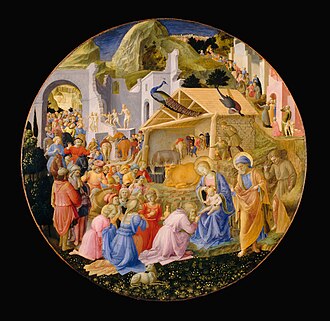
The altarpiece was originally commissioned to Lorenzo Monaco by the wealthy Florentine banker, humanist and rival of Cosimo de' Medici, Palla Strozzi, for the Strozzi Chapel in the church of Santa Trinita. The commission specified it had to be made in the same dimensions as the one he had commissioned from Gentile da Fabriano: the Adoration of the Magi.
Monaco allegedly completed the paintings in the pinnacles and the predella, but died suddenly in 1425. As a result, Fra Angelico was asked to complete it. The dating of the altarpiece completion by Fra Angelico is debated by scholars.
The commission had a political motivation. Palla Strozzi was one of the richest men in Florence and a leader of the oligarchic faction opposing the Medici. The opulence of the work and its location in a prominent church asserted the Strozzi family's status and piety. However, Palla Strozzi was exiled from Florence in 1434, the same year the altarpiece was likely completed or shortly thereafter.
Composition
Monaco had divided the main panel using columns to depict three individual scenes. Although this was typical for altarpieces of the period, Angelico removed the columns to paint one continuous scene. Gentile da Fabriano had taken the same approach in his 1423 work Adoration of the Magi, an imposing altarpiece for the same church also commissioned by Strozzi. Fra Angelico was one of the first painters of the Italian Renaissance to depict figures in a receding landscape. Previous painters placed all figures in the foreground, as in a theatrical presentation.
Description
At the center of the composition, Christ is being lowered from the Cross by Joseph of Arimathea and Nicodemus, who according to the Gospel of John were responsible for the burial of Christ. They are being assisted by three other men, two of them in wooden stairs placed against the Cross. At the bottom of the Cross, Christ's blood flows into a trapezoidal rock base which according to medieval iconography, represents man's redemption from sin through Christ's sacrifice.
Mary is praying and can be identified by her traditional lapis lazuli blue mantle. In front of her, Mary Magdalene is shown kissing Christ's feet. To the left, a group of women are preparing to receive Christ's the body in the shroud. A group of men on the right are depicted as scholars with Florentine dress, are discussing the symbols of the Passion. The man with the red chaperon holding the crown of thorns and the three nails of the cross is believed to be the donor, Palla Strozzi. The figure with the black hood behind Christ is the sculptor and architect Michelozzo, while the young man kneeling in the foreground is believed to be his son Alessio Strozzi.
The background shows two different scenes: in the left a fortified city with towers and in the right, a Tuscan landscape with pine-like trees and hills in the distance. The style was likely inspired by Cortona. The standing figures and the vertical background elements, as well as his placement being at the middle of the pyramidal composition, strongly focus the viewer's attention on Christ.
The ground is covered with a dense mantle of small plants depicted in detail, which may allude to spring as a symbol of rebirth.
Color
Fra Angelico's mastery of tempera is evident in the luminosity and transparency of the colors, qualities recently recovered in a major restoration completed in 2024. The restoration revealed the brilliance of the landscape, which depicts the Tuscan hills and a turreted city representing both Jerusalem and Florence. The use of light is not merely decorative but theological, enveloping the scene in a divine clarity that enhances the monumentality of the figures. The representation successfully combines the gravity appropriate to the sacred scene with the picturesque liveliness of the environmental recreation. The attention to detail in the character's faces and the background landscapes increases the realism of the scene. Their sharply outlined features are precisely traced, which suggests they are portraits.
节选,摘自英文维基百科「Deposition of Christ (Fra Angelico)」,按 CC BY-SA 4.0 使用。
相关词条
相关作品