艺廊
作品介绍
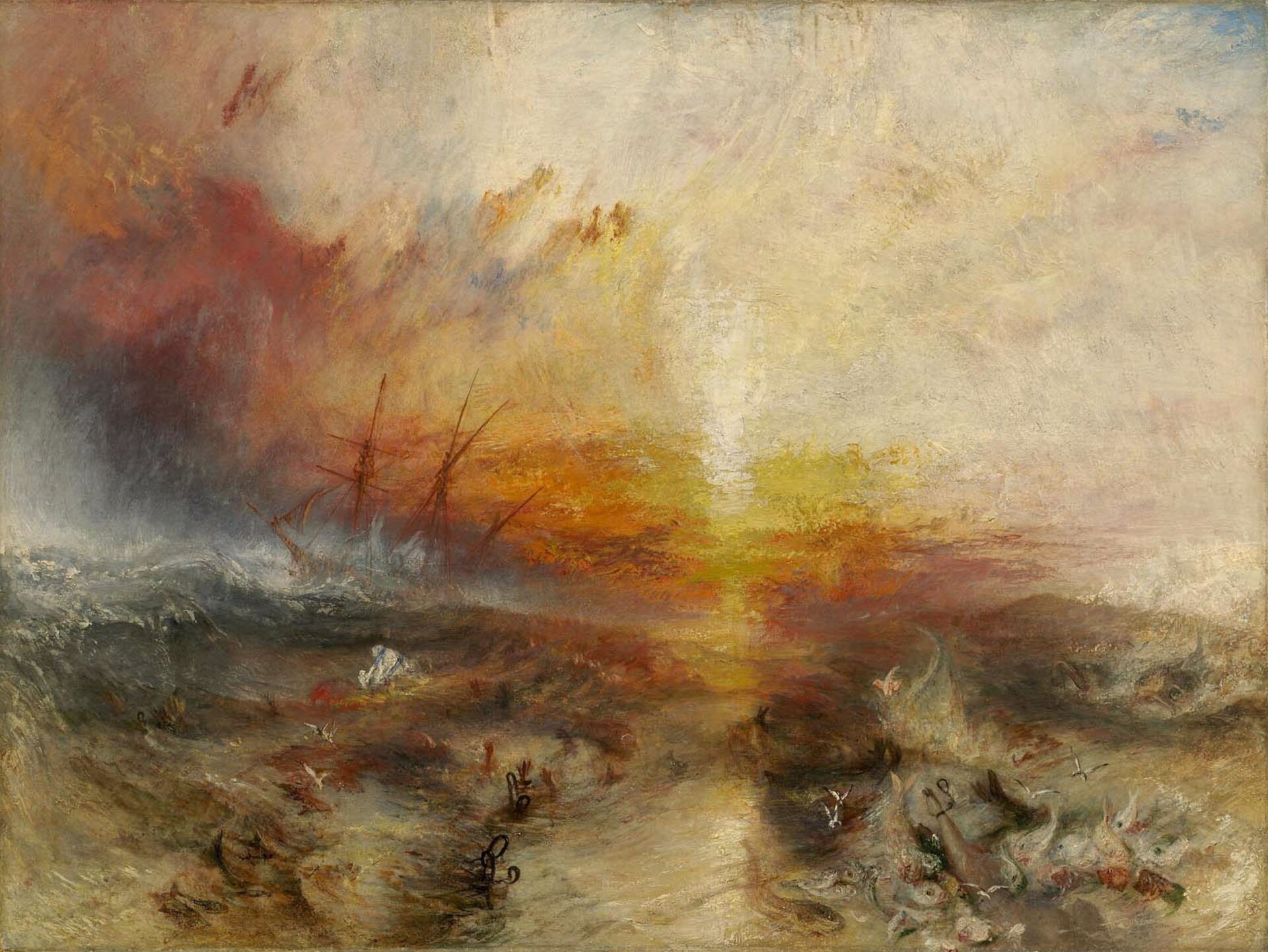
奴隶船(The Slave Ship)是英国画家约瑟夫·马洛德·威廉·透纳于1840年之作品。此作品现存于美国波士顿的波士顿美术馆。
背景
1781年,一艘驶往牙买加的奴隶船“关怀”(Zong)的船长在饮用水即将耗尽时下令将132名奴隶扔下船,以便收取保险金;因为自然死亡的奴隶不能获得保险赔偿 。此事被诉诸法庭,随后的审判引起了公众的广泛关注,废除奴隶制积累人们支持。尽管审判结果被认为没有定论,但宗号船大屠杀是英国废除奴隶制运动的关键催化剂,并启发透纳后来在《奴隶船》中描绘了这一事件。
虽然英国第一次有组织的废奴运动始于1727年,但大英帝国的奴隶贸易直到1807年才正式废除,奴隶制本身也于1833年废除。英国改革后,普遍废除奴隶制成为政治的中心。这场运动的核心动机是人道主义,但经济动机也激发了竞争国家终止奴隶贸易行为。
简介
这是工业革命时期的画,当时社会出现不少新制度。这幅画描述无良的商人把奴隶抛下海以取得保费,借此表达保险制度之不足及阶级制度之恶果。透纳是第一个直接用颜色来诉诸情感的画家。作为浪漫主义的作品,这幅画以红色为主,令人联想到革命。
摘自维基百科「奴隶船」,按 CC BY-SA 4.0 使用,繁体已转简体,去掉了参考文献、外部链接等尾部小节和表格,其余文字未作改动。
中文条目比较短,展开看英文维基百科的条目(英文原文)
The Slave Ship, originally titled Slavers Throwing overboard the Dead and Dying—Typhon coming on, is a painting by the British artist J. M. W. Turner, first exhibited at The Royal Academy of Arts in 1840.
Measuring 35+3⁄4 in × 48+1⁄4 in (91 cm × 123 cm) in oil on canvas, it is now on display at the Museum of Fine Arts, Boston. In this classic example of a Romantic maritime painting, Turner depicts a ship visible in the background, sailing through a tumultuous sea of churning water and leaving scattered human forms floating in its wake. Turner was possibly moved to paint The Slave Ship after reading about the slave ship Zong in The History and Abolition of the Slave Trade by Thomas Clarkson, the second edition of which was published in 1839. The initial exhibition of the painting in 1840 coincided with international abolitionist campaigns. As the piece changed hands in subsequent years, it was subject to a wide array of conflicting interpretations. While the work is generally admired for its spectacular atmospheric effects, there are conflicting opinions about the relationship between its style and its subject matter.
Historical background
In 1781, the captain of a slave ship inbound to Jamaica, the Zong, had ordered 132 slaves to be thrown overboard when drinking water was running low so that insurance payments could be collected; slaves who died of natural causes were not covered by insurance. This incident went to court, and the trial that ensued gained wide public attention, building support for the abolition of slavery. Although the trial was deemed to be inconclusive, it was a pivotal catalyst in the movement towards British abolition and a moment that later inspired Turner to portray the incident in The Slave Ship.
While the first organized British abolition movement was started in 1727, the slave trade in the British Empire was not officially abolished until 1807 with slavery itself abolished in 1833. Universal abolition was then at the center of politics following Britain's reform. Motives for the movement were centrally humanitarian, but economic incentives also incited a desire to terminate this commercial act in competing countries.
J. M. W. Turner
J. M. W. Turner was a well-known 19th-century landscape painter born in London in 1775, who was highly regarded for his stylistic innovation. His training in the arts was extensive. He started studying at the Royal Academy at the age of fourteen, and gained additional experience in topographical drawings and watercolour working under Dr. Thomas Monro, a physician and alienist, developing his interest in landscapes and distinctive application of colours.
Due to his liberal beliefs and interest in current events, Turner was directly exposed to the campaigns and publications of the anti-slavery societies of his time, the Society for the Mitigation and Gradual Abolition of Slavery Throughout the British Dominions (1823–1838) and the British and Foreign Anti-Slavery Society (founded 1839), which inevitably shaped his abolitionist beliefs. As an abolitionist, Turner was passionate about contributing to the slavery resistance campaigns in international regions, such as in the United States. The first documented sign of Turner's artistic contribution to the anti-slavery movement occurred in 1828 when he dedicated an engraving of his painting The Deluge to a well known abolitionist, John Joshua Proby. Twelve years later, after possibly being informed about the Zong incident from reading The History and Abolition of the Slave Trade by Thomas Clarkson, as well as the Amistad rebellion and subsequent court case in the United States which was international news, Turner was inspired to depict these horrific events in his piece The Slave Ship.
Exhibition at The Royal Academy of Arts
In 1840, two important international anti-slavery conventions were held in London: "The General Anti-Slavery Society" and "Society of the Extinction of the Slave Trade and the Civilization of Africa." Turner's exhibition of The Slave Ship at the Royal Academy of Arts coincided with these conventions. This public display of a horrific event reminding viewers of Britain's past was intended to evoke an emotional response to the inhumane slave trade still occurring at that time in other parts of the world. Given the context of its initial exhibition, the painting would likely have been interpreted as a political call to action.
节选,摘自英文维基百科「The Slave Ship」,按 CC BY-SA 4.0 使用。
相关词条
相关作品