艺廊
作品介绍
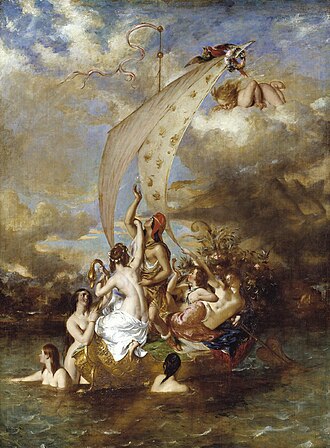
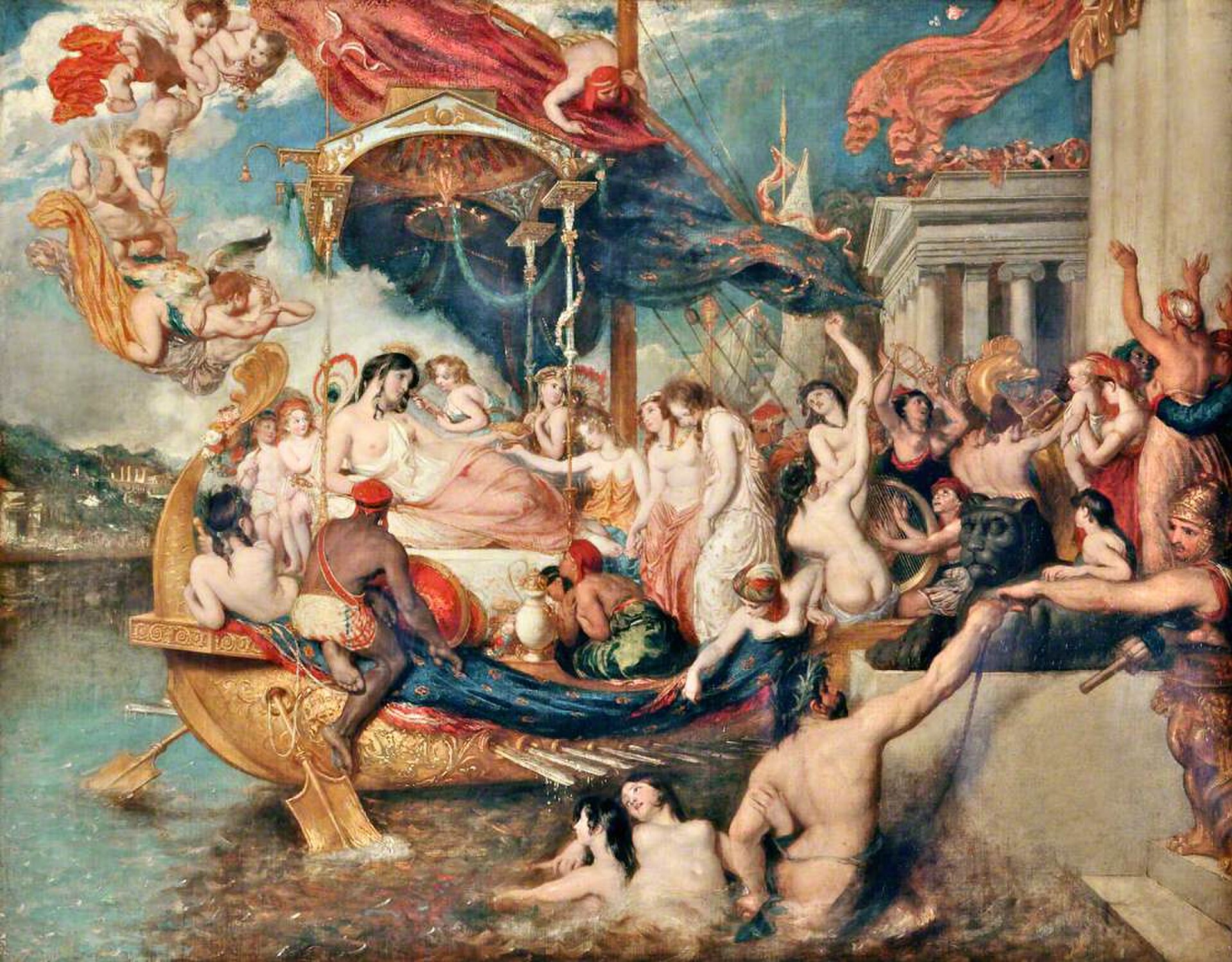
《克莱奥帕特拉的凯旋》,也被称为《克莱奥帕特拉抵达奇里乞亚》、《克莱奥帕特拉抵达奇里乞亚》,是英国艺术家威廉·埃蒂的一幅油画。它于1821年首次展出,现在位于默西塞德郡阳光港的利弗夫人美术馆。在1810年代,埃蒂在皇家艺术学院的教职员工和学生中广受尊重,尤其是因为他对色彩的运用和描绘逼真肤色的能力。尽管他在1811年以来的每一次夏季展览会上都展出过,但他几乎没有引起商业或评论界的兴趣。1820年,他展出了《寻找珊瑚者》,展示了镀金船上的裸体人物。这幅画引起了弗朗西斯·弗里林爵士的注意,他委托创作了一幅规模更大的类似画作。
克利奥帕特拉的胜利描绘了普鲁塔克的《安东尼生平》和莎士比亚的《安东尼与克利奥帕特拉》中的一个场景,其中埃及女王克利奥帕特拉乘坐装饰华丽的船前往奇里乞亚的塔尔苏斯,以巩固与罗马将军马克安东尼的联盟。画面刻意局促而拥挤,描绘了一大群脱衣状态各异的人聚集在岸边观看船只的到来;船上还有很多人。虽然这幅画并未受到媒体的普遍赞赏,但这幅画立即获得成功,几乎一夜之间让威廉·埃蒂名声大噪。受到好评的鼓舞,埃蒂在接下来十年的大部分时间里致力于创作更多包含裸体人物的历史画作,并因其将裸体与道德信息相结合而闻名。
摘自维基百科「克莱奥帕特拉的凯旋」,按 CC BY-SA 4.0 使用,繁体已转简体,去掉了参考文献、外部链接等尾部小节和表格,其余文字未作改动。
中文条目比较短,展开看英文维基百科的条目(英文原文)
The Triumph of Cleopatra, also known as Cleopatra's Arrival in Cilicia and The Arrival of Cleopatra in Cilicia, is an oil painting by English artist William Etty. It was first exhibited in 1821, and is displayed in the Lady Lever Art Gallery in Port Sunlight, Merseyside. During the 1810s Etty had become widely respected among staff and students at the Royal Academy of Arts, in particular for his use of colour and ability to paint realistic flesh tones. Despite having exhibited at every Summer Exhibition since 1811, he attracted little commercial or critical interest. In 1820, he exhibited The Coral Finder, which showed nude figures on a gilded boat. This painting attracted the attention of Sir Francis Freeling, who commissioned a similar painting on a more ambitious scale.
The Triumph of Cleopatra illustrates a scene from Plutarch's Life of Antony and Shakespeare's Antony and Cleopatra, in which Cleopatra, Queen of Egypt, travels to Tarsus in Cilicia aboard a magnificently decorated ship to cement an alliance with the Roman general Mark Antony. An intentionally cramped and crowded composition, it shows a huge group of people in various states of undress, gathering on the bank to watch the ship's arrival; another large number is on board. Although not universally admired in the press, the painting was an immediate success, making Etty famous almost overnight. Buoyed by its reception, Etty devoted much of the next decade to creating further history paintings containing nude figures, becoming renowned for his combination of nudity and moral messages.
Background
William Etty was born in York in 1787, the son of a miller and baker. He showed artistic promise from an early age, but his family were financially insecure, and at the age of 12 he left school to become an apprentice printer in Hull. On completing his seven-year indenture he moved to London "with a few pieces of chalk-crayons in colours", with the aim of emulating the Old Masters and becoming a history painter. Etty gained acceptance to the Royal Academy Schools in early 1807. After a year spent studying under the renowned portrait painter Thomas Lawrence, Etty returned to the Royal Academy, drawing in the life class and copying other paintings. He was unsuccessful in all the Academy's competitions, and every painting he submitted for the Summer Exhibition was rejected.
In 1811, one of his paintings, Telemachus Rescues Antiope from the Fury of the Wild Boar, was finally accepted for the Summer Exhibition. Etty was becoming widely respected at the Royal Academy for his painting, particularly his use of colour and his ability to produce realistic flesh tones, and from 1811 onwards had at least one work accepted for the Summer Exhibition each year. However, he had little commercial success and generated little interest over the next few years.
At the 1820 Summer Exhibition Etty exhibited The Coral Finder: Venus and her Youthful Satellites Arriving at the Isle of Paphos. Strongly inspired by Titian, The Coral Finder depicts Venus Victrix lying nude in a golden boat, surrounded by scantily-clad attendants. It was sold at exhibition to piano manufacturer Thomas Tomkinson for £30 (about £2,500 in 2025 terms).
Sir Francis Freeling admired The Coral Finder at its exhibition, and learning that it had been sold he commissioned Etty to paint a similar picture on a more ambitious scale, for a fee of 200 guineas (about £17,500 in 2025 terms). Etty had for some time been musing on the possibility of a painting of Cleopatra and took the opportunity provided by Freeling to paint a picture of her based loosely on the composition of The Coral Finder.
Composition
The Triumph of Cleopatra is based loosely on Plutarch's Life of Antony as repeated in Shakespeare's Antony and Cleopatra, in which Cleopatra, Queen of Egypt, travels to Tarsus in Cilicia aboard a grand ship to cement an alliance with the Roman general Mark Antony.
Therefore when she was sent unto by divers letters, both from Antonius himself and also from his friends, she made so light of it and mocked Antonius so much that she disdained to set forward otherwise but to take her barge in the river of Cydnus, the poop whereof was of gold, the sails of purple, and the oars of silver, which kept stroke in rowing after the sound of the music of flutes, howboys, cithernes, viols, and such other instruments as they played upon in the barge.……
节选,摘自英文维基百科「The Triumph of Cleopatra」,按 CC BY-SA 4.0 使用。
相关词条
相关作品