艺廊

作品介绍
The Beloved (also The Bride) is an oil painting on canvas by the English artist Dante Gabriel Rossetti (1828–1882), now in Tate Britain, London. Rossetti signed his initials (as a monogram) and the date as "1865-6" on the bottom left of the canvas. It depicts the bride, or "beloved", from the Song of Solomon in the Hebrew Bible as she approaches her bridegroom, with her attendants.
The bride, caught in the action of moving back her veil, is attended by four virginal bridesmaids and an African page, who contrasts strikingly with the red hair and pale skin of the bride, and the varying shades of brunette hair and skin tones of the four bridesmaids. It has been suggested that this colour contrast, carefully painted as a frame to the bride's features, was influenced by Édouard Manet's controversial painting Olympia, in progress when Rossetti visited Manet's studio in late 1864 while working on The Beloved, and the painting also owes much to the works of Titian.
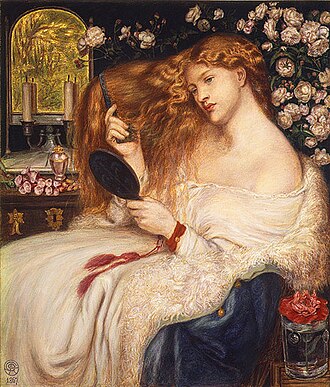
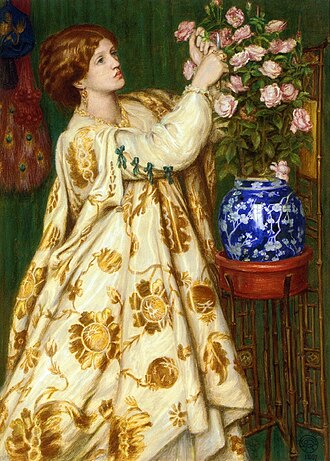
In many respects, the painting fits into the series of "bust-length oil paintings of beautiful women" which were Rossetti's main painted output from 1859 to about 1867. These were a conscious change of style, to explore painterly effects of (in his words) "flesh painting" and colour, abandoning the densely packed narrative scenes, in media other than oil painting, he had produced over most of the 1850s, when he followed more closely the ideals of the Pre-Raphaelite Brotherhood. These grew "larger and more luxurious" in the next decade, and included Bocca Baciata, Venus Verticordia, Beata Beatrix, The Blue Bower, Monna Vanna, Regina Cordium, and Lady Lilith. But these were all rather tightly framed pictures of a single figure, "in confined layers of space", with varying props and background, reflecting a variety of historical periods.
It is generally agreed that Rossetti set out to show a range of skin colours within the figures, but the identification and interpretation of these varies greatly.
History
The painting was commissioned in 1863 by Rossetti's regular patron, the Birkenhead banker George Rae, for £300. At that stage, the broad composition seems to have been the same as in the final work, but the subject was intended to be Dante's Beatrice, as imagined in the poet's Il Purgatorio. After a month or two's work in the summer of 1863, the subject was changed to illustrate the Song of Solomon from the Bible, apparently because Rossetti found the complexion of his chosen model for the main figure at that point, Marie Ford, "too bright for his conception of Dante's Beatrice".
Work progressed rather slowly, perhaps as Rossetti was working on other paintings at the same time, including Venus Verticordia, begun in 1864, but not finished until 1868. On a visit to Paris in November 1864, he paid a call to the studio of Édouard Manet, where he may well have seen Manet's Olympia, then a work in progress, where a white female nude contrasts with a clothed black maid. Manet did not paint the maid until the following month, but she may have been sketched in, or discussed with Rossetti.
It has also been suggested that the general composition was influenced by Titian's Allegory of Marriage (formerly so-called Allegory of Alfonso d'Avalos) in the Louvre, with three 17th-century copies (one a watercolour) in the Royal Collection. This is an allegory of marriage, with a number of figures arranged around a central object.
In March 1865 Rossetti painted a "Japanese" dress over the main figure, and replaced the previous female black ("mulatto" according to art historians) child with a male one, preferring his darker skin tone . By the autumn it was sufficiently complete to be shown to the leading art critic F.G. Stephens, who described it in some detail in the 21 October 1865 issue of the Athenaeum magazine, of which he was the editor for art, noting that: "As she unveils, they [the attendants] look with different expressions for the effect of the disclosure on the coming man". Stephens and Rossetti were close, and Rossetti would have seen the critique before publication. It appears Stephens sometimes allowed Rossetti to write such things himself, under Stephens's name.
Stephens praised Rossetti for his use of colour. However, he pointed out some technical errors. For example, Stephens claimed that the African page’s hands look unnatural considering the vase that he is holding. Furthermore, Stephens pointed out that the child's necklace does not seem to lie flat on his chest. Rather, the ornament is positioned in a way that the viewers of the piece could see its patterns and details.
Rossetti did further work over the winter, hence his date of "1865-6" on the canvas. The painting was first exhibited, for a single day, at the Arundel Club on 21 February 1866. Rossetti took the painting back in 1873, when it was "considerably altered", changing the tone and making "more ideal" the heads of the bride and the woman to the right of her, and the bride's hands. A photograph of the painting before these changes exists.
In the 1911 Encyclopædia Britannica, whose art entries were supervised by Rossetti's brother, William Michael Rossetti, Rossetti's biography was by F.G. Stephens and another close friend, Theodore Watts-Dunton. In the biography the painting is praised highly: The same elements, energy, a sympathetic and poetic scheme of colour, and composition of a fine order, combined with far greater force and originality in "The Bride", or "The Beloved", that magnificent illustration of The Song of Solomon. The last named is a life-size group of powerfully coloured and diversely beautiful damsels accompanying their mistress with music and with song on her way to the bridegroom. This picture, as regards its brilliance, finish, the charms of four lovely faces and the splendour of its lighting, occupies a great place 'in the highest grade of modern art of all the world. It is likewise, so far as the qualities named are concerned, the crowning piece of Rossetti's art, and stands for him much as the “ Sacred and Profane Love ” of Titian represents that master.
原文较长,这里只摘了前面一部分,摘自英文维基百科「The Beloved (Rossetti)」(暂时没有中文条目,下面是英文原文),按 CC BY-SA 4.0 使用,去掉了参考文献、外部链接等尾部小节和表格,其余文字未作改动。
相关词条
相关作品