艺廊
作品介绍
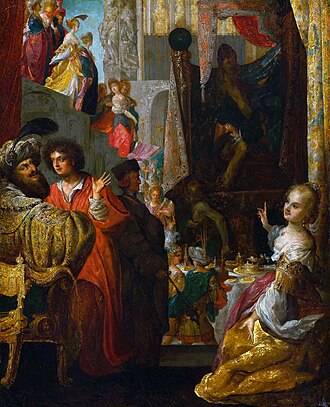
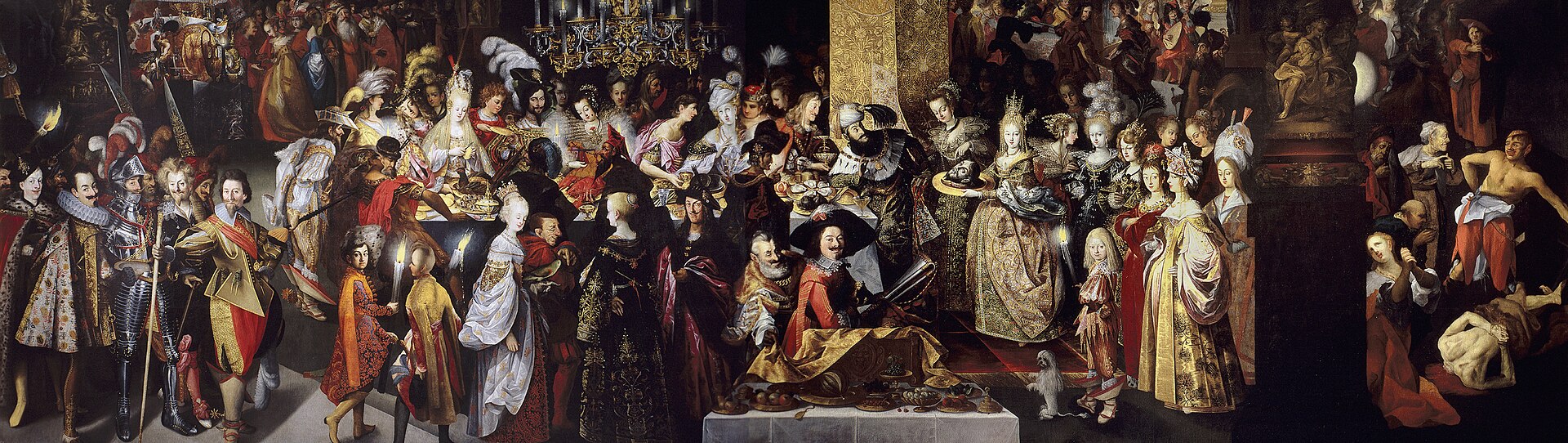
The Feast of Herod with the Beheading of St John the Baptist is a large painting by the Silesian artist Bartholomeus Strobel the Younger (1591 – about 1650) which is now displayed in the Museo del Prado in Madrid. In oil on canvas, it measures 2.80 by 9.52 metres (9 ft 2 in × 31 ft 3 in), and is variously dated between about 1630 and 1643.
The painting shows two scenes from the biblical account of the death of John the Baptist. The main part of the painting, on the left, shows the banquet of Herod Antipas at which his daughter Salome produced the head of John the Baptist. The much smaller execution scene is shown on the right hand side, to the right of the column dividing the picture space. The Beheading of John the Baptist had often been combined with the Feast of Herod in this way, with the execution relegated to a different space at the side of the image, a pattern Strobel takes to an extreme.
The figures include many portraits of leading figures of the Thirty Years' War, and probably other less well known court figures, not all so far identified, or with agreed identifications. It has been interpreted as an allegorical "appeal to the Christian world to save [Strobel's] doomed home country" of Silesia, which had suffered greatly from the wars.
Allegory of Europe
The painting includes many portraits of leading political and military figures from around Europe, relying on prints for the likenesses of those not known to Strobel. It is probably central to the allegory that the coat of arms of Strobel's home city, now Wrocław, Poland, which he would have known by its German name of Breslau, includes the image of the head of John the Baptist on a platter. Strobel was forced to leave Breslau by the Thirty Years' War in 1634, finally settling in Poland. Only Herod himself, dressed in oriental costume, reacts strongly to the head produced at the dining table; the other figures seem unconcerned, which may be the point of the allegory.
Identifications of the figures shown vary. One set, predicated on a date in the early 1640s for the work, is as follows: the figure holding a trumpet at the centre, looking out at the viewer, is the Dutch Admiral Tromp, whose victory at the Battle of the Downs in 1639 had decisively ended Spanish naval power. To his left Henry IV of France (who had died in 1610) pulls at a cloth over a table laid with fruit (so presenting "the fruits of victory"). The group of men standing in the foreground on the left are the Imperial generalissimo Wallenstein, with the long staff, with behind him his subordinate generals Count Vilém Kinský, Christian Freiherr von Ilow and Count Adam Erdmann Trčka von Lípa as well as one of their assassins in 1634, the Irish colonel of dragoons Walter Butler of Roscrea.
Among the diners at the table are John George I, Elector of Saxony, Charles I of England, the Infanta and from 1637 Empress Maria Anna of Spain (wife of Ferdinand III, Holy Roman Emperor), Marie de' Medici, Dowager Queen of France, her favourite Concino Concini (d. 1617), George Villiers, 1st Duke of Buckingham (favourite of Charles I until assassinated in 1637), and Marie de Rohan, duchesse de Chevreuse.
The head of John the Baptist on the platter has the features of Duke John Christian of Brieg (d. 1639), the staunch Calvinist champion of Silesian Protestantism. Salome holds the plate, and since her elaborate dress still leaves her implausibly high breasts completely uncovered, she is unlikely to be a portrait of an important figure.
To the right of Herod, the group of ladies includes: Elizabeth Stuart, Queen of Bohemia, Queen Maria Eleonora of Brandenburg, widow of Gustavus Adolphus of Sweden (died 1632), with her daughter Christina, Queen of Sweden (only born in 1626) and sister Catherine of Brandenburg, briefly ruler of Transylvania after her husband Gabriel Bethlen, King of Hungary, died in 1629. The boy with the torch in the foreground may be the exiled Charles I Louis, Elector Palatine (born 1617, son of Elizabeth Stuart), who inherited in 1632, and the somewhat lion-like dog in a sitting-up posture may be an allusion to the lions in the arms of the Electorate of the Palatinate as well as those of the Dutch Republic. The lady in the large turban in the row behind may be Amalia of Solms-Braunfels, wife of Frederick Henry, Prince of Orange, the Dutch stadtholder, who gave the Palatine family refuge in exile.
Alternative identifications find a portrait of Ferdinand II, Holy Roman Emperor, and identify the features of John the Baptist as those of Charles I of England, although he was not beheaded until 1649, which is probably well after Strobel painted the work.
Style
The style of the figures in the Prado painting varies between realistic portraiture, generalized and idealized faces, especially among the females, and expressive caricature, with the three types often mixed in a single group. The costumes of many figures are painted in great detail and with precision, but the fashions shown vary from French styles of the 1630s to those of Poland, with some purely fanciful elements. The two boys with candles in front of the left end of the table wear Polish styles, from the distinctive szkofia three-plumed hat badge of the right-hand one (held at his waist) to the boots of the one at left, who looks to be a portrait. He also wears a curved Polish or Hungarian type of szabla (sabre). Behind the two boys is a figure of uncertain gender wearing the modified Roman military uniform typically worn by goddesses and allegorical figures in Northern Mannerism; there is a similar figure at the front of the Munich Feast.
This mixture, both as to the depiction of faces and of clothing, is reminiscent of many northern religious paintings of the 15th and 16th centuries, especially those showing the Passion of Jesus. There are reminiscences of the fantastical style of the printmaker Jacques Bellange, another artist whose homeland of Lorraine was to be ravaged by the war. One critic finds the "blurred edges, eclecticism, mixed registers and parodic deflation of late Renaissance literature are mirrored in Mannerist painting, from Jacques Bellange to Bartholomeus Strobel". Despite its late date, Strobel's work remains rooted in the Rudolfine Northern Mannerism of Prague which he had absorbed in his youth.
原文较长,这里只摘了前面一部分,摘自英文维基百科「Feast of Herod with the Beheading of St John the Baptist」(暂时没有中文条目,下面是英文原文),按 CC BY-SA 4.0 使用,去掉了参考文献、外部链接等尾部小节和表格,其余文字未作改动。
相关词条
相关作品