艺廊
作品介绍
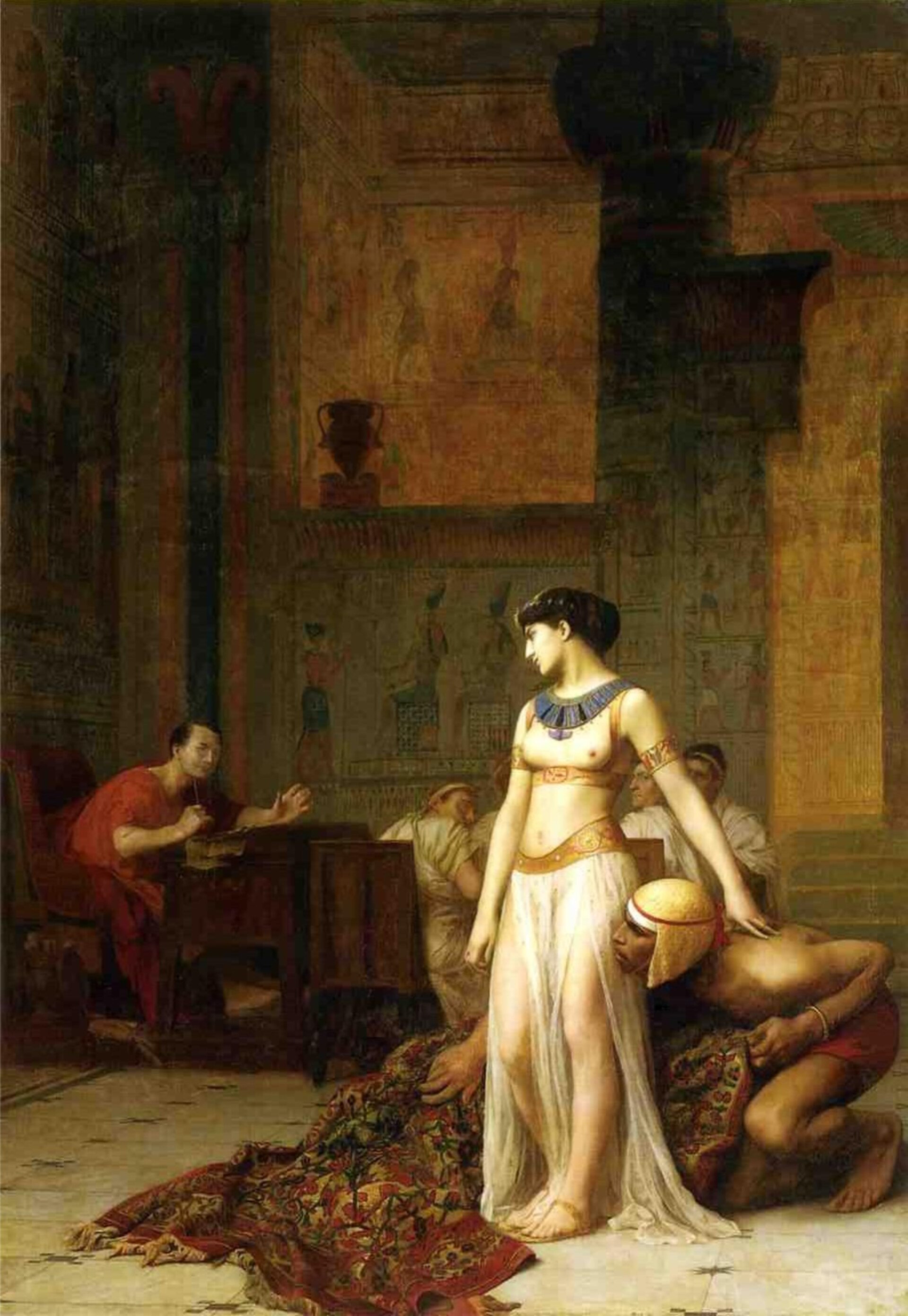
《克娄巴特拉与凯撒》(法语:Cléopâtre et César)是法国学院派艺术家让-莱昂·热罗姆的一幅油画,创作于1866年。
这幅画最初是由法国妓女拉帕瓦委托绘制,但作品完成后,她感到不满意,将其归还给热罗姆。阿克曼说,拉帕瓦觉得太贵。热罗姆在背面添加画布,来增强画的强度,随后由他的岳父阿道夫·古皮尔(Adolphe Goupil,1806-1893)购买,他是19世纪法国领先的艺术品经销商。1859年,热罗姆第一次见到古皮尔,几年后娶了他的女儿玛丽。
《克娄巴特拉与凯撒》是热罗姆在1866年巴黎沙龙展出的三幅作品之一。1871年在皇家艺术研究院展出。
热罗姆的画作是最早描绘克娄巴特拉七世从地毯出来,出现在凯撒面前的现代画作之一。这是一个小小的历史错误,源于对普鲁塔克的《凯撒的一生》中场景的误译,以及“地毯”一词随时间的语义变化。这部作品被认为是“埃及狂热”的经典范例。
1870年代,加州银行家、慈善家和纽约房地产开发商达瑞斯·奥格登·米尔斯(Darius Ogden Mills)买下这幅画。这幅画由米尔斯家族收藏了一个多世纪,直到1990年出售给私人收藏家。
这幅画描绘的是公元前47年,克娄巴特拉站在凯撒大帝面前,她的仆人阿波罗多鲁斯刚刚用地毯把她偷运到宫殿内。人物大约是真人的一半大小。
摘自维基百科「克娄巴特拉与凯撒」,按 CC BY-SA 4.0 使用,繁体已转简体,去掉了参考文献、外部链接等尾部小节和表格,其余文字未作改动。
中文条目比较短,展开看英文维基百科的条目(英文原文)
Cleopatra and Caesar (French: Cléopâtre et César), also known as Cleopatra Before Caesar, is an oil-on-canvas painting by the French Academic artist Jean-Léon Gérôme, completed in 1866. The work was originally commissioned by the French courtesan La Païva, but she was unhappy with the finished painting and returned it to Gérôme. It was exhibited at the Salon of 1866 and the Royal Academy of Arts in 1871.
Gérôme's painting is one of the earliest modern depictions of Cleopatra emerging from a carpet in the presence of Julius Caesar, a minor historical inaccuracy that arose out of the translation of a scene from Plutarch's Life of Caesar and the semantic change of the word "carpet" over time. The work is considered a classic example of Egyptomania and was mass-produced by Goupil, allowing it to reach a wide audience.
The painting was held by California banker Darius Ogden Mills and remained in the Mills family art collection for over a century until it was sold to a private collector in 1990.
Background
Jean-Léon Gérôme (1824–1904) was a nineteenth century French painter and sculptor. At the age of twenty-three, he came to the attention of the art world at the Salon of 1847 with The Cock Fight (1846), a Neo-Grec painting that was praised by Théophile Gautier. With works informed by his frequent travels throughout the Middle East and visits to Egypt, Gérôme specialized in historical and Orientalist painting and became known as a leader of the Academic art movement. According to historian Charles Sowerwine, Gérôme
painted erotic subjects with a photographic approach and sensual charge, but avoided 'indecency' by the use of Oriental and historical contexts . . . To us, Gérôme's nudes seem pornographic, but to contemporaries they were idealized by their removal from contemporary society and their insertion in the Oriental context.
French writer Prosper Mérimée first proposed the subject of Cleopatra and Caesar in a letter sent to Gérôme in December 1860. La Païva, a wealthy French courtesan, later commissioned the painting from Gérôme, intending it for display in the Hôtel de la Païva, her mansion on the Champs-Élysées. According to American art critic Earl Shinn, the work was originally painted on silk and was designed as a "transparency to be lowered or raised midway of a long saloon" in La Païva's mansion, "which it was desirable to divide occasionally into two".
Development
Gérôme made at least two previous oil paintings and a number of sketches in preparation for the work. One shows Cleopatra lying on the ground stretching out to Julius Caesar with Apollodorus crouching behind her. In one variation before the finished version, Caesar is shown by himself with his hands on the desk (instead of outstretched) without his four secretaries. When the work was finished in 1866, Cleopatra's position changed to show her standing before Caesar with Apollodorus bent down beside her.
Gérôme painted the scene based on the meeting between Cleopatra and Caesar written in the Life of Caesar by Greek historian Plutarch (c. AD 46 – AD 120) more than a century after the incident took place. Even though Gérôme visited Egypt in 1857, where George W. Whiting of Rice University notes "he acquired numerous abundant local color and exact detail" that informed the painting of Cleopatra and Caesar, the Egyptian background setting in the work is derived from a plate in a volume from the Description de l'Égypte (1809–29) that depicts a temple at Deir el-Medina.
Completion and exhibition
La Païva disliked the finished painting she had commissioned and returned it to Gérôme. Ackerman notes that La Païva felt the work was too expensive. Gérôme modified the painting by adding canvas to the back for strength, and it was subsequently purchased by his father-in-law, Adolphe Goupil (1806–1893) of Goupil & Cie, the leading art dealership in nineteenth-century France. Gérôme first met Goupil in 1859 and married his daughter Marie several years later. Cleopatra and Caesar was one of three works Gérôme presented at the Salon of 1866 where it was exhibited with the title César et Cléopâtre. The painting appeared at the Royal Academy of Arts exhibition in 1871 under the longer name Cléopâtre apportée à César dans un tapis (Cleopatra brought to Caesar in a carpet).
节选,摘自英文维基百科「Cleopatra and Caesar (painting)」,按 CC BY-SA 4.0 使用。
相关词条
相关作品