艺廊
资料卡
- 类型
- 乙级宗座圣殿、shrine of Our Lady、历史艺术古迹、联合主教座堂、朝圣教堂、sanctuary 等 8 项
- 创立
- 1681 年
- 国家
- 西班牙
- 所在地
- 萨拉戈萨
- 建筑师
- Francisco Herrera the Younger、José Felipe de Busiñac、Felipe Sánchez
- 建筑风格
- 新古典主义建筑、洛可可、巴洛克建筑
- 文化遗产级别
- 西班牙文化财产
- 坐标
- 北纬 41.6569°,西经 0.8783°
资料来自 Wikidata Q810684(CC0)。
博物馆介绍
圣柱圣母圣殿主教座堂(西班牙语:Catedral-Basílica de Nuestra Señora del Pilar)是位于西班牙阿拉贡自治区首府萨拉戈萨的天主教宗座圣殿,与耶稣救主主教座堂均位于圣柱广场上。该堂为巴洛克风格,目前的建筑兴建于1681年到1872年。它供奉圣柱圣母(Virgen del Pilar,Pilar 是“柱子”之意,音译为皮拉尔),若望保禄二世称之为“西班牙人民的母亲”。它被誉为历史上第一座圣母堂。
当地传说,基督教传入西班牙,起源于圣母玛利亚向宗徒圣雅各伯显灵,要他将基督教带来此地。据称这是她升天之前唯一的一次显灵。
许多西班牙国王、和外国统治者在圣母像前奉献。圣十字若望、大德兰和依纳爵·罗耀拉,是其中最杰出的几位。
摘自维基百科「圣柱圣母圣殿主教座堂」,按 CC BY-SA 4.0 使用,繁体已转简体,去掉了参考文献、外部链接等尾部小节和表格,其余文字未作改动。
中文条目比较短,展开看英文维基百科的条目(英文原文)
The Cathedral Basilica of Our Lady of the Pillar (Spanish: Catedral-Basílica de Nuestra Señora del Pilar) is a Catholic church in the city of Zaragoza, Aragon. It is dedicated to the Blessed Virgin Mary under the title of Our Lady of the Pillar, praised as "Mother of the Hispanic Peoples" by Pope John Paul II. It is reputed to be the first-ever church dedicated to Mary.
Local traditions take the history of this basilica to the spread of Christianity in Roman Spain attributing to an apparition to Saint James the Great, the apostle who is believed by tradition to have brought Christianity to the country. This is the only reported apparition of Mary to have occurred before her reputed Assumption.
Many of the kings of Spain, many other foreign rulers and saints have paid their devotion before this statue of Mary. Saint John of the Cross, Saint Teresa of Ávila, Saint Ignatius of Loyola, and Blessed William Joseph Chaminade are among the foremost ones. The Basilica of Our Lady of the Pillar is one of two minor basilicas in the city of Zaragoza, and is co-cathedral of the city alongside the nearby La Seo de Zaragoza. The architecture is of Baroque style, and the present building was predominantly built between 1681 and 1872.
Apparition of Pilar
According to local tradition, soon after the crucifixion and resurrection of Jesus, Saint James was preaching the Gospel in Spain, but was disheartened because of the failure of his mission. Tradition holds that on 2 January 40 AD, while he was deep in prayer by the banks of the Ebro, the Mother of Jesus appeared to him and gave a column of jasper and instructed him to build a church in her honour: "This place is to be my house, and this image and column shall be the title and altar of the temple that you shall build."
First chapel
About a year after the apparition, James is believed to have had a small chapel built in Mary's honour, the first church ever dedicated to her. After James returned to Jerusalem, he was executed by Herod Agrippa in about 44 AD, the first apostle to be martyred for his faith. Several of his disciples took his body and returned it for final burial in Spain.
This first chapel was eventually destroyed with various other Christian shrines, but the statue and the pillar stayed intact under the protection of the people of Zaragoza.
Expansions
Romanesque church
Numerous churches have been built upon this site through the years. The tiny chapel built by Saint James later gave way to a basilica-like enclosure during Constantine I's time, subsequently being transformed into Romanesque, then Gothic then Mudéjar styles. The venerated shrines at Zaragoza date to the Christian Reconquest by King Alfonso I in 1118. A church in the Romanesque style was built under the pontificate of Pedro de Librana who is also credited with the oldest written testimonial to the Virgin at Zaragoza. A tympanum on the south wall of this Romanesque church still stands.
Gothic church
The Romanesque church was damaged by fire in 1434, and reconstruction began in the Mudéjar Gothic style. A Gothic-style church was built in the 15th century but only a few parts of it remain intact or were later restored, including the choir stand and the altarpiece in alabaster by Damián Forment.
Current church
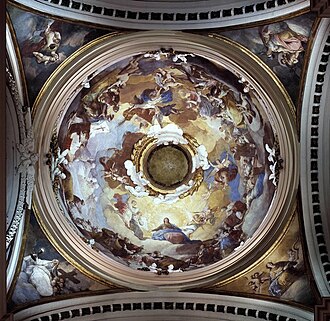
The present spacious church in Baroque style was begun in 1681 by Charles II, King of Spain and completed in 1686. The early constructions were supervised by Felipe Sánchez and were later modified by Francisco Herrera the Younger under John of Austria the Younger. In 1725, the Cabildo of Zaragoza decided to change the aspect of the Holy Chapel and commissioned the architect Ventura Rodríguez, who transformed the building into its present dimensions of 130 meters long by 67 wide, with its eleven cupolas and four towers. The area most visited is the eastern part of the chapel, because this is where the Holy Chapel by Ventura Rodríguez (1754) is built, which houses the venerated image of the Virgin. Around the Holy Chapel are the vaults or domes painted with frescoes by Francisco Goya: The Queen of Martyrs and Adoration of the Name of God. The gilt covering and other ornamentation throughout the building were designed and overseen by Goya's father José. By 1718, the church's vaults had been completed. However, it was not until 1872 that the final touches were put to these vaults, when the main dome and the final spire were finished.
节选,摘自英文维基百科「Cathedral-Basilica of Our Lady of the Pillar」,按 CC BY-SA 4.0 使用。