艺廊
资料卡
- 类型
- 别墅、建造物群、城市宫殿
- 创立
- 1536 年
- 国家
- 意大利
- 所在地
- 曼托瓦
- 地址
- Viale Te、viale Te, 13
- 建筑师
- 朱利奥·罗马诺
- 建筑风格
- 风格主义建筑
- 所有者
- 费德里克二世
- 文化遗产级别
- 意大利国家遗迹
- 坐标
- 北纬 45.1476°,东经 10.7866°
资料来自 Wikidata Q1261544(CC0)。
博物馆介绍
得特宫(意大利语:Palazzo del Te)是位于意大利曼托瓦的一座宫殿建筑。得特宫修建于1524年至1534年期间,由拉斐尔的门徒朱利奥·罗马诺设计。1630年时,宫殿曾遭到洗劫。现在得特宫的部分房间作为博物馆对外开放。
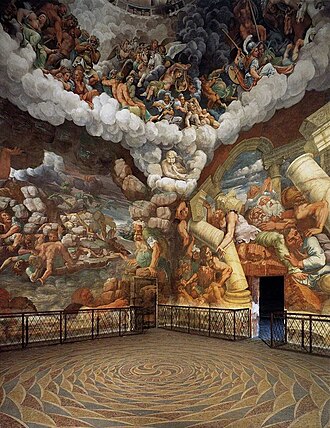
巨人室(Sala dei Giganti)
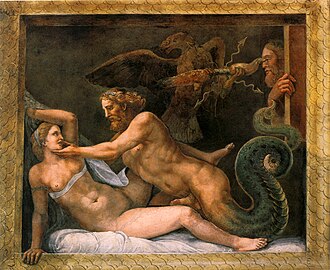
普赛克室(Sala di Amore e Psiche):西墙:丘比特和普赛克的宴会;北墙:维纳斯和马尔斯共浴:南墙:众神的盛宴。
马室(Sala dei cavalli):
日月室(Sala del Sole e della Luna):穹顶:太阳和月亮的战车
鹰室(Sala delle Aquile)
皇帝室(Sala degli Imperatori)
黄道室(Sala dei Venti o dello zodiaco)
浅浮雕室和凯撒室(Sala dei bassorilievi e Sala dei Cesari)
大卫凉廊(Loggia d'onore o di Davide)
摘自维基百科「得特宫」,按 CC BY-SA 4.0 使用,繁体已转简体,去掉了参考文献、外部链接等尾部小节和表格,其余文字未作改动。
中文条目比较短,展开看英文维基百科的条目(英文原文)
Palazzo del Te (Italian pronunciation: [paˈlattso del ˈte]), or simply Palazzo Te, is a palace in the suburbs of Mantua, Italy. It is an example of the mannerist style of architecture, and the acknowledged masterpiece of Giulio Romano.
Name
The palace is mostly referred to by English-speaking writers, especially art historians, as Palazzo del Te. In Italian, the name is now commonly shortened to Palazzo Te.
It was originally named after Il Te, the suburb where it was built. The toponym is most likely derived from Lombard tejee or tejé, referring to a "linden grove" that once grew in the area, or alternatively from Latin attegia "hut". Art historian Giorgio Vasari spelled the name Palazzo del T, based on the now archaic Italian-language name of the letter T.
History
Palazzo del Te was constructed 1524–34 for Federico II Gonzaga, Marquess of Mantua, as a palace of leisure. The site chosen was that of the family stables which he had built at Isola del Te, on the edge of the marshes just outside Mantua's city walls, as early as in 1502.
Giulio Romano, a pupil of Raphael, was commissioned to design the building. The shell of the palazzo, erected within eighteen months, is basically a square house containing a cloistered courtyard. A formal garden complemented the house, enclosed by colonnaded outbuildings ending in a semicircular colonnade known as the Exedra or Esedra.
Once the shell of the building was completed, for ten years a team of plasterers, carvers, and fresco painters laboured until barely a surface in any of the loggias or salons remained undecorated. Under Romano's direction, local decorative painters such as Benedetto Pagni and Rinaldo Mantovano worked extensively on the frescos.
In July 1630, during the War of the Mantuan Succession (1628–31), Mantua and the palace were sacked over three days by an Imperial army of 36,000 Landsknecht mercenaries. The remaining populace fell victim to one of the worst plagues in history that the invaders had brought with them. The Palazzo was looted from top to bottom and remained an empty shell with nymphs, gods, goddesses, and giants adorning the walls of the empty, echoing rooms.
Description
Like the Villa Farnesina in Rome, the suburban location allowed for a mixing of both palace and villa architecture. The four exterior façades have flat pilasters against rusticated walls, the fenestration indicating that the piano nobile is the ground floor, with a secondary floor above. The East façade differs from the other three by having Palladian motifs on its pilaster and an open loggia at its centre rather than an arch to the courtyard. The facades are not so symmetrical as they appear and the spans between the columns are irregular. The centers of the North and South facades are pierced by two-storey arches without portico or pediment, simply a covered way leading to the interior courtyard.
Few windows overlook the inner courtyard ("cortile"); the colonnaded walls are decorated on all sides by deep niches and blind windows, and the intervening surfaces are spattered by spezzato (broken and blemished plaster) giving life and depth to the surfaces.
The frescoes are a feature of the Palazzo. The subjects range from Olympian banquets in the Sala di Psiche ("Hall of Psyche") and stylised horses in the Sala dei Cavalli ("Hall of the Horses") to giants and grotesques around the walls of the Sala dei Giganti ("Hall of the Giants").
These rooms, once used by the ducal court of the Gonzaga family, were viewed by the Emperor Charles V, who, when visiting in 1530, elevated his host Federico II of Gonzaga from Marquess to Duke of Mantua.
One of the most evocative parts of the lost era of the palazzo is the Casino della Grotta ("Lodge of the Grotto"), a small suite of intimate rooms arranged around a grotto and loggetta (covered balcony) where courtiers once bathed in the small cascade that splashed over the pebbles and shells encrusted in the floor and walls.
Part of the Palazzo today houses the Museo Civico del Palazzo Te (Civic Museum of Palazzo del Te), endowed by the publisher Arnoldo Mondadori. It contains a collection of Mesopotamian art.
摘自英文维基百科「Palazzo del Te」,按 CC BY-SA 4.0 使用。