艺廊
名画 › 流派
丹麦黄金时代
资料卡
- 类型
- 文化运动
- 上位类别
- Danish art
- 开始
- 1800 年
- 结束
- 1850 年
资料来自 Wikidata Q934618(CC0)。
流派介绍
丹麦黄金时代 (英语:Danish Golden Age, 丹麦语:Den danske guldalder)是指在19世纪上半叶,尽管首都哥本哈根遭受过火灾,银行破产,以及轰炸,但丹麦在文学,艺术,建筑,音乐方面取得诸多惊人的成就,誉为其巅峰时期。它的发展不仅仅为丹麦带来了巨大成就,还影响了世界的发展。
绘画
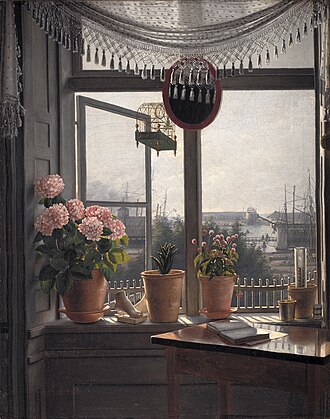
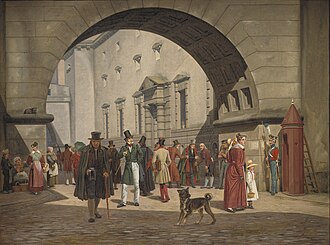
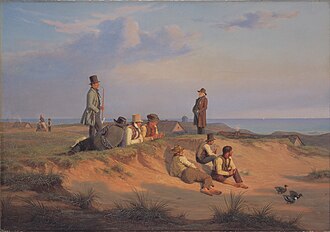
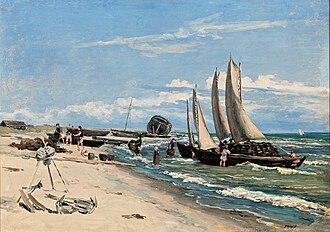
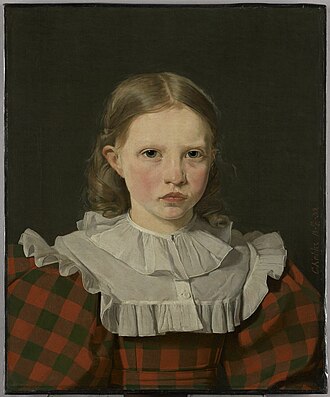
这段时期丹麦涌现出大量画家,诸如克里斯托弗·威廉·埃克斯贝尔以及他的学生,威廉·本茨,克里森·科布克,马丁努斯·罗尔比耶,康斯坦丁·汉森和威廉·马斯特兰德以及雕塑家贝特尔·托瓦尔森.
建筑
它也见证了丹麦建筑在新古典主义建筑中的发展。包括建筑师克里斯蒂安·弗雷德里克·汉森和迈克尔·戈特利布·宾德斯柏尔.
音乐
在音乐方面,涌现了丹麦浪漫民族主义音乐家约翰·彼得·埃米琉斯·哈特曼,汉斯·克里斯蒂安·伦拜,尼尔斯·加德和芭蕾舞大师奥古斯特·布农维尔。
文学
在文学方面,挪威裔丹麦作家亨里克·斯蒂芬斯,以及亚当·戈特洛布·奥伦施拉格,伯恩哈德·塞韦林·英格曼,格龙维和童话大王安徒生。
摘自维基百科「丹麦黄金时代」,按 CC BY-SA 4.0 使用,繁体已转简体,去掉了参考文献、外部链接等尾部小节和表格,其余文字未作改动。
中文条目比较短,展开看英文维基百科的条目(英文原文)
The Danish Golden Age (Danish: guldalderen, lit. 'the golden age') covers a period of exceptional creative production in Denmark, especially during the first half of the 19th century. Although Copenhagen had suffered from fires, bombardment and national bankruptcy, the arts took on a new period of creativity catalysed by Romanticism from Germany. The period is probably most commonly associated with the Golden Age of Danish Painting from 1800 to around 1850 which encompasses the work of Christoffer Wilhelm Eckersberg and his students, including Wilhelm Bendz, Christen Købke, Martinus Rørbye, Constantin Hansen and Wilhelm Marstrand, as well as the sculpture of Bertel Thorvaldsen.
It also saw the development of Danish architecture in the Neoclassical style. Copenhagen, in particular, acquired a new look, with buildings designed by Christian Frederik Hansen and Michael Gottlieb Bindesbøll.
In relation to music, the Golden Age covers figures inspired by Danish romantic nationalism including J. P. E. Hartmann, Hans Christian Lumbye, Niels W. Gade and the ballet master August Bournonville. Literature centred on Romantic thinking, introduced in 1802 by the Norwegian-German philosopher Henrik Steffens. Key contributors were Adam Oehlenschläger, Bernhard Severin Ingemann, N. F. S. Grundtvig and Hans Christian Andersen—the proponent of the modern fairytale. Søren Kierkegaard furthered philosophy while Hans Christian Ørsted achieved fundamental progress in science. The Golden Age thus had a profound effect not only on life in Denmark but, with time, on the international front too.
Background and context
The origins of the Golden Age can be traced back to around the beginning of the 19th century, which was a very rough period for Denmark-Norway. Copenhagen, the centre of the country's intellectual life, first experienced huge fires in 1794 and 1795 which destroyed both Christiansborg Palace and large areas of the inner city. In 1801, as a result of the country's involvement in the League of Armed Neutrality, the Royal Navy successfully attacked a Danish fleet at the Battle of Copenhagen. In 1807, on rumours that the French might force Denmark-Norway to close the Baltic to their shipping, the British bombarded Copenhagen, burning large portions of the city. Then in 1813, as a result of the country's inability to support the costs of war, the Dano-Norwegian government declared a state of bankruptcy. To make matters worse, Norway ceased to be part of the Oldenburg realms when it was ceded to Sweden the following year, at the Treaty of Kiel.
These events nevertheless provided new opportunities for Copenhagen. Architects and planners widened the streets, constructing beautifully designed Neoclassical buildings offering a brighter yet intimate look. At the time, with a population of only 100,000, the city was still quite small, built within the confines of the old ramparts. As a result, the leading figures of the day met frequently, sharing their ideas, bringing the arts and the sciences together. Henrik Steffens was perhaps the most effective proponent of the Romantic idea. In a series of lectures in Copenhagen, he successfully conveyed the ideas behind German romanticism to the Danes. Influential thinkers, such as Oehlenschläger and Grundtvig were quick to take up his views. It was not long before Danes from all branches of the arts and sciences were involved in a new era of Romantic nationalism, later known as the Danish Golden Age.
Especially in the field of painting, change became apparent. While art had previously served to uphold the monarchy and the establishment, Christoffer Wilhelm Eckersberg and his students realized that, with the arrival of industrialization, the middle classes were increasingly gaining power and influence. Grand historical art gave way to more widely appealing but less pretentious genre paintings and landscapes.
The main period of the Golden Age took place during the first half of the nineteenth century. Around that time, Danish culture suffered from the outbreak of the First Schleswig War (1848–1851) and then the Second one in 1864. In addition, political reforms involving the end of the absolute monarchy in 1848 and the adoption of the Danish constitution the following year signalled the beginning of a new era. Finally, the extension of Copenhagen beyond the old ramparts during the 1850s opened up new horizons for urban expansion.
节选,摘自英文维基百科「Danish Golden Age」,按 CC BY-SA 4.0 使用。
主要画家
作品(16)