艺廊
资料卡
- 本名
- Hendrik Emil Wouters
- 出生
- 1882 年
- 出生地
- 梅赫伦
- 去世
- 1916 年
- 逝世地
- 阿姆斯特丹
- 国籍
- 比利时
- 职业
- 画家、雕塑家、平面设计师
- 领域
- 绘画、雕塑艺术
- 流派
- Brabant fauvism
- 老师
- Charles van der Stappen
- 就读
- 布鲁塞尔皇家美术学院
- 配偶
- Nel Duerinckx
资料来自 Wikidata Q939197(CC0)。
生平与创作
Hendrik Emil (Rik) Wouters (21 August 1882 – 11 July 1916) was a Belgian painter, sculptor and draughtsman. Wouters produced 200 paintings, drawings and sculptures in his 34 years before his illness-caused death. He died partway through the First World War on 11 July 1916 in Amsterdam. A sculptor, painter, draughtsman and etcher of typically fauvist style, Wouters' art resembled the works of artists including Henri Matisse, Paul Cézanne and André Derain – the "forefathers" of Fauvism.
Rik Wouters' art, according to Adams (2018), reflects themes of "warmth and tenderness", his paintings characterised by an array of colours and brush strokes, frequently leaving unpainted canvas to increase this effect. Often depicting his muse-wife, Hélène, Wouters disregarded hidden symbolic inferences within his art in favour of a more "simplistic and genuine" style, distancing himself from mainstream artists. Wouters was educated in fine arts academies in Mechelen and Brussels, however his works usually slightly differ stylistically from other Fauvist artists.
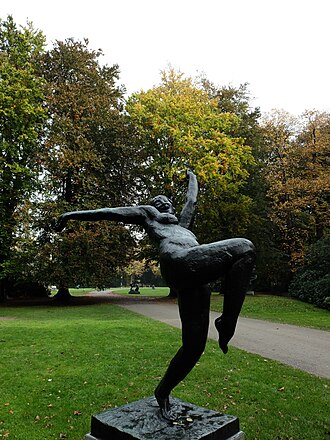
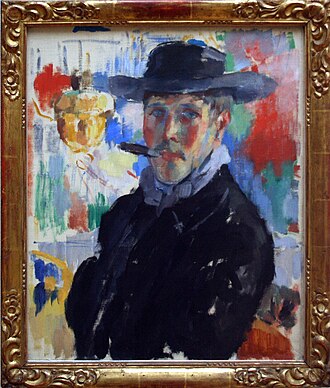
Wouters is known primarily for his sculptures and paintings including 'Lady in blue' (1914), 'Self-portrait with cigar' (1914) and Chrysanthèmes (1915).
Early life
Hendrik Emil Wouters was born on 21 August 1882 in Mechelen, Belgium. His father, Emil Wouters, was an ornamental sculptor and his mother, Melania Daems, was a housewife. Wouters' mother died in 1888. After dropping out of school at age 12, he began working on wooden sculptures and furniture decorations in his father's workshop and developed a passion for the craft. It was here that he met and began working with fellow Mechelen-born sculptor Ernest Wijnants, who would remain a lifelong friend. In 1912, Wouters painted a portrait of his friend, entitled Portrait of Ernest Wijnants. Wouters also developed an interest in drawing, and practiced in his free time.
In 1897, aged fifteen, Wouters left his father's workshop in pursuit of a career as an artist and sculptor.
Education and apprenticeship
Having left the workshop, Rik Wouters enrolled at the Academy of Mechelen in 1897. He remained a pupil for 4 years; until 1901. Wouters applied to the Academy of Brussels in 1900, but was only admitted in 1901, resulting in a relocation to the Belgian capital to begin his tutelage under Charles Van der Stappen. Restricted by the mores of the institution, Wouters was unable to produce any works of originality and so painted within popular methodologies, including hidden iconographical meanings – a style he would later reject. Wouters achieved high results in the academy, ranking first in sculpture and second in historical composition. Regardless of his academic success, Wouters burned his works at the end of each year of his apprenticeship. His earliest completed surviving pieces of sculpture are from 1907 and his earliest paintings date from 1908.
Edith Hoffman (1956) suggests that in these early works, although proficient in both crafts, Wouters remained "dependant on those masters he admired most", and that it wasn't until 1909 for his sculpting and 1910 for his painting that he became "completely individual".
During his education in Brussels Wouters met Hélène Philomène Leonardine Duerinckx, born in Schaerbeek on 18 October 1886. Hélène, known as "Nel", would become Wouters' wife and greatest muse. The two were acquainted in 1902 and married three years later, in Amsterdam on April 15, 1905.
Career
Rik Wouters' The Nymph (an unfinished sculpture created during 1904 and 1905) is considered to be his "breakthrough" piece as it represented his desire to escape the restrictions of the academy as well as the limits his own talent, although it was never finished nor sold.
Following the completion of his studies, Wouters and his wife moved into a house in Watermael. However, Wouters was unable to support himself financially and so moved back in with his father in Mechelen. Again helping his father, Wouters failed to produce anything he deemed as satisfactory. He and his wife only intended to stay with his father for a short period, so he briefly worked for a porcelain manufacturer to make enough money to move to the countryside (in Boitsfort) in order to accommodate Hélène's recently contracted tuberculosis. They did this (in 1907) for clean air upon the advice of a doctor they had seen in the east side of Brussels however it also allowed Wouters an opportunity to paint freely. Initially Wouters primarily made sketches and developed his etching in the evenings. Sculpting began to occupy a larger portion of his focus over the next year and, in 1908, he modelled 12 bronze statues.
Here Wouters experimented with light, unmixed colours, painting the cardboard evenly with a palette knife. He achieved three-dimensionality through colour contrasts – shadowing with darker reds, blues or greens – but rarely using drawn contours. Preferring to paint still lifes and interiors, Wouters created a "vibrant atmosphere" through the use of contrast and large strokes. This can be seen in works like 'Portrait of a woman in grey' (1905) and Portrait of a young boy (1905).
Completely free of academic rigidity, Wouters was awarded second place in the Godecharle competition for his work Rêverie (1907) in 1907. This gave him access to a state allowance of 500 francs, allowing him to pay rent for the next two years. Despite this payment, Wouters and Hélène saved food in order to afford expensive paint.
Over the next 4 years, Wouters further developed his style, using "highly sought-after plays of light and space", attracting the attention of Georges Giroux, who offered a contract with "Galerie Georges Giroux" in 1912. This contract granted Wouters the financial assistance required for him to work with his choice of materials, allowing him to produce works far more frequently. In 1912, he painted 60 canvasses, providing the money to travel to Paris and discover the Impressionists. Rik Wouters was the first Belgian artist to commit to a gallery contract of this kind. Whilst demonstrating the confidence the gallerist had in his art, it also meant that his profits were being split 50/50.
原文较长,这里只摘了前面一部分,摘自英文维基百科「Rik Wouters」(暂时没有中文条目,下面是英文原文),按 CC BY-SA 4.0 使用,去掉了参考文献、外部链接等尾部小节和表格,其余文字未作改动。