艺廊
资料卡
- 字
- 眉生、眉庄
- 号
- 梅生、智珠、横波
- 出生
- 1619 年
- 出生地
- 南京市
- 去世
- 1663 年
- 逝世地
- 北京市
- 国籍
- 清朝
- 职业
- 诗人、交际花、画家、娼妓
- 领域
- 诗歌
- 配偶
- 龚鼎孳
资料来自 Wikidata Q8249439(CC0)。
生平与创作
顾横波(1619年—1664年),原名媚,又名眉,字眉生,一字眉庄,别字后生,号横波、智珠、梅生,应天府上元县(今江苏省南京市)人,明末歌妓,“秦淮八艳”之一。
生平
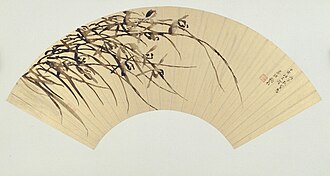
顾横波是八艳中地位最显赫的一位,受诰封为“一品夫人”。据《板桥杂记》记载,顾横波“庄妍靓雅,风度超群。鬓发如云,桃花满面;弓弯纤小,腰支轻亚”,工于诗画,尤善画兰,个性豪爽不羁,与柳如是较像,时人呼之“眉兄”,柳如是自称为“弟”。龚鼎孳年方二十四,来到眉楼,一见顾横波,为之倾倒不已。龚鼎孳为顾画成“佳人倚栏图”并题诗:“腰妒垂杨发妒云,断魂莺语夜深闻。秦楼应被东风误,未遣罗敷嫁使君。”崇祯十四年嫁龚鼎孳,洗尽铅华,改名换姓“徐善持”。
崇祯十七年(1644年),闯王李自成攻下京城,龚鼎孳出仕李闯,随即降清。三朝之臣,做到了礼部尚书,顾横波也堂皇受诰封为“一品夫人”。康熙三年(1664年)冬,顾横波一病不起,病卒于北京铁狮子胡同,龚鼎孳在北京长俸寺建妙香阁纪念。
顾媚善诗词,作有《海月楼夜坐》、《花深深·闺坐》、《虞美人·答远山夫人寄梦》、《千秋岁·送远山夫人南归》等诗词,收入所著《柳花阁集》。
摘自维基百科「顾横波」,按 CC BY-SA 4.0 使用,繁体已转简体,去掉了参考文献、外部链接等尾部小节和表格,其余文字未作改动。
中文条目比较短,展开看英文维基百科的条目(英文原文)
Gu Mei (Chinese: 顧媚; Wade–Giles: Ku Mei; 1619–1664), better known by her art name Gu Hengbo (Chinese: 顧橫波; Wade–Giles: Ku Heng-po) - also known as Xu Shanchi (徐善持) and Xu Zhizhu (徐智珠) after her marriage - was a Chinese Gējì, poet and painter. She received the title "Lady" (furen) from the early Qing court, and is often addressed as "Lady Hengbo" in Qing writings.
Gu Hengbo was famous for both her beauty and her talent in painting and poetry. As such, she was considered an elite geji, alongside names like Dong Xiaowan, Bian Yujing, and Liu Rushi. She was admired for her paintings of orchids, and published a collection of poems which gained good critical reviews (although few of her works have survived). She was one of the Eight Beauties of Qinhuai described by late Qing officials. The other famed gejis of this group are Ma Xianglan, Bian Yujing, Li Xiangjun, Dong Xiaowan, Liu Rushi, Kou Baimen, and Chen Yuanyuan.
Life
Gu Hengbo was born near Nanjing in 1619. Before her marriage to Gong Dingzi, Gu was a Gējì in Nanjing during the reign of Chongzhen. She was well versed in literature and history, and was good at poetry, being known as "the best in Nan Qu" (南曲第一). Gu Hengbo painted both orchids and landscapes in her own style, and did not follow the painting methods of previous generations. When she was eighteen years old, she joined Li Xiangjun, Wang Yue, and others in the "Lan Society", founded by Yangzhou celebrity Zheng Yuanxun in Nanjing. In her Tower Meilou in the Qinhuai district, she hosted a famous literary salon, which counted Chen Liang, Qian Lucan and Mao Xiang among its guests. Yu Huai described Meilou (literally house of bewitchment) as lavish and extravagant.
Gu Hengbo also acted in kunqu as a male (sheng) impersonator. One of her roles was Zhou Yu (周羽) in Disciplining the Son (教子). The writer Yu Huai (余懷) recounted how, after he had helped her when she ran afoul of the law, she offered to perform a stage drama for him on his birthday.
She fell in love with one of her patrons, Liu Fang (劉芳), promised to marry him and to end her career as a Geji. When she later changed her mind, Liu Fang committed suicide.
One of her patrons, the career official Gong Dingzi, paid 1,000 ounces of silver for her services. In 1643, she left her profession to become a concubine to Gong, and settled with him in the capital. His openly demonstrated love for her attracted much attention during their time, as it offended the norms of Confucian ideals, and her influence over him became legendary. She is known to have saved the poet Yan Ermei from execution, and to have been the benefactor of the artist Zhu Yizun.
In 1659, Gu Hengbo gave birth to a daughter. Anxious to have a son, Gong Dingzi built a private Buddhist temple where the couple could pray for a son.
摘自英文维基百科「Gu Hengbo」,按 CC BY-SA 4.0 使用。